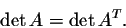
- Any matrixAand its transpose have the same determinant, meaning
- 2.
- The determinant of a triangular matrix is the product of the entries on the diagonal.
- 3.
- If we interchange two rows, the determinant of the new matrix is the opposite of the old one.
- 4.
- If we multiply one row with a constant, the determinant of the new matrix is the determinant of the old one multiplied by the constant.
- 5.
- If we add one row to another one multiplied by a constant, the determinant of the new matrix is the same as the old one.
- 6.
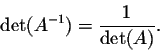
- We have
In particular, ifAis invertible (which happens if and only if ), then
So let us see how this works in case of a matrix of order 4.
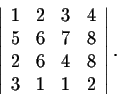
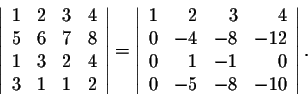
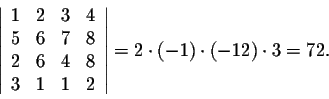
Example.Evaluate
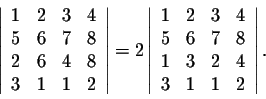
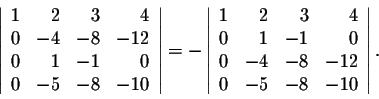
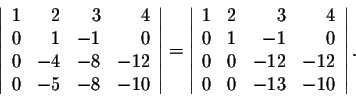
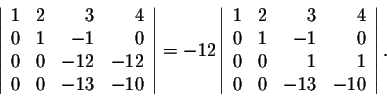
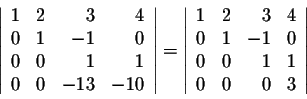
We haveIf we subtract every row multiplied by the appropriate number from the first row, we getWe do not touch the first row and work with the other rows. We interchange the second with the third to getIf we subtract every row multiplied by the appropriate number from the second row, we getUsing previous properties, we haveIf we multiply the third row by 13 and add it to the fourth, we getwhich is equal to 3. Putting all the numbers together, we get
Thank You
Ruchi
Askiitians Faculty