Lagrange multipliers, also called Lagrangian multipliers (e.g., Arfken 1985, p. 945), can be used to find the of a multivariate function  subject to the constraint
  , where
  and
and  are functions with continuous first partial derivatives on the open set containing the curve
  , and
, and  at any point on the curve (where
  is the gradient).
For an extremum of  to exist on
  , the gradient of
  must line up with the gradient of
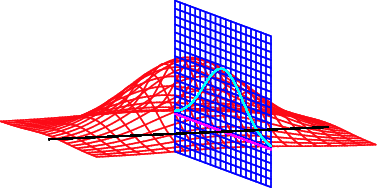
  . In the illustration above,
  is shown in red,
  in blue, and the intersection of
  and
and  is indicated in light blue. The gradient is a horizontal vector (i.e., it has no
  -component) that shows the direction that the function increases; for
  it is perpendicular to the curve, which is a straight line in this case. If the two gradients are in the same direction, then one is a multiple (
 ) of the other, so
 |
(1)
|
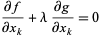
The two vectors are equal, so all of their components are as well, giving
 |
(2)
|
for all  , ...,
  , where the constant
  is called the Lagrange multiplier.
The extremum is then found by solving the  equations in
  unknowns, which is done without inverting
  , which is why Lagrange multipliers can be so useful.
For multiple constraints  ,
,  , ...,