Revision notes on Definite Integral
-
If
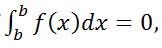 then the equation f(x) = 0 has at least one root lying in (a, b) provided f is a continuous function in (a, b).
 -
If the function f is same then
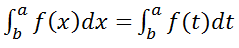
-

-
 dx where c is any point lying inside or outside [a, b].
This holds true only when f is piecewise continuous in (a, b)
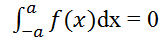 if f(x) = -f(-x) i.e. f is an odd function
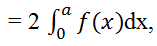 if f(x) = f(-x) i.e. f is an even function
-
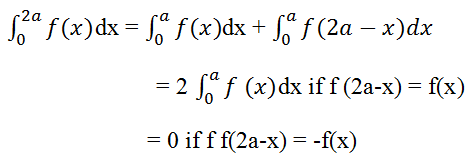
 where f is a periodic function with period a
 -
-
 where f(a+x) = f(x), i.e. a is the period of the function f
 -

-

-
If f(x) ≤ φ[x] for a ≤ x ≤ b then

-

-
Gamma Function:
If n is a positive rational number, then the improper integral

is defined as the gamma function.
Γ(n+1) = n!
Γ1 = 1
Γ0 = ∞
Γ(1/2) = √π
![\int_{0}^{\pi/2}sin^{m}x cos^{n}x dx = \frac{[(m-1)(m-3)... 2 or 1][(n-1)(n-3)... 2 or 1]}{[(m+n)(m+n-2).... 2 or 1]}](https://files.askiitians.com/cdn1/cms-content/common/latex.codecogs.comgif.latex_int_0_pi2sinmxcosnxdx_fracm-1m-3.2or1n-1n-3.2or1mnmn-22or1.jpg)
-
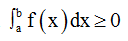
If f(x) ≥ 0 on the interval [a, b] then
-
Walli’s Formula

where K =  , if both m and n are even (m, n ϵ N)
= 1 otherwise
-
Leibnitz’s Rule:
If h(x) and g(x) are differentiable functions of x then

-
For a monotonically increasing function in (a, b)

-
 Where f(x) is a continuous function on [a, b] and F’(x) = f(x).
 -

-
If f(x) = f(a – x), then

-
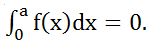
If f(x) = – f (a – x), then
-

-
If f(x) is a periodic function with period T, then

-
In the above result, if n = 1, then

-
The definite integral
 f(x)dx is in fact a limiting case of the summation of an infinite series, provided f(x) is continuous on [a, b] i.e.,
 where h = b – a/n.
-
The converse is also true i.e., if we have an infinite series of the above form, it can be expressed as definite integral.
-
Method to express the infinite series as definite integral:
1. Express the given series in the form Σ 1/n f (r/n)
2. Then the limit is its sum when n → ∞, i.e. limn→∞ h Σ 1/n f(r/n)
3. Replace r/n by x and 1/n by dx and limn→∞ Σ by the sign of ∫
4. The lower and the upper limit integration are the limiting values of r/n for the first and the last terms of r respectively.
-
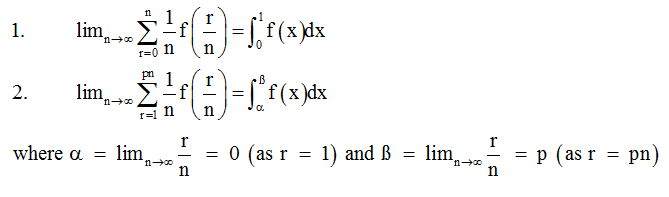
Some particular case of the above are:
-
Important Results:


View courses by askIITians


Design classes One-on-One in your own way with Top IITians/Medical Professionals
Click Here Know More

Complete Self Study Package designed by Industry Leading Experts
Click Here Know More

Live 1-1 coding classes to unleash the Creator in your Child
Click Here Know More