Revision Notes on Complex Numbers
-
z1 = a + ib and z2 = c + id then z1 = z2 implies that a = c and b = d.

-
i2 = –1, i3 = – i, i4 = 1, i4n+1 = i, i4n+2 = – 1, i4n+3 = – i, i4n = 1
-
z1 + z2 = (Re(z1) + Re (z2)) + i (Im (z1) + Im (z2))
-
z1 – z2 = (Re(z1) – Re(z2)) + i (Im (z1) - Im (z2))
-
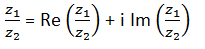
Re (z1. z2) = Re (z1). Re(z2) – Im(z1). Im (z2)
Im (z1. z2) = Im(z1). Re(z2) + Im(z2). Re(z1)
-
-
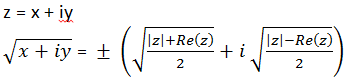
Square root of a complex number:
-

-

-
Argument of a Complex Number:
1. Argument of a complex number p(z) is defined by the angle which OP makes with the positive direction of x-axis.
2. Argument of z generally refers to the principal argument of z (i.e. the argument lying in (–π, π) unless the context requires otherwise.
-
General argument: General value of argument = 2nπ + θ; where θ is one of the argument of z.
-
Amplitude (Principal value of argument):
z = a + ib, then calculate ∝ = tan-1 |b/a|.
Then consider the following cases:
Case I: I quadrant
amp (z) = θ = ∝
Case II: II quadrant
amp (z) = θ = (π – ∝)
Case III: III quadrant
amp (z) = θ = – (π – ∝)
Case IV: IV quadrant
amp (z) = θ = – ∝
- ?Least Positive argument: Value of θ such that 0 < θ ≤ 2π
-
If OP = |z| and arg (z) = θ, then obviously z = r (cos θ + i sin θ) and is called the polar form of complex number z.
-
|(z-z1) / (z-z2)| =1 the locus of point representing z is the perpendicular bisector of line joining z1 and z2.
-
-|z| ≤ Re(z) ≤ |z| and -|z| ≤ Im(z) ≤ |z|


-
If a and b are real numbers and z1 and z2 are complex numbers then |az1 + bz2|2 + |bz1 - az2|2 = (a2 + b2) (|z1|2 + (|z2|2)
-
The distance between the complex numbers z1 and z2 is given by |z1 - z2|.
-
In parametric form, the equation of line joining z1 and z2 is given by z = tz1 + (1 – t)z2.
-
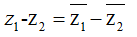
If A(z1) and B(z2) are two points in the argand plane, then the complex slope μ of the straight line AB is given by μ, where μ =
-
Two lines having complex slopes μ1 and μ2 are:
1. Parallel iff μ1 = μ2
2. Perpendicular iff μ1 = - μ2 or μ1 + μ2 = 0
-
If A(z1), B(z2), C(z3) and D(z4) are four points in the argand plane, then the angle θ between the lines AB and CD is given by θ = arg{(z1 - z2)/ (z3 – z4)}
-
Some basic properties of complex numbers:
I. ||z1| - |z2|| = |z1 + z2| and |z1 - z2| = |z1| + |z2| iff origin, z1, and z2 are collinear and origin lies between z1 and z2.
II. |z1 + z2| = |z1| + |z2| and ||z1| - |z2|| = |z1 - z2| iff origin, z1 and z2 are collinear and z1 and z2 lie on the same side of origin.
III.amp (z1 z2) = amp (z1) + amp (z2) + 2kπ, k ∈ I
IV. amp(zn) = n amp z
V. The least value of |z - a| + |z - b| is |a - b|.
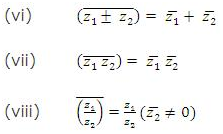
- Demoivre's Theorem: The theorem can be stated in two forms:
Case I: If n is any integer, then
(i) (cos θ + i sin θ)n = cos nθ + i sin nθ
(ii) (cos θ1 + i sin θ1) . (cos θ2 + i sin θ2) ......... (cos θn + i sin θn) = cos (θ1 + θ2 + θ3 .................. + θn) + i sin (θ1 + θ2 + .............. θn)
Case II: For p and q such that q ≠ 0, we have
(cos θ + i sin θ)p/q = cos((2kπ + pθ)/q) + i sin((2kπ + pθ/q) where k = 0,1,2,3,....., q-1
-
Demoivre’s formula does not hold for non-integer powers.
-
Main application of Demoivre’s formula is in finding the nth roots of unity. So, if we write the complex number z in the polar form then,
z = r(cos x + isin x)
Then z1/n = [r (cos x + i sin x)]1/n
= r 1/n [ cos (x + 2kπ/n) + i sin (x + 2kπ/n)]
Here k is an integer. To get the n different roots of z one only needs to consider values of k from 0 to n – 1.
- Cube roots of unity
-
1, ω, ω 2 are the 3 cube roots of unity
-
1 + ω + ω 2 = 0 & ω 3 = 1
-
1 + ω r + ω 2r = 0 if r is not multiplier of 3
-
or 3 if r is multiple of 3
- n, nth roots of unity 1, α, α² . . . . αn are n nth roots of unity, then 1 + α + α² + . . . . . + αn – 1 = 0.
-
Continued product of the roots of a complex quantity should be determined using theory of equations.
-
The only complex number with modulus zero is the number (0, 0).
-
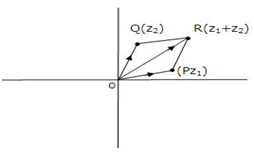
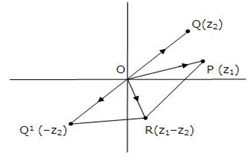
The following figures illustrate geometrically the meaning of addition and subtraction of complex numbers:
-
Different forms of equation of circle:
-
(i) |z| = r, r ∈ R+ then locus of z represent a circle whose centre is the origin and radius is equal to r.
-
(ii) |z – z0| = r, r ∈ R+ then locus of z represents a circle whose centre is z0 and radius is equal to r.
-
(iii) Equation
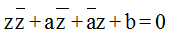 represents a circle whose centre is z0 and radius is equal to r.
-
-
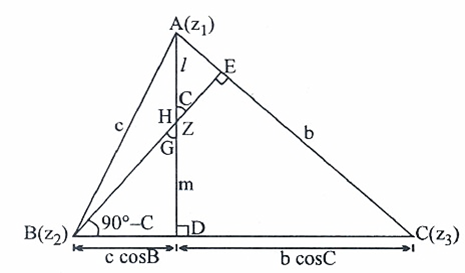
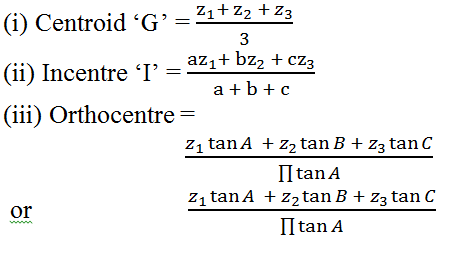
The formulae for centroid, incentre and orthocentre are as given below:
View courses by askIITians


Design classes One-on-One in your own way with Top IITians/Medical Professionals
Click Here Know More

Complete Self Study Package designed by Industry Leading Experts
Click Here Know More

Live 1-1 coding classes to unleash the Creator in your Child
Click Here Know More