Chapter 10: Congruent Triangles Exercise – 10.1
Question: 1
In Fig. (10).22, the sides BA and CA have been produced such that: BA = AD and CA = AE. Prove that segment DE ∥ BC.

Solution:
Given that, the sides BA and CA have been produced such that BA = AD and CA = AE and given to prove DE ∥ BC Consider triangle BAC and DAE,
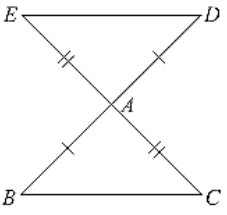 We have
BA = AD and CA= AE [given in the data]
And also ∠BAC = ∠DAE [vertically opposite angles]
So, by SAS congruence criterion, we have
∠BAC ≃ ∠DAE
BC = DE and ∠DEA = ∠BCA, ∠EDA = ∠CBA
[Corresponding parts of congruent triangles are equal]
Now, DE and BC are two lines intersected by a transversal DB such that ∠DEA = ∠BCA i.e.. alternate angles are equal Therefore, DE, BC ∥ BC.
Question: 2
In a PQR, if PQ = QR and L, M and N are the mid-points of the sides PQ, QR and RP respectively. Prove that LN = MN.
Solution:
Given that,
In PQR, PQ = QR and L, M, N are midpoints of the sides PQ, QP and RP respectively and given to prove that LN = MN
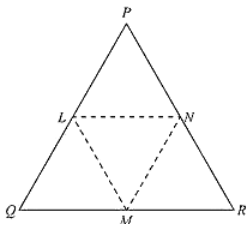 Here we can observe that PQR is an isosceles triangle
PQ = QR and ∠ QPR = ∠ QRP .... (i)
And also, L and M are midpoints of PQ and QR respectively
PL = LQ = QM = MR = PQ/2 = QR/2
And also, PQ = QR
Now, consider Δ LPN and Δ MRN, LP = MR [From - (2)]
∠LPN = ∠MRN ... [From - (1)]
∠QPR and ∠LPN and ∠QRP and ∠MRN are same.
PN = NR [N is midpoint of PR]
So, by SAS congruence criterion, we have ΔLPN = ΔMRN
LN = MN [Corresponding parts of congruent triangles are equal]
Question: 3
In fig. (10).23, PQRS is a square and SRT is an equilateral triangle. Prove that (i) PT = QT (ii) ∠TQR = 15°
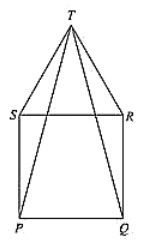
Solution:
Given that PQRS is a square and SRT is an equilateral triangle. And given to prove that
(i) PT = QT and (ii) ∠TQR = 15°
Now, PQRS is a square
PQ = QR = RS = SP ... (i)
And ∠SPQ = ∠PQR = ∠QRS = ∠RSP = 90° = right angle
And also, SRT is an equilateral triangle.
SR = RT = TS ... (ii)
And ∠TSR = ∠SRT = ∠RTS = 60°
From (i) and (ii)
PQ = QR = SP = SR = RT = TS .... (iii)
And also,
∠TSP = ∠TSR + ∠RSP = 60° + 90° + 150°
∠TRQ = ∠TRS + ∠SRQ = 60° + 90° + 150°
⟹ ∠TSR = ∠TRQ = 150° ... (iv)
SP = RQ [From (iii)]
So, by SAS congruence criterion we have
ΔTSP = ΔTRQ
PT = QT [Corresponding parts of congruent triangles are equal] Consider ΔTQR.
QR = TR [From (iii)]
ΔTQR is a isosceles triangle.
∠QTR = ∠TQR [angles opposite to equal sides]
Now,
Sum of angles in a triangle is equal to 180∘
⟹ ∠QTR + ∠TQR + ∠TRQ = 180°
⟹ 2∠ TQR + 150° = 180° [From (iv)]
⟹ 2∠TQR = 180° - 150°
⟹ 2∠ TQR = 30° ∠TQR = 15°] ...
Hence proved
Question: 4
Prove that the medians of an equilateral triangle are equal.
Solution:
Given,
To prove the medians of an equilateral triangle are equal.
Median: The line Joining the vertex and midpoint of opposite side. Now, consider an equilateral triangle ABC.
Let D, E, F are midpoints of BC, CA and AB.
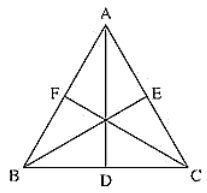 Then, AD, BE and CF are medians of ABC.
Now,
D Is midpoint of BC ⟹ BD = DC = BC/2
Similarly, CE = EA = AC/2
AF = FB = AB/2
Since ΔABC is an equilateral triangle
⟹ AB = BC = CA ... (i)
⟹ BD = DC = CE = EA = AF = FB = BC/2 = AC/2 = AB/2 .... (ii)
And also, ∠ABC = ∠BCA = ∠CAB = 60° ... (iii)
Now, consider ΔABD and ΔBCE AB = BC [From (i)]
BD = CE [From (ii)]
Now, in ΔTSR and ΔTRQ
TS = TR [From (iii)]
∠ABD = ∠BCE [From (iii)] [∠ABD and ∠ABC and ∠BCE and ∠BCA are same]
So, from SAS congruence criterion, we have
ΔABD = ΔBCE
AD = BE .... (iv)
[Corresponding parts of congruent triangles are equal]
Now, consider ΔBCE and ΔCAF, BC = CA [From (i)]
∠BCE = ∠CAF [From (ii)]
[∠BCE and ∠BCA and ∠CAF and ∠CAB are same]
CE = AF [From (ii)]
So, from SAS congruence criterion, we have
ΔBCE = ΔCAF
BE = CF (v)
[Corresponding parts of congruent triangles are equal]
From (iv) and (v), we have
AD = BE = CF
Median AD = Median BE = Median CF
The medians of an equilateral triangle are equal.
Hence proved
Question: 5
In a ΔABC, if ∠A = 120° and AB = AC. Find ∠B and ∠C.
Solution:
Consider a ΔABC
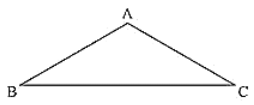 Given Mat ∠A = 120° and AB = AC and given to find ∠B and ∠C.
We can observe that ΔABC is an isosceles triangle since AB = AC
∠B = ∠C (i)
[Angles opposite to equal sides are equal]
We know that sum of angles in a triangle is equal to 180°
⟹ ∠A + ∠B + ∠C = 180° [From (i)]
⟹ ∠A + ∠B + ∠B = 180°
⟹ 120° + 2∠B = 180°
⟹ 2∠B = 180° - 120°
⟹ ∠B = ∠C = 30°
Question: 6
In a ΔABC, if AB = AC and ∠B = 70°. Find ∠A.
Solution:
Consider a ΔABC, if AB = AC and ∠B = 70°
Since, AB = AC ΔABC is an isosceles triangle
∠B = ∠C [Angles opposite to equal sides are equal]
∠B = ∠C = 70∘
And also,
Sum of angles in a triangle = 180°
∠A + ∠B + ∠C = 180°
∠A + 70° + 70° = 180°
∠A = 180° - 140°
∠A = 40°
Question: 7
The vertical angle of an isosceles triangle is (10)0°. Find its base angles.
Solution:
Consider an isosceles ΔABC such that AB = AC
Given that vertical angle A is (10)0°
To find the base angles
Since ΔABC is isosceles
∠B = ∠C [Angles opposite to equal sides are equal]
And also,
Sum of interior angles of a triangle = 180°
∠A + ∠B + ∠C = 180°
(10)0° + ∠B ∠B = 180°
2∠B = 180∘ - (10)0°
∠B = 40°
∠B = ∠C = 40°
Question: 8
In a ∆ABC = AC and ∠ACD = (10)5°. Find ∠BAC.
Solution:
We have,
AB = AC and ∠ACD = (10)5°
Since, ∠BCD = 180° = Straight angle
∠BCA + ∠ ACD = 180°
∠BCA + (10)5° = 180°
∠BCA = l80° - (10)5°
∠BCA = 75°
And also,
ΔABC is an isosceles triangle [AB = AC]
∠ABC = ∠ ACB [Angles opposite to equal sides are equal]
From (i), we have
∠ACB = 75°
∠ABC = ∠ACB = 75°
And also,
Sum of Interior angles of a triangle = 180°
∠ABC = ∠BCA + ∠CAB = 180°
75° + 75° + ∠CAB =180°
150° + ∠BAC = 180°
∠BAC = 180° - 150° = 30°
∠BAC = 30°
Question: 9
Find the measure of each exterior angle of an equilateral triangle.
Solution:
Given to find the measure of each exterior angle of an equilateral triangle consider an equilateral triangle ABC.
We know that for an equilateral triangle
AB = BC = CA and ∠ABC = ∠BCA = CAB =180°/3 = 60° .... (i)
Now,
Extend side BC to D, CA to E and AB to F.
Here BCD is a straight line segment
BCD = Straight angle =180°
∠BCA + ∠ACD = 180° [From (i)]
60° + ∠ACD = 180°
∠ACD = 120°
Similarly, we can find ∠FAB and ∠FBC also as 120° because ABC is an equilateral triangle
∠ACD = ∠EAB - ∠FBC = 120°
Hence, the median of each exterior angle of an equilateral triangle is 120°
Question: 10
If the base of an isosceles triangle is produced on both sides, prove that the exterior angles so formed are equal to each other.
Solution:
ED is a straight line segment and B and C an points on it.
∠EBC = ∠BCD = straight angle = 180°
∠EBA + ∠ABC = ∠ACB + ∠ACD
∠EBA = ∠ACD + ∠ACB - ∠ABC
∠EBA = ∠ACD [From (i) ABC = ACD]
∠ABE = ∠ACD
Hence proved
Question: 11
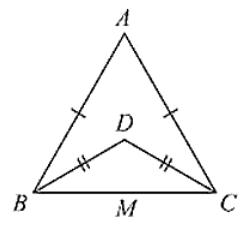
In Fig. (10).2(5) AB = AC and DB = DC, find the ratio ∠ABD: ∠ACD.
Solution:
Consider the figure
Given,
AB = AC, DB = DC and given to find the ratio
∠ABD = ∠ACD
Now, ΔABC and ΔDBC are isosceles triangles since AB = AC and DB = DC respectively
∠ABC = ∠ACB and ∠DBC = ∠DCB [Angles opposite to equal sides are equal]
Now consider,
∠ABD : ∠ACD
(∠ABC - ∠DBC): (∠ACB - ∠DCB)
(∠ABC - ∠DBC): (∠ABC - ∠DBC) [∠ABC = ∠ACB and ∠DBC = ∠DCB]
1: 1
ABD: ACD = 1: 1
Question: 12
Determine the measure of each of the equal angles of a right-angled isosceles triangle. OR
ABC is a right-angled triangle in which ∠A = 90° and AB = AC. Find ∠B and ∠C.
Solution:
ABC is a right angled triangle
Consider on a right - angled isosceles triangle ABC such that
∠A = 90° and AB = AC Since,
AB = AC ⟹ ∠C = ∠B .... (i)
[Angles opposite to equal sides are equal]
Now, Sum of angles in a triangle = 180°
∠A + ∠B + ∠C =180°
⟹ 90° + ∠ B+ ∠ B = 180°
⟹ 2∠B = 90°
⟹ ∠B = 45°
∠B = 45°, ∠C = 45°
Hence, the measure of each of the equal angles of a right-angled Isosceles triangle Is 45°
Question: 13
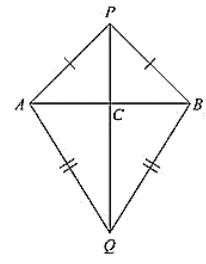
AB is a line segment. P and Q are points on opposite sides of AB such that each of them is equidistant from the points A and B (See Fig. (10).26). Show that the line PQ is perpendicular bisector of AB.
Solution:
Consider the figure.
We have
AB is a line segment and P, Q are points on opposite sides of AB such that
AP = BP ... (i)
AQ = BQ ... (ii)
We have to prove that PQ is perpendicular bisector of AB.
Now consider ΔPAQ and ΔPBQ,
We have
AP = BP [From (i)]
AQ = BQ [From (ii)]
And PQ - PQ [Common site]
Δ PAQ ≃ Δ PBQ ... (iii) [From SAS congruence]
Now, we can observe that APB and ABQ are isosceles triangles. [From (i) and (ii)]
∠ PAB = ∠ ABQ and ∠ QAB = ∠ QBA
Now consider Δ PAC and Δ PBC
C is the point of intersection of AB and PQ
PA = PB [From (i)]
∠ APC = ∠ BPC [From (ii)]
PC = PC [common side]
So, from SAS congruency of triangle ΔPAC ≅ ΔPBC
AC = CB and ∠PCA = ∠PBC ... (iv) [Corresponding parts of congruent triangles are equal]
And also, ACB is line segment
∠ACP + ∠ BCP = 180°
∠ACP = ∠PCB
∠ACP = ∠PCB = 90°<
We have AC = CB ⟹ C is the midpoint of AB
From (iv) and (v)
We can conclude that PC is the perpendicular bisector of AB
Since C is a point on the line PQ, we can say that PQ is the perpendicular bisector of AB.
View courses by askIITians


Design classes One-on-One in your own way with Top IITians/Medical Professionals
Click Here Know More

Complete Self Study Package designed by Industry Leading Experts
Click Here Know More

Live 1-1 coding classes to unleash the Creator in your Child
Click Here Know More