Chapter 7: Decimals – Exercise 7.2
Question: 1
i) Three tenths
ii) Two ones and five tenths
iii) Thirty and one tenths
iv) Twenty two and six tenths
v) One hundred, two ones and three tenths
Solution:
i) 3/10 = 0.3
ii) 2+ 5/10 = 2.5
iii) 30 +1/10 = 30.1
iv) 22+ 6/10 = 22.6
v) 100 + 2 + 3/10 = 102.3
Question: 2
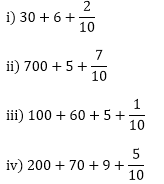
Solution:
i) We have 3 tens, 6 ones and 2 tenths. Therefore, the decimal is 36.2
ii) We have 7 hundreds, 5 ones and 7 tenths. Therefore the decimal is 705.7
iii) We have 2 hundreds, 6 tens, 5 ones and 1 tenths. Therefore the decimal is 265.1
iv) We have 2 hundreds, 7 tens, 9 ones and 5 tenths. Therefore, the decimal is 279.5
Question: 3
i) 22/10
ii) 3/2
iii) 2/5
Solution:
i) Since the denominator is ten, the decimal is 2.2
ii) Making the denominator 10, we have 3/2
3(52)(5) = 1510 = 1.5
iii) Making the denominator 10, we have 2/5
2(25)(2) = 410 = 0.4
Question: 4
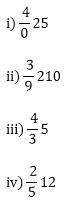
Solution:
i) To write in decimal, we need to make the denominator 10 by multiplying it by a number. But, to maintain the value of the fraction, we should also multiply the numerator by the same number. Thus, we get
= 40 + 2(25)(2) = 40 + 410 = 40.4
ii) 39210 = 39 +210
Here, the denominator is 10 .
Therefore, the decimal is 39.2
iii) 435 = 4 + 35
To write in decimal, we need the denominator by 10 by multiplying it by a number. but, to maintain the value of the fraction, we should also multiply the numerator by the same number. Thus we get,
= 4 + 3(3)(25)(2)
= 4 + 610 = 4.6
iv) 2512 = 25 +12
To write in decimal, we need to make the denominator 10 by multiplying it by a number. But, to maintain the value of the fraction, we should also multiply the numerator by the same number. Thus, we get
= 25 + 1(52)(5)
= 25 + 510 = 25.5
Question: 5
i) 3.8
ii) 21.2
iii) 6.4
iv) 1
Solution:
i) 3.8
= 3 + 8 tenths
= 3 + 810
= 3(1010) + 810 = 3010 + 810 = 3810 = 195
ii) 21.2
=21+2 tenths
= 21+210= 21(1010) + 210 = 21010 + 210 = 21210 = 1065
iii) 6.4
= 6 + 4 tenths
= 6 + 410
= 6(1010) +410 = 6010 + 410 = 325
iv) 1
Since the only number after the decimal is 0, the fraction is 1
Question: 6
Represent the following number on the number line.
i) 0.2
ii) 1.9
iii) 1.1
iv) 2.5
Solution:
i)
.png "Number line(i)")
ii)
.png "Number line (ii)")
iii)
.png "Number line (iii)")
iv)
.png "Number line (iv)")
Question: 7
i) 0.8 is between the two whole numbers 0 and 1
ii) 5.1 is between the two whole number 5 and 6.
iii) 2.6 is between 2 and 3
iv) 6.4 is between 6 and 7
Solution:
i) As 0.8 is 8 units from 0 and 2 units from 1, it is nearer to 1
ii) As 5.1 is 1 unit from 5 and 9 units from 6, it is nearer to 5
iii) As 2.6 is 6 units from 2 and 4 units from 3, it is nearer to 3
iv) As 6.4 is 4 units from 6 and 6 units from 7, it is nearer to 6
9.0 is itself a whole number, that is 9
4.9 is between 4 and 5
As 4.9 is 9 units from 4 and 1 unit from 5, it is nearer to 5
Question: 8
Write the decimal number represented by the points on the given number line A, B, C, D

Solution:
A) 0.8, since A is at the eighth place between 0 and 1
B) 1.3, since B is at the third place between 1 and 2
C) 1.9, since C is at the ninth place between 1 and 2
D) 2.6, since D is at the sixth place between 2 and 3
Disclaimer: the image given in the book is not consistent; as the number of periods between 0 and 1 is ten but the number of periods between 1 and 2 are seven. So, ignoring the position of the given numbers 1, 2 and 3. it has been assumed that there are ten periods between every two consecutive numbers starting from the first point taken as zero.
View courses by askIITians


Design classes One-on-One in your own way with Top IITians/Medical Professionals
Click Here Know More

Complete Self Study Package designed by Industry Leading Experts
Click Here Know More

Live 1-1 coding classes to unleash the Creator in your Child
Click Here Know More