Chapter 6: Fractions – Exercise 6.9
Question: 1
Add:
i) 3/4 and 5/6
ii) 7/10 and 2/15
iii) 8/13 and 2/3
iv) 4/5 and 7/15
Solution:
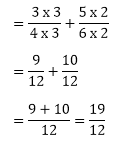
i) Given: 3/4 and 5/6

LCM of 4 and 6 is 12, so we will convert each fraction into an equivalent fraction with denominator 12.
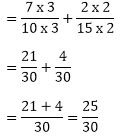
ii) Given: 7/10 and 2/15

LCM of 10 and 15 is 30, so we will convert each fraction into an equivalent fraction with denominator 30.
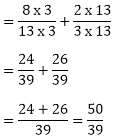
iii) Given: 8/13 and 2/3

LCM of 13 and 3 is 39, so we will convert each fraction into an equivalent fraction with denominator 39.
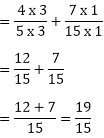
iv) Given: 4/5 and 7/15

LCM of 5 and 15 is 1, so we will convert each fraction into an equivalent fraction with denominator 15.
Question: 2
Subtract:
Solution:
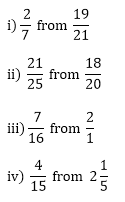
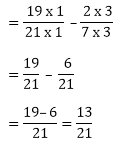
i) Given: 2/7 and 19/21

LCM of 21 and 7 is 21, so we will convert each fraction into an equivalent fraction with denominator 21.
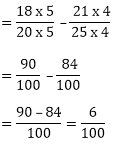
ii) Given: 21/25 and 18/20

LCM of 20 and 25 is 100, so we will convert each fraction into an equivalent fraction with denominator 100.
iii) Given: 2/1 and 7/16

LCM of 1 and 16 is 16, so we will convert each fraction into an equivalent fraction with denominator 16.
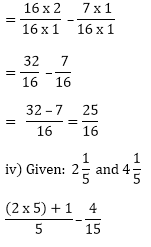
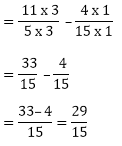
LCM of 5 and 15 is 15, so we will convert each fraction into an equivalent fraction with denominator 15.
Question: 3
Find the difference of:
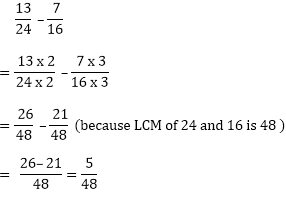
i) 13/24 and 7/16
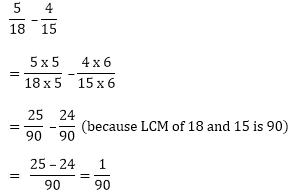
i) 5/18 and 4/15
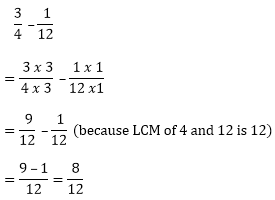
i) 1/12 and 3/4
i) 2/3 and 6/7
Solution:
i) Given: 13/24 and 7/16
ii) Given: 5/18 and 4/15
iii) Given: 3/4 and 1/12
iv) Given: 6/7 and 2/3
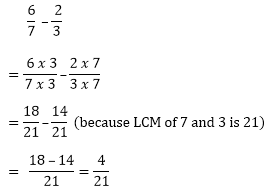
Question: 4
Subtract as indicated:
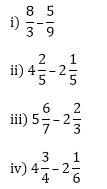
Solution:
i) Given: 8/3 and 5/9
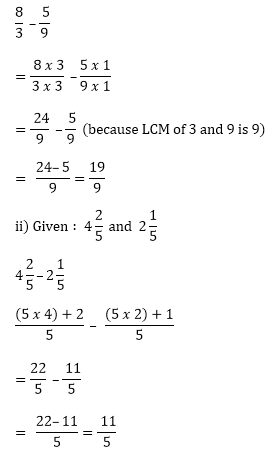
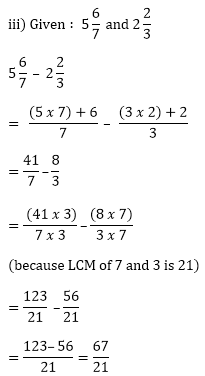
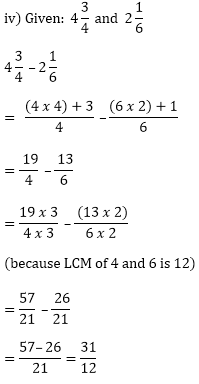
Question: 5
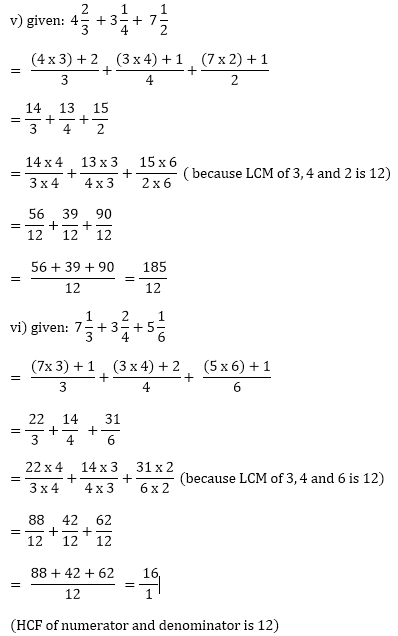
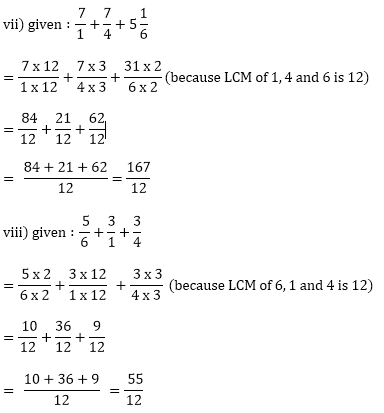
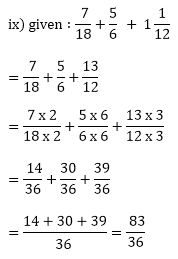
Simplify:
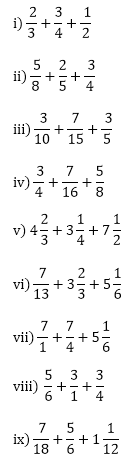
Solution:
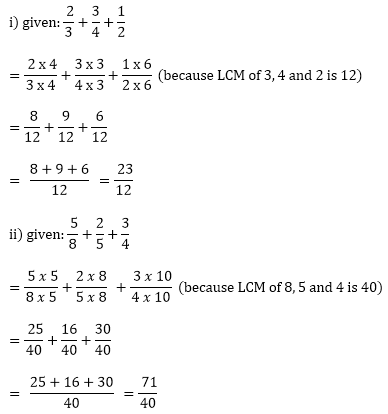
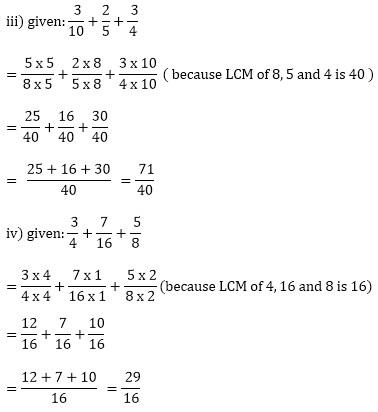
Question: 6
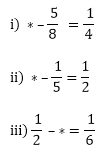
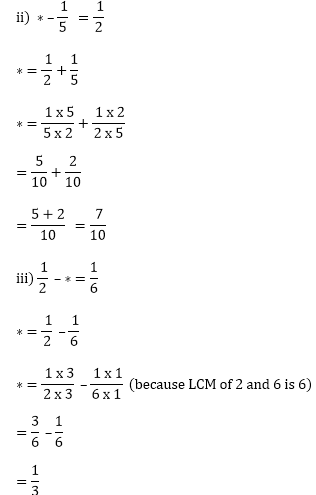
Replace * with a correct number:
Solution:
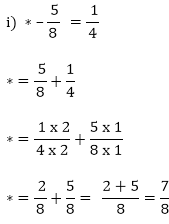
Therefore, 7/8
Question: 7
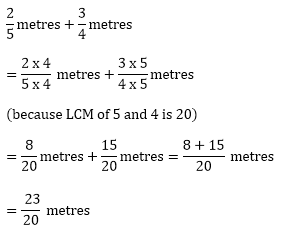
Savita bought 2/5 m of ribbon and kavita 3/4 m of ribbon. What was the total length of the ribbon they bought?
Solution:
Length of the ribbon bought by savita = 2/5 metres
Length of the ribbon bought by kavita = 3/4 metres
Total length of the ribbon bought by them:
Question: 8
Ravish takes minutes to walk across the school ground. Rahul takes 7/4 minutes to do the same. Who takes less time and by what fraction?
Solution:
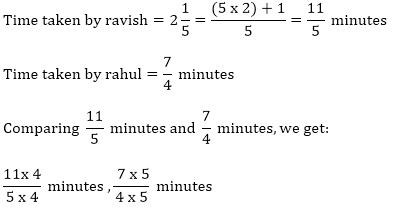
(LCM of 4 and 5 is 20, so will we convert each fraction into an equivalent fraction with denominator 20)

Rahul takes less time,

Question: 9
A piece of a wire 7/8 metres long broke into two pieces. One piece was 1/4 meter long. How long is the other piece?
Solution:
Length of the wire = 7/8 metres
Length of one piece of wire = 1/4 metres
Let the length of the second piece of wire be x m.
Therefore, Length of the wire = length of one piece + length of the second piece
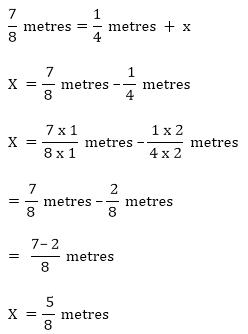
Therefore, the length of the second piece is 5/8 metres
Question: 10
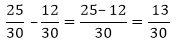
Shikha and priya have bookshelves of the same size shikha’s shelf is 5/6 full of book and priya’s shelf is 2/5 full. Whose bookshelf is more full? By what fraction?
Solution:
Fraction of shikha’s filled bookshelf = 5/6
Fraction of Priya’s filled bookshelf = 2/5
Comparing 5/6 and 2/5, we get :
LCM of 5 and 6 is 30, so will convert each fraction into an equivalent fraction with denominator 30.
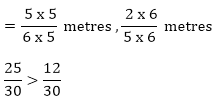
Shikha’s shelf is more full.
Therefore,
Question: 11
Ravish’s house is 9/10 Km from his school. He walked some distance and then took a bus for 1/2 Km. How far did he walk?
Solution:
Total distance between the house and the school = 9/10 Km
Distance covered in the bus = 1/2 Km
Distance covered by walking + distance covered in the bus = total distance between
the house and the school
Distance covered by walking = total distance between the house and the school – Distance
covered in the bus
Distance covered by walking:
9/10 Km – 1/2 Km
LCM of 10 and 2 is 10, so we convert each fraction into an equivalent fraction with denominator 10
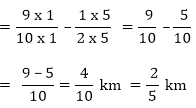
(HCF of numerator and denominator is 2)
View courses by askIITians


Design classes One-on-One in your own way with Top IITians/Medical Professionals
Click Here Know More

Complete Self Study Package designed by Industry Leading Experts
Click Here Know More

Live 1-1 coding classes to unleash the Creator in your Child
Click Here Know More