Chapter 20: Mensuration Exercise 20.4
Question: 1
Question 1. Find the area of a rectangle, whose
(i) Length = 6cm, breadth = 3 cm
(ii) Length = 8 cm, breadth = 3 cm
(iii) Length = 4.5 cm, breadth = 2 cm
Solution:
(i) Area of a rectangle = Length × Breadth
Length = 6 cm Breadth = 3 cm
Area of rectangle = 6 × 3 = 18 cm2
(ii) Area of a rectangle = Length × Breadth
Length = 8 cm Breadth = 3 cm
Area of rectangle = 8 × 3 = 24 cm2
(iii) Area of a rectangle = Length × Breadth
Length = 4.5 cm
Breadth = 2 cm
Area of rectangle = 4.5 × 2 = 9 cm2
Question: 2
Find the area of a square whose side is:
(i) 5 cm
(ii) 4.1 cm
(iii) 5.5 cm
(iv) 2.6 cm
Solution:
Area of a square = Side × Side
(i) Side of the square = 5 cm
Area of the square = 5 × 5 = 25 cm2
(ii) Side of the square = 4.1 cm
Area of the square = 4.1 × 4.1 = 16.81 cm2
(iii) Side of the square = 5.5 cm
Area of the square = 5.5 × 5.5 = 30.25 cm2
(iv) Side of the square = 2.6 cm
Area of the square = 2.6 × 2.6 = 6.76 cm2
Question: 3
The area of a rectangle is 49 cm2 and its breadth is 2.8 cm. Find the length of the rectangle.
Solution:
Area = 49 cm2 Breadth = 2.8 cm
Area of the rectangle = Length × Breadth
Therefore, Length = Area/Breadth
= 49/2.8 = 17.5 cm
Question: 4
The side of a square is 70 cm. Find its area and perimeter.
Solution:
Side of the square = 70 cm
Area of the square = Side × Side = 70 × 70 = 4900 cm2
Perimeter of the square = 4 × Side
= 4 × 70 = 280 cm
Question: 5
The area of a rectangle is 225 cm2 and its one side is 25 cm, find its other side.
Solution:
Area = 225 cm2
One of the sides = 25 cm
Area of the rectangle = Product of the lengths of its two side
Other side = Area/Side = 225/25 = 9 cm
Question: 6
What will happen to the area of a rectangle if its
(i) Length and breadth are trebled (ii) Length is doubled and breadth is same
(iii) Length is doubled
Solution:
(i) If the length and breadth of a rectangle are trebled.
Let the initial length and breadth be l and b, respectively.
Original area = l × b = lb
Now,
the length and breadth are trebled which means they become three times of their original value.
Therefore New length = 3l
New breadth = 3b
New area = 3l × 3b = 9lb
Thus, the area of the rectangle will become 9 times that of its original area.
(ii) If the length is doubled and the breadth is same.
Let the initial length and breadth be l and b, respectively.
Original area = l × b = lb
Now, length is doubled and breadth remains same.
Therefore New length = 2l
New breadth = b
New area = 2l × b = 2 lb
Thus, the area of the rectangle will become 2 times that of its original area.
(iii) If the Length is doubled and breadth is halved.
Let the initial length and breadth be land b, respectively.
Original area =l × b = lb
Now, length is doubled and breadth is halved.
Therefore New length = 2l
New breadth = b/2
New area = 2 l × b / 2 = lb
New area is also lb.
This means that the areas remain the same.
Question: 7
What will happen to the area of a square if its side is :
(i) Tripled
(ii) increased by half of it
Solution:
(i) Let the original side of the square be s.
Original area = s x s = s2
If the side of a square is tripled, new side will be equal to 3s.
New area = 3s × 3s = 9s2
This means that the area becomes 9 times that of the original area.
(ii) Let the original side of the square be s.
Original area = s × s = s2
If the side of a square is increased by half of it, new side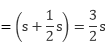
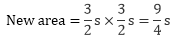
This means that the area becomes 9/4 times that of the original area.
Question: 8
Find the perimeter of a rectangle whose area is 500 cm2 and breadth is 20 cm.
Solution:
Area = 500 cm2
Breadth = 20 cm
Area of rectangle = Length × Breadth
Therefore Length = Area/Breadth
= 500/20 = 25 cm
Perimeter of a rectangle = 2 (Length + Breadth)
= 2(25 + 20) cm = 2 × 45 cm = 90 cm
Question: 9
A rectangle has the area equal to that of a square of side 80 cm. If the breadth of the rectangle is 20 cm, Find its length.
Solution:
Side of the square = 80 cm
Area of square = Side × Side = 80 × 80 = 6400 cm2
Given that:
Area of the rectangle = Area of the square = 6400 cm2
Breadth of the rectangle = 20 cm
Applying the formula:
Length of the rectangle = Area/Breadth
We get:
Length of the rectangle = 6400/20 = 320 cm
Question: 10
Area of a rectangle of breadth 17 cm is 340 cm2. Find the perimeter of the rectangle.
Solution:
Area of the rectangle = 340 cm2
Breadth of the rectangle = 17 cm
Applying the formula:
Length of a rectangle = Area / Breadth
We get:
Length of the rectangle = 340/17 = 20 cm
Perimeter of rectangle = 2 (Length + Breadth)
= 2 (20 + 17)
= 2 × 37
= 74 cm
Question: 11
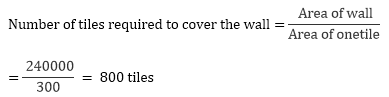
A marble tile measures 15 cm × 20cm. How many tiles will be required to cover a wall of size 4m × 6m?
Solution:
Dimensions of the tile = 15 cm × 20 cm
Dimensions of the wall = 4 m × 6 m = 400 cm × 600 cm (Since, 1 m = 100 cm)
Area of the tile = 15 cm × 20 cm = 300 cm2
Area of the wall = 400 cm × 600 cm = 2, 40, 000 cm2
Question: 12
A marble tile measures 10 cm × 12 cm. How many tiles will be required to cover a wall of size 3m × 4m? Also, find the total cost of the tiles at the rate of Rs 2 per tile.
Solution:
Dimension of the tile = 10 cm × 12 cm
Dimension of the wall =3 m × 4 m = 300 cm × 400 cm (Since, 1 m = 100 cm)
Area of the tile = 10 cm × 12 cm = 120 cm2
Area of the wall = 300 cm × 400 cm = 1, 20, 000 cm2
Number of tiles required to cover the wall = Area of wall / Area of one tile
= 120000/120 = 1,000 tiles
Cost of tiles at the rate of Rs. 2 per tile = 2 × 1,000 = Rs. 2,000
Question: 13
One tile of a square plot is 250 m, find the cost of leveling it at the rate of Rs 2 per square meter.
Solution:
Side of the square plot = 250 m
Area of the square plot = Side × Side = 250 × 250 = 62,500 m2
Rate of leveling the plot = Rs. 2 per m2
Cost of leveling the square plot = Rs. 62,500 × 2 = Rs. 1, 25, 000
Question: 14
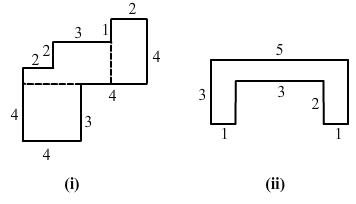
The following figures have been split into rectangles. Find the areas. (The measures are given in centimeters)
Solution:
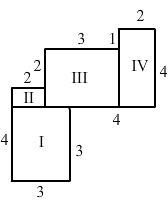 (i) This figure consists of two rectangles II and IV and two squares I and III.
Area of square I = Side × Side = 3 × 3 = 9 cm=2
Similarity, area of rectangle II = (2 × 1) = 2 cm2
Area of square III = (3 × 3) = 9 cm2
Area of rectangle IV = (2 × 4) = 8 cm2
Thus, the total area of this figure = (Area of square I + Area of rectangle II + Area of square III + Area of rectangle IV) = 9 + 2 + 9 + 8 = 28 cm2
(ii) This figure consists of three rectangles I, II and Ill.
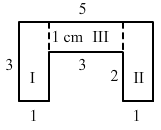 Area of rectangle I = Length × Breadth = 3 × 1 = 3 cm2
Similarly, area of rectangle II = (3 × 1) = 3 cm2
Area of rectangle III = (3 × 1) = 3 cm2
Thus,
the total area of this figure = (Area of rectangle I + area of rectangle II + area of rectangle III)
= 3 + 3 + 3 = 9 cm2
Question: 15
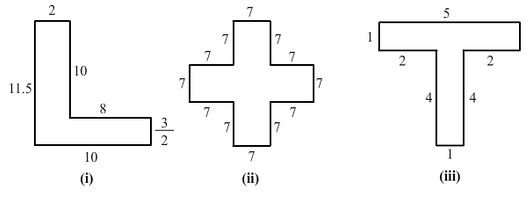
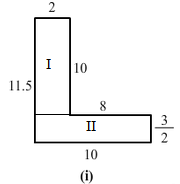
Split the following shapes into rectangles and find the area of each. (The measures are given in centimeters)
 Solution:
(i) This figure consists of two rectangles I and II.
The area of rectangle I = Length × Breadth = 10 × 2 = 20 cm2
Similarly, area of rectangle II = 10 × 32 = 15 cm2
Thus, total area of this figure = (Area of rectangle I + Area of rectangle II) = 20 + 15 = 35 cm2
(ii) This figure consists of two squares I and III and one rectangle II.
Area of square I = Area of square III = Side × Side = 7 × 7 = 49 cm2
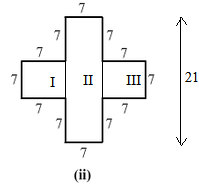 Similarly, area of rectangle II = (21 × 7) = 147 cm2
Thus, total area of this figure = (Area of square I + Area of rectangle II + Area of square III)
= 49 + 49 + 147 = 245 cm2
(iii) This figure consists of two rectangles I and II.
Area of rectangle I = Length × Breadth = 5 × 1 = 5 cm2
Similarly, area of rectangle II = 4 × 1 = 4 cm2
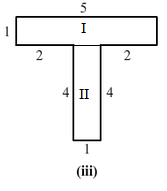 Thus, total area of this figure = (Area of rectangle I + Area of rectangle II) = 5 + 4 = 9 cm2
Question: 16
How many tiles with dimension 5 cm and 12 cm will be needed to fit a region whose length and breadth are respectively?
(i) 100 cm and 144 cm
(ii) 70 cm and 36 cm
Solution:
(i) Dimension of the tile = 5 cm × 12 cm
Dimension of the region = 100 cm × 144 cm
Area of the tile = 5 cm × 12 cm = 60 cm2
Area of the region = 100 cm × 144 cm = 14,400 cm2
Number of tiles required to cover the region = Area of the region / Area of one tile
= 14400/60 = 240 tiles
(ii) Dimension of the tile = 5 cm × 12 cm
Dimension of the region = 70 cm × 36 cm
Area of the tile = 5 cm × 12 cm = 60 cm2
Area of the region = 70 cm × 36 cm = 2,520 cm2
Number of tiles required to cover the region = Area of the region / Area of one tile
= 2520/42 = 42 tiles
View courses by askIITians


Design classes One-on-One in your own way with Top IITians/Medical Professionals
Click Here Know More

Complete Self Study Package designed by Industry Leading Experts
Click Here Know More

Live 1-1 coding classes to unleash the Creator in your Child
Click Here Know More