Chapter 8: Quadratic Equations Exercise – 8.10
Question: 1
The hypotenuse of a right triangle is 25 cm. The difference between the lengths of the other two sides of the triangle is 5 cm. Find the lengths of these sides.
Solution:
Let the length of one side of the right triangle be x cm then,
the other side be = (x + 5) cm
and given that hypotenuse = 25 cm
By using Pythagoras Theorem,
x2 + (x + 5)2 = 252
x2 + x2 + 10x + 25 = 625
2x2 + 10x + 25 - 625 = 0
2x2 + 10x - 600 = 0
x2 + 5x - 300 = 0
x2 - 15x + 20x - 300 = 0
x(x - 15) + 20(x -15) = 0
(x - 15)(x + 20) = 0
x = 15 or x = - 20
Since, the side of triangle can never be negative
Therefore, when, x = 15
And, x + 5 = 15 + 5 = 20
Therefore, length of side of right triangle is = 15 cm and other side is = 20 cm
Question: 2
The diagonal of a rectangular field is 60 meters more than the shorter side. If the longer side is 30 meters more than the shorter side, find the sides of the field.
Solution:
Let the length of smaller side of rectangle be x metres then, the larger side be (x + 30) metres and
diagonal be = (x + 60) metres
By using Pythagoras theorem,
x2 + (x + 30)2 = (x + 60)2
x2 + x2 + 60x + 900 = x2 + 120x + 3600
2x2 + 60x + 900 - x2 - 120x - 3600 = 0
x2 - 60x - 2700 = 0
x2 - 90x + 30x - 2700 = 0
x(x - 90) + 30(x - 90) = 0
(x - 90)(x + 30) = 0
x = 90 or x = -30
Since, the side of rectangle can never be negative
Therefore, x = 90
x + 30 = 90 + 30 = 120
Therefore, the length of smaller side of rectangle is = 90 metres and larger side is = 120 metres.
Question: 3
The hypotenuse of a right triangle is 3√10 cm. If the smaller leg is tripled and the longer leg doubled, new hypotenuse will be 9√5 cm. How long are the legs of the triangle?
Solution:
Let the length of smaller side of right triangle be = x cm then large side be = y cm
By using Pythagoras theorem,
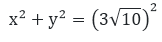
x2 + y2 = 90 .... eqn. (1)
If the smaller side is triple and the larger side is doubled, the new hypotenuse is 9√5 cm
Therefore,

9x2 + 4y2 = 405 .... eqn. (2)
From equation (1) we get,
y2 = 90 - x2
Now putting the value of y2 in eqn. (2)
9x2 + 4(90 - x2) = 405
9x2 + 360 - 4X2 - 405 = 0
5x2 - 45 = 0
5(x2 - 9) = 0
x2 - 9 = 0
x2 = 9
x = √9
x = ±3
Since, the side of triangle can never be negative
Therefore, when x = 3
Then, y2 = 90, x2 = 90 , (3)2 = 90, 9 = 81
y = √81
y = ±9
Hence, the length of smaller side of right triangle is = 3 cm and larger side is = 9 cm
Question: 4
A pole has to be erected at a point on the boundary of a circular park of diameter meters in such a way that the difference of its distances from two diametrically opposite fixed gates A and B on the boundary is 7 meters. Is it possible to do so? If yes, at what distances from the two gates should the pole be erected?
Solution:
Let P be the required location on the boundary of circular park such that its distance from the gate B is x metres that is BP = x metres
Then, AP = x + 7
In right triangle ABP, by using Pythagoras theorem,
AP2 + BP2 = AB2
(x + 7)2 + x2 = 132
x2 + 14x + 49 + x2 = 169
2x2 +14x + 49 - 169 = 0
2x2 + 14x - 120 = 0
2(x2 + 7x - 60) = 0
x2 + 12x - 5x - 60 = 0
x(x + 12) - 5(x + 12) = 0
(x + 12)(x - 5) = 0
x = - 12 or x = 5
Since, the side of triangle can never be negative
Therefore, P is at a distance of 5 metres from the gate B
View courses by askIITians


Design classes One-on-One in your own way with Top IITians/Medical Professionals
Click Here Know More

Complete Self Study Package designed by Industry Leading Experts
Click Here Know More

Live 1-1 coding classes to unleash the Creator in your Child
Click Here Know More