Constructions Exercise 17.2
Question: 1
Draw △ABC in which AB = 5.5 cm. BC = 6 cm and CA = 7 cm. Also, draw perpendicular bisector of side BC.
Solution:
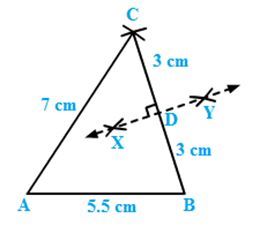
Steps of construction:
-
Draw a line segment AB of length 5.5 cm.
-
From B, cut an arc of radius 6 cm.
-
With centre A, draw an arc of radius 7 cm intersecting the previously drawn arc at C.
-
Join AC and BC to obtain the desired triangle.
-
With centre B and radius more than half of BC, draw two arcs on both sides of BC.
-
With centre C and the same radius as in the previous step, draw two arcs intersecting the arcs drawn in the previous step at X and Y.
-
Join XY to get the perpendicular bisector of BC.
Question: 2
Draw ∆PQR in which PQ = 3 cm, QR. 4 cm and RP = 5 cm. Also, draw the bisector of ∠Q
Solution:
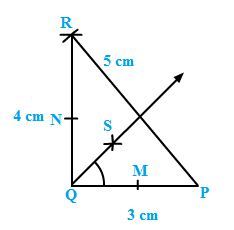
Steps of construction:
-
Draw a line segment PQ of length 3 cm.
-
With Q as centre and radius 4 cm, draw an arc.
-
With P as centre and radius 5 cm, draw an arc intersecting the previously drawn arc at R.
-
Join PR and OR to obtain the required triangle.
-
From Q, cut arcs of equal radius intersecting PQ and QR at M and N, respectively.
-
From M and N, cut arcs of equal radius intersecting at point S.
-
Join QS and extend to produce the angle bisector of angle PQR.
-
Verify that angle PQS and angle SQR are equal to 45° each.
Question: 3
Draw an equilateral triangle one of whose sides is of length 7 cm.
Solution:
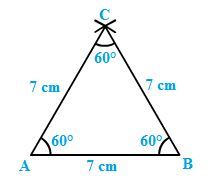
Steps of construction:
-
Draw a line segment AB of length 7 cm.
-
With centre A, draw an arc of radius 7 cm.
-
With centre B, draw an arc of radius 7 cm intersecting the previously drawn arc at C.
-
Join AC and BC to get the required triangle.
Question: 4
Draw a triangle whose sides are of lengths 4 cm, 5 cm and 7 cm. Draw the perpendicular bisector of the largest side.
Solution:
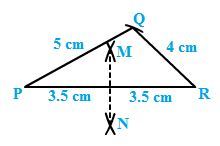
Steps of construction:
Draw a line segment PR of length 7 cm.
-
With centre P, draw an arc of radius 5 cm.
-
With centre R, draw an arc of radius 4 cm intersecting the previously drawn arc at Q.
-
Join PQ and QR to obtain the required triangle.
-
From P, draw arcs with radius more than half of PR on either sides.
-
With the same radius as in the previous step, draw arcs from R on either sides of PR intersecting the arcs drawn in the previous step at M and N.
-
MN is the required perpendicular bisector of the largest side.
Question: 5
Draw a triangle ABC with AB = 6 cm, BC = 7 cm and CA = 8 cm. Using ruler and compass alone, draw (i) the bisector AD of ∠A and (ii) perpendicular AL from A on BC. Measure LAD.
Solution:
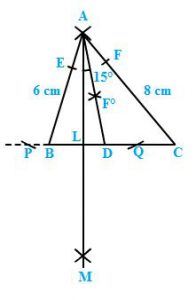
Steps of construction:
Draw a line segment BC of length 7 cm.
With centre B, draw an arc of radius 6 cm.
With centre C, draw an arc of radius 8 cm intersecting the previously drawn arc at A.
Join AC and BC to get the required triangle.
Angle bisector steps:
-
From A, cut arcs of equal radius intersecting AB and AC at E and F, respectively.
-
From E and F, cut arcs of equal radius intersecting at point H.
-
Join AH and extend to produce the angle bisector of angle A, meeting line BC at D.
Perpendicular from Point A to line BC steps:
-
From A, cut arcs of equal radius intersecting BC at P and Q, respectively (Extend BC to draw these arcs).
-
From P and Q, cut arcs of equal radius intersecting at M.
-
Join AM cutting BC at L.
-
AL is the perpendicular to the line BC.
-
Angle LAD is 15°.
Question: 6
Draw △DEF such that DE= DF= 4 cm and EF = 6 cm. Measure ∠E and ∠F.
Solution:
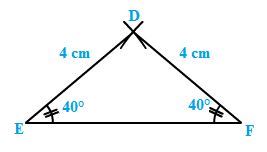
Steps of construction:
-
Draw a line segment EF of length 6 cm.
-
With E as centre, draw an arc of radius 4 cm.
-
With F as centre, draw an arc of radius 4 cm intersecting the previous arc at D.
-
Join DE and DF to get the desired triangle DEF.
-
By measuring we get, ∠E= ∠F= 40°..
Question: 7
Draw any triangle ABC. Bisect side AB at D. Through D, draw a line parallel to BC, meeting AC in E. Measure AE and EC.
Solution:
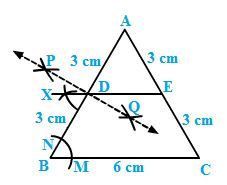
Steps of construction:
We first draw a triangle ABC with each side = 6 cm.
Steps to bisect line AB:
-
Draw an arc from A on either side of line AB.
-
With the same radius as in the previous step, draw an arc from B on either side of AB intersecting the arcs drawn in the previous step at P and Q.
-
Join PQ cutting AB at D. PQ is the perpendicular bisector of AB.
Parallel line to BC:
-
With B as centre, draw an arc cutting BC and BA at M and N, respectively.
-
With centre D and the same radius as in the previous step, draw an arc on the opposite side of AB to cut AB at Y.
-
With centre Y and radius equal to MN, draw an arc cutting the arc drawn in the previous step at X.
-
Join XD and extend it to intersect AC at E.
-
DE is the required parallel line.
View courses by askIITians


Design classes One-on-One in your own way with Top IITians/Medical Professionals
Click Here Know More

Complete Self Study Package designed by Industry Leading Experts
Click Here Know More

Live 1-1 coding classes to unleash the Creator in your Child
Click Here Know More