Congruence Exercise 16.2
Question: 1
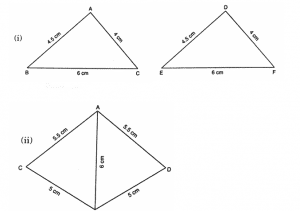
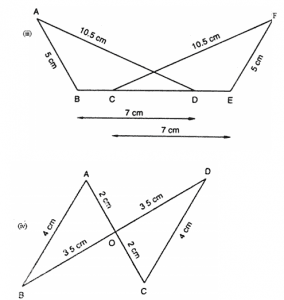
In the following pairs of triangle (Figures), the lengths of the sides are indicated along sides. By applying SSS condition, determine which are congruent. State the result in symbolic.
Solution:
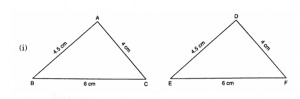
1) In
AB = DE = 4.5 cm (Side)
BC = EF = 6 cm (Side) and
AC = DF = 4 cm (Side)
Therefore, by SSS criterion of congruence,
2)
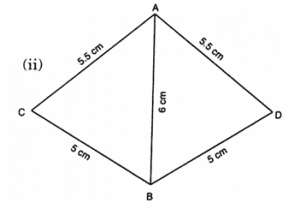
In
AC = AD (Side)
BC = BD (Side) and
AB = AB (Side)
Therefore, by SSS criterion of congruence,
3) In
AB = FE (Side)
AD = FC (Side)
BD = CE (Side)
Therefore, by SSS criterion of congruence,
4) In
AB = DC (Side)
AO = OC (Side)
BO = OD (Side)
Therefore, by SSS criterion of congruence,
Question: 2
In figure, AD = DC and AB = BC
(i) Is
(ii) State the three parts of matching pairs you have used to answer (i).
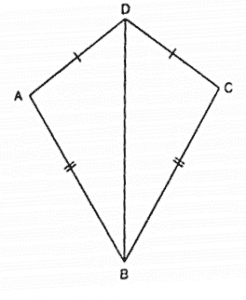
Solution:
Yes
AD = DC
AB = BC and
DB = BD
Question: 3
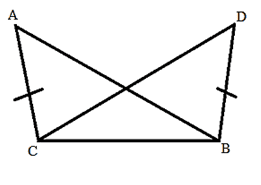
In Figure, AB = DC and BC = AD.
(i) Is
(ii) What congruence condition have you used?
(iii) You have used some fact, not given in the question, what is that?
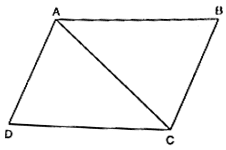
Solution:
We have AB = DC
BC = AD
and AC = AC
Therefore by SSS
We have used Side congruence condition with one side common in both the triangles.
Yes, have used the fact that AC = CA.
Question: 4
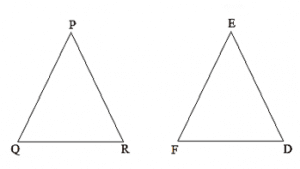
In
(i) Which side of
(ii) Which angle of
Solution:
(i) Therefore PR = ED since the corresponding sides of congruent triangles are equal.
(ii)
Question: 5
Triangles ABC and PQR are both isosceles with AB = AC and PO = PR respectively. If also, AB = PQ and BC = QR, are the two triangles congruent? Which condition do you use?
It ∠B = 50°, what is the measure of ∠R?
Solution:
And PQ = PR in isosceles
Also, we are given that AB = PQ and QR = BC.
Therefore, AC = PR (AB = AC, PQ = PR and AB = PQ)
Hence,
Now
Therefore,
Question: 6
Solution:
Question: 7
(i)
(ii)
(iii)
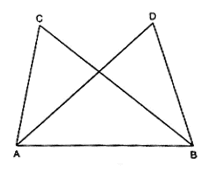
Solution:
In
AC = BD (given)
BC = AD (given)
and AB = BA (common)
Therefore by SSS criterion of congruency, ΔABC ≅ ΔBAD
There option (iii) is true.
Question: 8
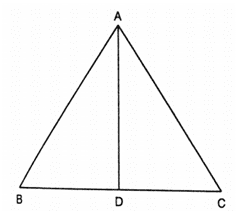
In Figure,
(i) Is
(ii) State the three pairs of matching parts you use to arrive at your answer.
Solution:
We have AB = AC.
Also since D is the midpoint of BC, BD = DC
Also, AD = DA
Therefore by SSS condition,
We have used AB, AC : BD, DC AND AD, DA
Question: 9
In figure,

Solution:
Yes,
Since, ABC is an isosceles triangle, AB = BC, BC = CB and AC = AB
Question: 10
Triangles ABC and DBC have side BC common, AB = BD and AC = CD. Are the two triangles congruent? State in symbolic form, which congruence do you use? Does
Solution:
Yes,
Given,
By SSS criterion of congruency,
No,
View courses by askIITians


Design classes One-on-One in your own way with Top IITians/Medical Professionals
Click Here Know More

Complete Self Study Package designed by Industry Leading Experts
Click Here Know More

Live 1-1 coding classes to unleash the Creator in your Child
Click Here Know More