Chapter 15: Properties of Triangles Exercise – 15.3
Question: 1
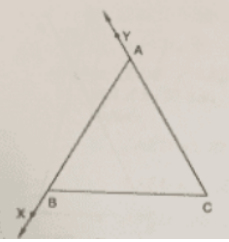
∠CBX is an exterior angle of ∆ABC at B. Name
(i) the interior adjacent angle
(ii) the interior opposite angles to exterior ∠CBX
Also, name the interior opposite angles to an exterior angle at A.
Solution:
(i) ∠ABC
(ii) ∠BAC and ∠ACB
Also the interior angles opposite to exterior are ∠ABC and ∠ACB
Question: 2
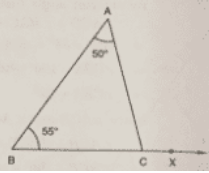
In the fig, two of the angles are indicated. What are the measures of ∠ACX and ∠ACB?
Solution:
In ∆ABC, ∠A = 50° and ∠B = 55°
Because of the angle sum property of the triangle, we can say that
∠A + ∠B + ∠C = 180°
50°+ 55°+ ∠C = 180°
Or
∠C = 75°
∠ACB = 75°
∠ACX = 180°− ∠ACB = 180°−75° = 105°
Question: 3
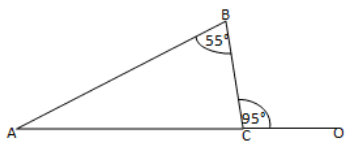
In a triangle, an exterior angle at a vertex is 95° and its one of the interior opposite angles is 55°. Find all the angles of the triangle.
Solution:
We know that the sum of interior opposite angles is equal to the exterior angle.
Hence, for the given triangle, we can say that:
∠ABC+ ∠BAC = ∠BCO
55° + ∠BAC = 95°
Or,
∠BAC= 95°– 95°
= ∠BAC = 40°
We also know that the sum of all angles of a triangle is 180°.
Hence, for the given △ABC, we can say that:
∠ABC + ∠BAC + ∠BCA = 180°
55° + 40° + ∠BCA = 180°
Or,
∠BCA = 180° –95°
= ∠BCA = 85°
Question: 4
One of the exterior angles of a triangle is 80°, and the interior opposite angles are equal to each other. What is the measure of each of these two angles?
Solution:
Let us assume that A and B are the two interior opposite angles.
We know that ∠A is equal to ∠B.
We also know that the sum of interior opposite angles is equal to the exterior angle.
Hence, we can say that:
∠A + ∠B = 80°
Or,
∠A +∠A = 80° (∠A= ∠B)
2∠A = 80°
∠A = 40/2 =40°
∠A= ∠B = 40°
Thus, each of the required angles is of 40°.
Question: 5
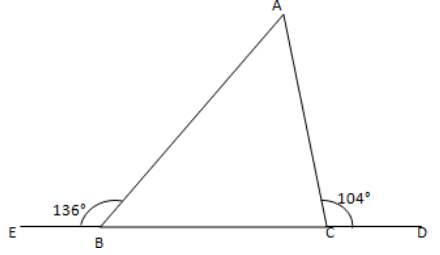
The exterior angles, obtained on producing the base of a triangle both ways are 104° and 136°. Find all the angles of the triangle.
Solution:
In the given figure, ∠ABE and ∠ABC form a linear pair.
∠ABE + ∠ABC =180°
∠ABC = 180°– 136°
∠ABC = 44°
We can also see that ∠ACD and ∠ACB form a linear pair.
∠ACD + ∠ACB = 180°
∠AUB = 180°– 104°
∠ACB = 76°
We know that the sum of interior opposite angles is equal to the exterior angle.
Therefore, we can say that:
∠BAC + ∠ABC = 104°
∠BAC = 104°– 44° = 60°
Thus,
∠ACE = 76° and ∠BAC = 60°
Question: 6
In Fig, the sides BC, CA and BA of a ∆ABC have been produced to D, E and F respectively. If ∠ACD = 105° and ∠EAF = 45°; find all the angles of the ∆ABC
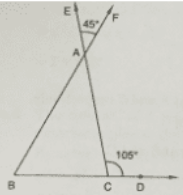
Solution:
In a ∆ABC, ∠BAC and ∠EAF are vertically opposite angles.
Hence, we can say that:
∠BAC = ∠EAF = 45°
Considering the exterior angle property, we can say that:
∠BAC + ∠ABC = ∠ACD = 105°
∠ABC = 105°– 45° = 60°
Because of the angle sum property of the triangle, we can say that:
∠ABC + ∠ACS +∠BAC = 180°
∠ACB = 75°
Therefore, the angles are 45°, 65° and 75°.
Question: 7
In Figure, AC perpendicular to CE and C ∠A: ∠B: ∠C= 3: 2: 1. Find the value of ∠ECD.
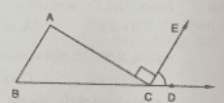
Solution:
In the given triangle, the angles are in the ratio 3: 2: 1.
Let the angles of the triangle be 3x, 2x and x.
Because of the angle sum property of the triangle, we can say that:
3x + 2x + x = 180°
6x = 180°
Or,
x = 30° … (i)
Also, ∠ACB + ∠ACE + ∠ECD = 180°
x + 90° + ∠ECD = 180° (∠ACE = 90°)
∠ECD = 60° [From (i)]
Question: 8
A student when asked to measure two exterior angles of ∆ABC observed that the exterior angles at A and B are of 103° and 74° respectively. Is this possible? Why or why not?
Solution:
Here,
Internal angle at A + External angle at A = 180°
Internal angle at A + 103° =180°
Internal angle at A = 77°
Internal angle at B + External angle at B = 180°
Internal angle at B + 74° = 180°
Internal angle at B = 106°
Sum of internal angles at A and B = 77° + 106° =183°
It means that the sum of internal angles at A and B is greater than 180°, which cannot be possible.
Question: 9
In Figure, AD and CF are respectively perpendiculars to sides BC and AB of ∆ABC. If ∠FCD = 50°, find ∠BAD
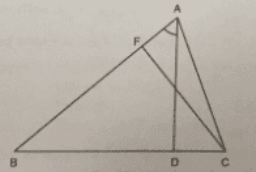
Solution:
We know that the sum of all angles of a triangle is 180°
Therefore, for the given ∆FCB, we can say that:
∠FCB + ∠CBF + ∠BFC = 180°
50° + ∠CBF + 90°= 180°
Or,
∠CBF = 180° – 50°– 90° = 40° … (i)
Using the above rule for ∆ABD, we can say that:
∠ABD + ∠BDA + ∠BAD = 180°
∠BAD = 180° – 90°– 40° = 50° [from (i)]
Question: 10
In Figure, measures of some angles are indicated. Find the value of x.
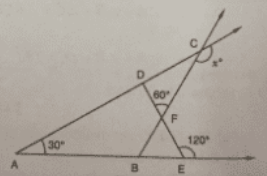
Solution:
Here,
∠AED + 120° = 180° (Linear pair)
∠AED = 180°– 120° = 60°
We know that the sum of all angles of a triangle is 180°.
Therefore, for △ADE, we can say that:
∠ADE + ∠AED + ∠DAE = 180°
60°+ ∠ADE + 30° =180°
Or,
∠ADE = 180°– 60°– 30° = 90°
From the given figure, we can also say that:
∠FDC + 90° = 180° (Linear pair)
∠FDC = 180°– 90° = 90°
Using the above rule for △CDF, we can say that:
∠CDF + ∠DCF + ∠DFC = 180°
90° + ∠DCF + 60° =180°
∠DCF = 180°−60°− 90°= 30°
Also,
∠DCF + x = 180° (Linear pair)
30° + x = 180°
Or,
x = 180°– 30° = 150°
Question: 11
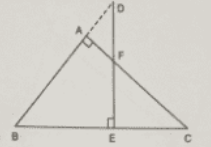
In Figure, ABC is a right triangle right angled at A. D lies on BA produced and DE perpendicular to BC intersecting AC at F. If ∠AFE = 130°, find
(i) ∠BDE
(ii) ∠BCA
(iii) ∠ABC
Solution:
(i) Here,
∠BAF + ∠FAD = 180° (Linear pair)
∠FAD = 180°- ∠BAF = 180°– 90° = 90°
Also,
∠AFE = ∠ADF + ∠FAD (Exterior angle property)
∠ADF + 90° = 130°
∠ADF = 130°− 90° = 40°
(ii) We know that the sum of all the angles of a triangle is 180°.
Therefore, for ∆BDE, we can say that:
∠BDE + ∠BED + ∠DBE = 180°.
∠DBE = 180°– ∠BDE ∠BED = 180°− 90°− 40°= 50° — (i)
Also,
∠FAD = ∠ABC + ∠ACB (Exterior angle property)
90° = 50° + ∠ACB
Or,
∠ACB = 90°– 50° = 40°
(iii) ∠ABC = ∠DBE = 50° [From (i)]
Question: 12
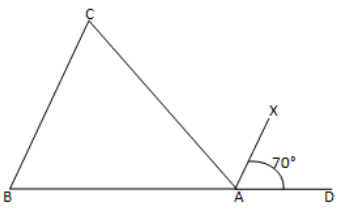
ABC is a triangle in which ∠B = ∠C and ray AX bisects the exterior angle DAC. If ∠DAX = 70°. Find ∠ACB.
Solution:
Here,
∠CAX = ∠DAX (AX bisects ∠CAD)
∠CAX =70°
∠CAX +∠DAX + ∠CAB =180°
70°+ 70° + ∠CAB =180°
∠CAB =180° –140°
∠CAB =40°
∠ACB + ∠CBA + ∠CAB = 180° (Sum of the angles of ∆ABC)
∠ACB + ∠ACB+ 40° = 180° (∠C = ∠B)
2∠ACB = 180°– 40°
∠ACB = 140/2
∠ACB = 70°
Question: 13
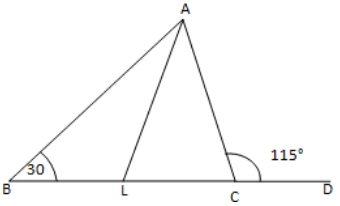
The side BC of ∆ABC is produced to a point D. The bisector of ∠A meets side BC in L. If ∠ABC= 30° and ∠ACD = 115°, find ∠ALC
Solution:
∠ACD and ∠ACL make a linear pair.
∠ACD+ ∠ACB = 180°
115° + ∠ACB =180°
∠ACB = 180°– 115°
∠ACB = 65°
We know that the sum of all angles of a triangle is 180°.
Therefore, for ∆ABC, we can say that:
∠ABC + ∠BAC + ∠ACB = 180°
30° + ∠BAC + 65° = 180°
Or,
∠BAC = 85°
∠LAC = ∠BAC/2 = 85/2
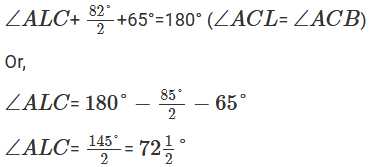
Using the above rule for ∆ALC, we can say that:
∠ALC + ∠LAC + ∠ACL = 180°
Question: 14
D is a point on the side BC of ∆ABC. A line PDQ through D, meets side AC in P and AB produced at Q. If ∠A = 80°, ∠ABC = 60° and ∠PDC = 15°, find
(i) ∠AQD
(ii) ∠APD
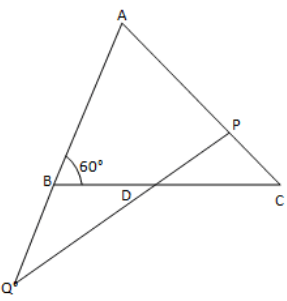
Solution:
∠ABD and ∠QBD form a linear pair.
∠ABC + ∠QBC =180°
60° + ∠QBC = 180°
∠QBC = 120°
∠PDC = ∠BDQ (Vertically opposite angles)
∠BDQ = 75°
In ∆QBD:
∠QBD + ∠QDB + ∠BDQ = 180° (Sum of angles of ∆QBD)
120°+ 15° + ∠BQD = 180°
∠BQD = 180°– 135°
∠BQD = 45°
∠AQD = ∠BQD = 45°
In ∆AQP:
∠QAP + ∠AQP + ∠APQ = 180° (Sum of angles of ∆AQP)
80° + 45° + ∠APQ = 180°
∠APQ = 55°
∠APD = ∠APQ
Question: 15
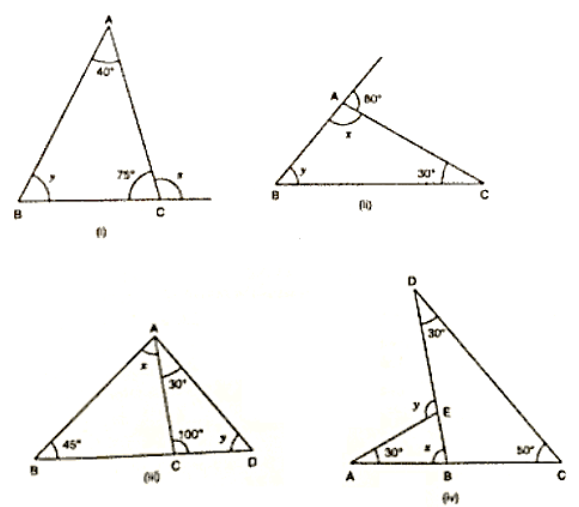
Explain the concept of interior and exterior angles and in each of the figures given below. Find x and y
Solution:
The interior angles of a triangle are the three angle elements inside the triangle.
The exterior angles are formed by extending the sides of a triangle, and if the side of a triangle is produced, the exterior angle so formed is equal to the sum of the two interior opposite angles.
Using these definitions, we will obtain the values of x and y.
(I) From the given figure, we can see that:
∠ACB + x = 180° (Linear pair)
75°+ x = 180°
Or,
x = 105°
We know that the sum of all angles of a triangle is 180°.
Therefore, for ∆ABC, we can say that:
∠BAC+ ∠ABC +∠ACB = 180°
40°+ y +75° = 180°
Or,
y = 65°
(ii) x + 80°= 180° (Linear pair)
= x = 100°
In ∆ABC:
x+ y+ 30° = 180° (Angle sum property)
100° + 30° + y = 180°
= y = 50°
(iii) We know that the sum of all angles of a triangle is 180°.
Therefore, for ∆ACD, we can say that:
30° + 100° + y = 180°
Or,
y = 50°
∠ACB + 100° = 180°
∠ACB = 80° … (i)
Using the above rule for ∆ACD, we can say that:
x + 45° + 80° = 180°
= x = 55°
(iv) We know that the sum of all angles of a triangle is 180°.
Therefore, for ∆DBC, we can say that:
30° + 50° + ∠DBC = 180°
∠DBC = 100°
x + ∠DBC = 180° (Linear pair)
x = 80°
And,
y = 30° + 80° = 110° (Exterior angle property)
Question: 16
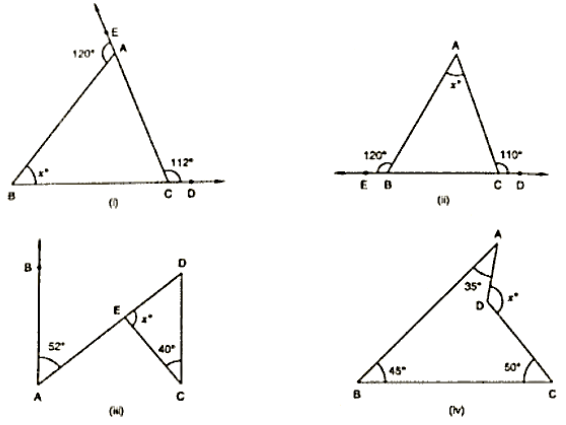
Compute the value of x in each of the following figures
Solution:
(i) From the given figure, we can say that:
∠ACD + ∠ACB = 180° (Linear pair)
Or,
∠ACB = 180°– 112° = 68°
We can also say that:
∠BAE + ∠BAC = 180° (Linear pair)
Or,
∠BAC = 180°– 120° = 60°
We know that the sum of all angles of a triangle is 180°.
Therefore, for ∆ABC:
x + ∠BAC + ∠ACB = 180°
x = 180°– 60°– 68° = 52°
= x = 52°
(ii) From the given figure, we can say that:
∠ABC + 120° = 180° (Linear pair)
∠ABC = 60°
We can also say that:
∠ACB+ 110° = 180° (Linear pair)
∠ACB = 70°
We know that the sum of all angles of a triangle is 180°.
Therefore, for ∆ABC:
x + ∠ABC + ∠ACB = 180°
x = 50°
(iii) From the given figure, we can see that:
∠BAD = ∠ADC = 52° (Alternate angles)
We know that the sum of all the angles of a triangle is 180°.
Therefore, for ∆DEC:
x + 40°+ 52° = 180°
= x = 88°
(iv) In the given figure, we have a quadrilateral whose sum of all angles is 360°.
Thus,
35° + 45° + 50° + reflex ∠ADC = 360°
Or,
reflex ∠ADC = 230°
230° + x = 360° (A complete angle)
= x = 130°
View courses by askIITians


Design classes One-on-One in your own way with Top IITians/Medical Professionals
Click Here Know More

Complete Self Study Package designed by Industry Leading Experts
Click Here Know More

Live 1-1 coding classes to unleash the Creator in your Child
Click Here Know More