Methods of Expressing the Concentration of a Solution
The concentration of a solution can be expresses in a number of ways. The important methods are:
Mass/Weight Percentage or Per cent by Mass/Weight :
It is defined as the amount of solute in grams present in 100 grams of the solution.


-
The ratio mass of solute to the mass of solvent is termed as mass fraction.
-
Thus, Mass percentage of solute = Mass fraction × 100
-
10% solution of sugar by mass means that 10 grams of sugar is present in 100 grams of the solution, i.e., 10 grams of sugar has been dissolved in 90 grams of wat
 er. e
er. e
Example 1: |
|
Question: What is the weight percentage of urea solution in which 10 gm of urea is dissolved in 90 gm water. Solution Weight percentage of urea = (weight of urea/ weight of solution) = 10/(90+10) |
 100
100Volume Percentage
- It is defined as the volume of solute in mL present in 100 mL solution.

-
10% solution of HCl by volume means that 10 mL of liquid HCl is present in 100 mLof the solution.
Mass by Volume Percentage
- It is defined as the mass of solute present in 100 mL of solution.

-
A 10% mass by volume solution means that 10 gm solute is present in 100 mL of solution.
Molarity
- The molarity of a solution gives the number of gram molecules of the solute present in one litre of the solution.

- Thus, if one gram molecule of a solute is present in 1 litre of the solution, the concentration of the solution is said to be one molar.
- Units of molarity: mol L-1
Molarity of dilution:
Before dilution After dilution
M1V1 = M2V2
Molarity of mixing:
Let there be three samples of solution (containing same solvent and solute) with their molarity M1, M2, M3 and volumes V1, V2, V3 respectively. These solutions are mixed; molarity of mixed solution may be given as:
M1V1 + M2V2 + M3V3 = MR(V1 + V2 + V3)
Where MR = resultant molarity
V1 + V2 + V3 = resultant molarity
|
Molarity is dependent on volume; therefore, it depends on temperature. |
-
1 M → Molar solution, i.e., molarity is 1
-
0.5 M or M/2 → Semimolar
-
0.1 M or M/10 → Decimolar
-
0.01 M or M/100 → Centimolar
-
0.001 M or M/1000 → Millimolar
Example 2: |
|
Question: 3.65 gm of HCL gas is present in 100 mL of its aqueous solution.What is the molarity? Solution Molarity = |
 = (3.65/36.5)
Molality
-
Molality of a solution is defined as the number of moles of solute dissolved in 1 Kg of the solvent.

-
Thus, if one gram molecule of a solute is present in 1 kg of the solvent, the concentration of the solution is said to be one molal.
-
Units of molarity: mol kg-1???
-
Molality is the most convenient method to express the concentration because it involves the mass of liquids rather than their volumes. It is also independent of the variation in temperature.
-
Molality and solubity are related by the following relation.
Molality = Solubility×10/Molecular mass of the solute
[Solubility = Mass of solute in grams/Mass of solvent in grams × 100]
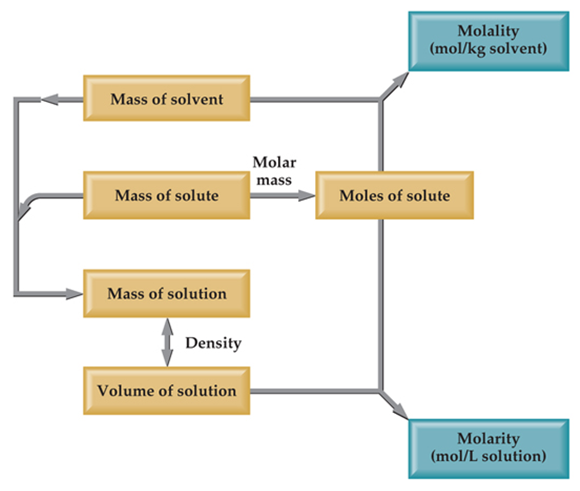
Relationship Between Molality and Molarity: |
|
Let the density of the solution be d. Unit= g mL−1 Mass of solution = V × d Mass of solute = number of moles × molecular mass of solute = n mA Mass of solvent, W = mass of solution – mass of solute = V × d – n × mA Thus,
Where mA is molecular mass of solvent. |


?
Example 3: |
|
Question: The density of a 3M sodium thiosulphate solution is 1.25 gm cm–3. Calculate i) the molalities of Na+ and S2O32– ions ii) percentage of weight of solution Solution 3 M Na2S2O3 (Sodium thiosulphate) solution means 3 moles Na2S2O3 is present in 1 L or, 1000 ml solution Wt. of solute Na2S2O3 = 3×158 wt. of solution = v × d = 1000 ml × 1.25 gm/ml = 1000 × 1.25 gm Wt. of solvent = (1000 × 1.25 – 3 ×158) gm H2O Molality = no. of moles of solute per 1000 gm solvent
= 3.865 mol kg–1 solvent Now, Na2S2O3 2Na+ +S2O3- a) Hence molality of Na+ = 2 ×3.865 mol kg-1 = 7.73 mol kg–1 Hence molality = 1× 3.865 mol kg–1 = 3.865 mole/kg b) % of wt. of solution 1 L i.e. 1000 ml solution containing 3 moles Na2S2O3 1000 × 1.25 gm solution containing 3 ×158 gm Na2S2O3
= 37.92% |


Normality:
-
The normality of a solution gives the number of gram equivalents of the solute present in one litre of the solution.
 ?
?
|
Number of gram equivalent of solute = Mass of solute in gram/ equivalent weight of solute Equivalent weight of solute (E) = Molar mass of solute/ Valence factor
|
- Thus, if one gram equivalent of a solute is present in one litre of the solution, the concentration of the solution is said to be one normal.
-
1N = Normal = One gram equivalent of the solute per litre of solution = Normality is 1
-
N/2 = Seminormal = 0.5 g equivalent of the solute per litre of solution = Normality is 0.5
-
N/10 = Decinormal = 0.1 g equivalent of the solute per litre of solution = Normality is 0.1
-
N/100 = Centinormal = 0.01 g equivalent of the solute per litre of solution = Normality is 0.01
-
N/1000 = Millinormal = 0.001 g equivalent of the solute per litre of solution = Normality is 0.001
Relationship between normality and molarity: |
|
We know that Molarity × Molecular mass = Strength of solution (g/L) Similarly, Normality × Equivalent mass = Normality of the solution (g/L) Hence, Molarity × Molecular mass = Normality × Equivalent mass So, Normality = n × Molarity __________________________________________ Let ‘d’ is the density of solution in g/mL and x is the percentage of the solute by mass. Then,
|

Mole Fraction
-
The mole fraction of any component in a solution is the ratio of the number of moles of that component to the total number of moles of all components .
-
Total mole fraction of all the components of any solution is 1.
-
For a binary solution of A and B

Mole Fraction of A (XA) =

Mole Fraction of B (XB) =

And, XA+XB = 1
Relation between mole fraction and Molality: |
|
XA = n/N+n and XB = N/N+n XA/XB = n/N = Moles of solute/Moles of solvent = wA/mB/wB×mA XA×1000/XB×mB = wA×1000/wB×mA = m or
|

Refer to the Following Video for Molarity, Molality and Mole Fraction
Parts per million (ppm):
-
When a solute is present in trace quantities, it is convenient to express concentration in parts per million (ppm)

-
In case of mass it may be expressed as : (Mass of solute/Mass of solution )× 106
-
In case of volume it may be expressed as: (Volume of solute/Volume of solution) × 106
-
So, concentration in parts per million can be expressed as mass to mass, volume to volume and mass to volume form.
-
Atmospheric pollution in cities is also expressed in ppm by volume. It refers to the volume of the pollutant in 106 units of volume. 10 ppm of SO2 in air means 10 mL of SO2 is present in 106 mL of air.
Formality
It is the number of formula mass in grams present per litre of solution. In case formula mass is equal to molecular mass, formality is equal to molarity. Like molarity and normality, the formality is also dependent on temperature. It is used for ionic compounds in which there is no existence of molecule. Mole of ionic compounds is called formole and molarity as formality.


Where,
w = weight of solute,
f = formula weight of solute
V= volume of solution
nf = no. of gram formula weight

Example 3: |
|
Question: CH3COOH exists as dimer in benzene. 1.2 gm of the acid was dissolved and the volume was made up to one litre using benzene. What is the formality? Solution Molar mass of CH3COOH = 60 Formula weight of the associated molecule of the acid = 2 Weight of CH3COOH = 1.2 gm Volume of solution = 1 L Formality = 1.2/120 |

Question 1: How much water would be present in 100 mL of 20% aqueous solution of sugar by volume?
a. 20 mL
b. 80 mL
c. 90 mL
d. 100 mL
Question 2: What would be concentration of the solution formed by adding two moles of solute in 1 kg water?
a. 2 M
b. 2 m
c. 20 M
d. 20 m
Question 3: What will be mole fraction of solute of a binary solution if that of its solvent is 0.2?
a. 0.8
b. 0.1
c. 0.7
d. 1.0
Question 4: Unit of molarity is
a. mol L-1
b.mol kg-1
c. mol-1 L
d. mol-1 kg

|
Q.1 |
Q.2 |
Q.3 |
Q.4 |
|
b |
b |
a |
a |
Related Resources
-
Click here to go through Syllabus of IIT JEE,
-
Look here for Reference books of Chemistry
-
You can also refer Solutions
To read more, Buy study materials of Solutions comprising study notes, revision notes, video lectures, previous year solved questions etc. Also browse for more study materials on Chemistry here.
View courses by askIITians


Design classes One-on-One in your own way with Top IITians/Medical Professionals
Click Here Know More

Complete Self Study Package designed by Industry Leading Experts
Click Here Know More

Live 1-1 coding classes to unleash the Creator in your Child
Click Here Know More