REFLECTION AT SPHERICAL MIRRORS
Light rays and beams
A ray of light is the direction along which the light energy travels. In practice a ray has a finite width and is represented in diagrams as straight lines. A beam of light is a collection of rays. A search light emits a parallel beam of light as shown in figure (a). Light from a lamp travels in all directions which is a divergent beam as shown in figure (b). A convex lens produces a convergent beam of light, when a parallel beam falls on it as shown in figure (c).

Reflection of light
Highly polished metal surfaces reflect about 80% to 90% of the light incident on them. Mirrors in everyday use are therefore usually made of depositing silver on the backside of the glass. The largest reflector in the world is a curved mirror nearly 5 metres across, whose front surface is coated with aluminium. It is the hale Telescope on the top of Mount Palomar, California, U.S.A. Glass by itself, will also reflect light, but the percentage is small when compared with the case of silvered surface. It is about 5% for an air-glass surface.
Laws of reflection
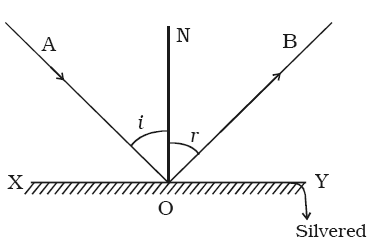
Consider a ray of light, AO, incident on a plane mirror XY at O. It is reflected along OB. Let the normal ON is drawn at the point of incidence. The angle AON between the incident ray and the normal is called angle of incidence, i (as shown in figure) the angle BON between the reflected ray and the normal is called angle of reflection, r. Experiments show that :
(i) The incident ray, the reflected ray and the normal drawn to the reflecting surface at the point of incidence, all lie in the same plane.
(ii) The angle of incidence is equal to the angle of reflection. (i.e) i = r.
These are called the laws of reflection.
Deviation of light by plane mirror
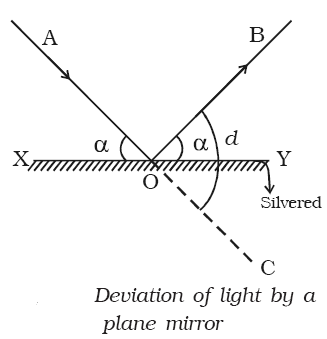
Consider a ray of light, AO, incident on a plane mirror XY (as shown in figure) at O. It is reflected along OB. The angle AOX made by AO with XY is known as the glancing angle α with the mirror. Since the angle of reflection is equal to the angle of incidence, the glancing angle BOY made by the reflected ray OB with the mirror is also equal to α.
The light has been deviated from a direction AO to a direction OB. Since angle COY = angle AOX, it follows that angle of deviation, d = 2α.
So, in general, the angle of deviation of a ray by a plane mirror or a plane surface is twice the glancing angle.
Deviation of light due to rotation of a mirror.
Let us consider a ray of light AO incident on a plane mirror XY at O. It is reflected along OB. Let α be the glancing angle with XY (as shown in figure). We know that the angle of deviation COB = 2α.
Suppose the mirror is rotated through an angle θ to a position X′Y′.
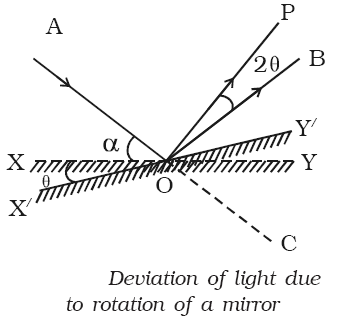
The same incident ray AO is now reflected along OP. Here the glancing angle with X′Y′ is (α + θ). Hence the new angle of deviation COP = 2 (α + θ). The reflected ray has thus been rotated through an angle BOP when the mirror is rotated through an angle θ.
∠BOP = ∠COP – ∠COB
∠BOP = 2 (α + θ) – 2α = 2θ
For the same incident ray, when the mirror is rotated through an angle, the reflected ray is rotated through twice the angle.
Image in a plane mirror
?Let us consider a point object A placed in front of a plane mirror M as shown in the figure. Consider a
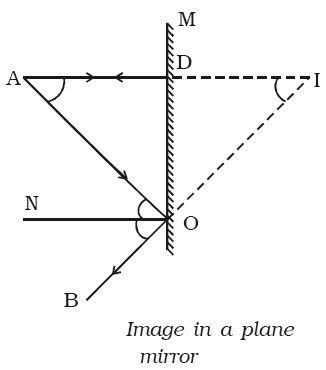
ray of light AO from the point object incident on the mirror and reflected along OB. Draw the normal ON to the mirror at O.
The angle of incidence AON = angle of reflection BON.
Another ray AD incident normally on the mirror at D is reflected back along DA. When BO and AD are produced backwards, they meet at I. Thus the rays reflected from M appear to come from a point I behind the mirror.
From the figure,
∠AON = ∠DAO, alternate angles and ∠BON = ∠DIO, corresponding angles it follows that ∠DAO = ∠DIO
The triangles ODA and ODI are congruent
Thus, AD = ID
For a given position of the object, A and D are fixed points. Since AD = ID, the point I is also fixed. It should be noted that AO = OI. So the object and its image in a plane mirror are at equal perpendicular distances from the mirror.
Virtual and real images
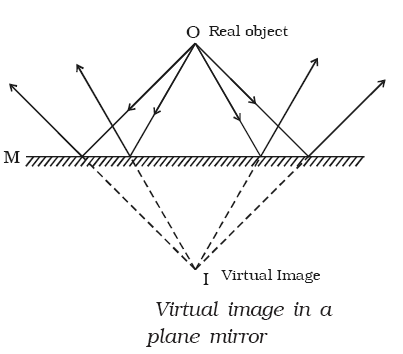
An object placed in front of a plane mirror has an image behind the mirror. The rays reflected from the mirror do not actually meet through I, but only appear to meet M and the image cannot be received on the screen, because the image is behind the mirror. This type of image is called an unreal or virtual image (as shown in the figure).
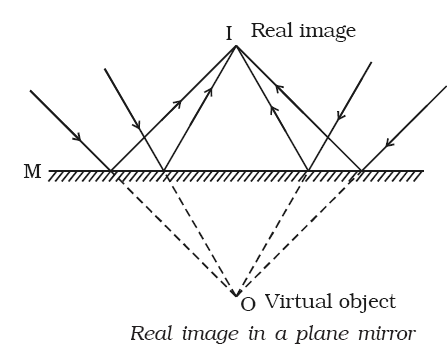
If a convergent beam is incident on a plane mirror, the reflected rays pass through a point I in front of M, as shown in the figure. In the figure, a real object (divergent beam) gives rise to a virtual image. In the figure, a virtual object (convergent beam) gives a real image. Hence plane mirrors not only produce virtual images for real objects but also produce real images for virtual objects.
(a) Characteristics of the image formed by a plane mirror
(a) Image formed by a plane mirror is as far behind the mirror as the object is in front of it and it is always virtual.
(b) The image produced is laterally inverted.
(c) The minimum size of the mirror required to see the complete image of the object is half the size of the object.
(d) If the mirror turns by an angle θ, the reflected ray turns through an angle 2θ.
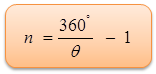
(e) If an object is placed between two plane mirrors inclined at an
(f) angle θ, then the number of images formed is,
Refer this video to know more about on critical angle and total internal reflection
Problem (JEE Main):
When an object is at distance x and y from a lens, a real image and a vertical image is formed respectively having same magnification. The focal length of the lens is
(a) (x+y)/2 (b) x – y
(c) √xy (d) x+y
Solution:
The given lens is a convex lens. Let the magnification be m, then for real image
(1/mx) + (1/x) = 1/f …... (1)
and for virtual image [1/(-my)] + [1/y] = 1/f …... (2)
From Equ.(1) and Equ. (2), we get,
f = (x+y)/2
Thus from the above observation, we conclude that, option (a) is correct.
|
|




Question 1
The centre of the sphere of which the spherical mirror forms a part is called ____________.
(a) centre of curvature
(b) focus
(c) pole
(d) vertex
Question 2
A converging mirror is known as ________.
(a) convex mirror
(b) plane mirror
(c) concave mirror
(d) cylindrical mirror
Question 3
If the image formed by a concave mirror is virtual, erect and magnified, then the object is placed __________.
(a) between the pole of the mirror and the focus
(b) beyond the centre of curvature
(c) at the centre of curvature
(d) at the focus
Question 4
An object placed 2m from a plane mirror is shifted by 0.5 m away from the mirror. What is the distance between the object and its image?
(a) 1.2 m
(b) 1.5 m
(c) 5 m
(d) 3 m
Question 5
Name the type of image that can be obtained on a screen.
(a) Virtual (b) Real
(c) Diverging (d) Converging


| Q.1 | Q.2 | Q.3 | Q.4 | Q.5 |
|
a |
c |
a |
c |
b |
Related Resources:-
-
You might like to critical angle and total internal reflection.
-
For getting an idea of the type of questions asked, refer the Previous Year Question Papers.
-
Click here to refer the most Useful Books of Physics.
-
To get answer to any question related to reflection at spherical mirrors click here.
To read more, Buy study materials of Ray Optics and Optical Instruments comprising study notes, revision notes, video lectures, previous year solved questions etc. Also browse for more study materials on Physics here.