Forces between Multiple Charges
Table of Content |
Forces between Multiple Charges
With the help of Coulomb’s Law, we can easily find out the mutual force of attraction/ repulsion between two charges easily. But the arising question is what to do when we have to deal with more than two charges? Suppose in a system there are ‘n’ charges namely q1, q2, q3…qn and we are asked to find force on q1 due to other charges q2, q3….. qn. Can we use Coulomb’s Law in this case? The answer is partial yes because we know a limitation of coulomb’s law is it can’t be used directly to find force between multiple charges.
So in order to calculate force due to multiple charges, we will use Coulomb’s law with a different approach. Since force is a vector quantity, it has both direction and magnitude; it can’t be added like scalars. Addition and subtraction of vector quantity are a quite different from those of scalar quantities. Suppose mass of body A is 5 kg and mass of body B is 10 kg, then the total mass of A and B, that is, addition of A and B will yield 15 kg as the final result. Scalars involve simple algebraic additions.
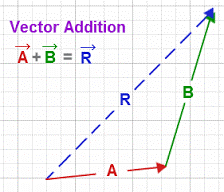
Image 1: Rule of vector addition
Now let’s say there are two vectors, namely A and B, with magnitude 3 and 4 and direction in the x- direction and y-direction. Mathematically
A = 3 i
B = 4 j
Then vector sum of vector quantities A and B will be adding squares of A and B and square rooting the sum of both the squares, that is 32 + 42 = 25, and the square root of 25 is 5. So the conclusion is the vector sum of vectors A and B is 5.
So, to calculate the force between multiple charges, we can do the vector addition of all forces acting on a specific charge by other charges in a system.
Principle of Superposition
It has been experimentally verified that force on any charge due to a number of other charges is the vector sum of all the forces on that charge due to other charges are taken at a time. The individual forces remain unaffected due to other charges presence. This method is called the principle of superposition.
The principal of superposition relies on Coulomb’s statement ‘like charges repel each other and unlike charges attract each other” and can be used to find the force on any charge in a system of multiple charges.
To better understand what principle of superposition is, consider a system having charges q1, q2, q3 and q4, and we have to find the force on q1, due to other remaining three charges.
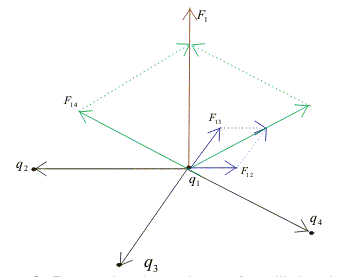
Image 2: Force due to system of multiple charges
From the figure, we can see that charge q1 , faces three repulsive forces from q2 , q3 and q4 respectively. Let the force on charge q1, due to charge q2 be F12, the force on charge q1 due to charge q3 be F13 and force on charge q1 due to charge q4 be F14. And the distance between charge q1 and q2 is r12, the distance between charge q1 and q2, and the distance between charge q1 and q4 is r14.
The resultant force F will be the vector sum of F12 , F13 and F14. Mathematically
F = F12 + F13 + F14
where
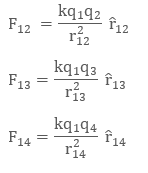
Then total force on charge q1 due to other charges will be
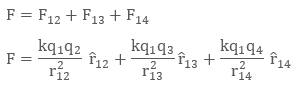
Similarly, if there are ‘n’ charges in a system namely q1, q2 , q3 ……. qn then force q1 due to other charges will be given as:
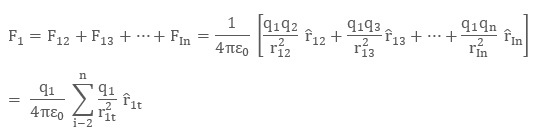

Image 3: Finding net force on a specific charge if multiple charges are present in a system
Example:
Four equal charges q are kept on corners of a square, find net force on one of the charge. The side of square is ‘r’
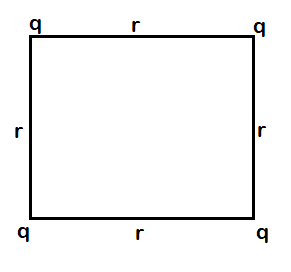
Image 4: Four charges placed at corners of the square
In this problem we have four equal charges ‘q’ and distance between them is r.
Now we will take individual repulsive forces on the corner charge q and make a vector diagram and note down the forces, which as:
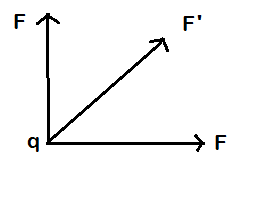
Image 5: Vector Diagram
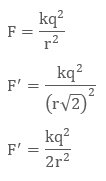
(Force due to opposite corner charge q, which r √2 apart)
Let the resultant force on charge q be Fnet , then mathematically Fnet will be the vector sum of F, F, and F’.
Fnet = F + F + F’
The vector sum of F and F will be √2 F, then Fnet
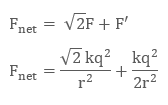
General Algorithm to solve problems involving multiple charges
To make complex physics problem simple, we can follow a general algorithm:
-
Understand the question, analyze on which charge we have to find the net force
-
Make a vector diagram of all forces being repulsive/ attractive acting on the charge
-
Solve the vector diagram using vector addition
Watch this Video for more reference
More Readings
View courses by askIITians


Design classes One-on-One in your own way with Top IITians/Medical Professionals
Click Here Know More

Complete Self Study Package designed by Industry Leading Experts
Click Here Know More

Live 1-1 coding classes to unleash the Creator in your Child
Click Here Know More