BENZENE COMPOUND
For naming aromatic compounds, no special rules are required, but are named substituted benzene.
The benzene ring is considered to be a parent and alkyl groups, halogens and the nitro group are named as prefix to benzene.
|
|
|
|
|
1, 3, 5 – tribromobenzene |
2 – chloro – 4 – nitro aniline |
|
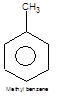

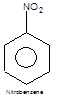

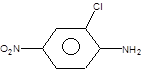
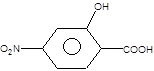
2 – hydroxyl – 4 – nitro – benzoic acid
When a benzene ring is attached to an alkane chain with a functional group or to an aklane chain of two or more carbon atoms, then benzene is considered as a substituent (phenyl) instead of a parent.
|
|
|
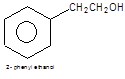
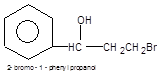
When more than one group is present on benzene ring then following prefix are giving to certain organic compound.
|
|
2 & 6 = Ortho or ‘o’ 3 & 5 = Meta or ‘m’ 4 = Para or ‘p’ With respect to G. |

|
|
|
|


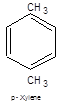
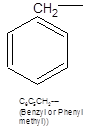
The following names are given to certain aromatic hydrocarbon residues formed by the loss of one or more hydrogen atoms from the parent hydrocarbon.
|
|
|
|
|
|
|
|


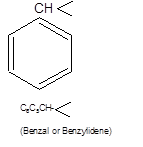
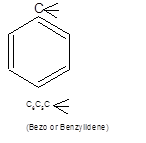
ALICYCLIC (CYCLIC COMPOUNDS)
IUPAC name-cycloalkane (saturated), cyclo alkene, cyclo alkyne (unsaturated)……………….
Examples:
|
|
|
|
|
|
|
|

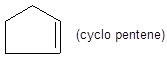
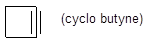
Note:
Naming of cyclic compounds containing functional group – same as open chain compound.
 Exercise 6.
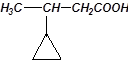
Write the IUPAC name of compounds
|
(i) |
|
(ii) |
|

BOND CLEAVAGE
Organic reactions take place through the formation of reactive intermediates. These intermediates are formed due to cleavage of covalent bonds. These intermediates can be
(i) free radicals like 
(ii) carbocation like 
(iii) carbanion like 
Homolytic (symmetrical) cleavage
In which the two electrons shared in a s bond become unpaired as the bond is broken.
|
|
|
|


The species formed are called free radicals
(i) They are electrically neutral.
(ii) They are extremely reactive.
Their stability is in the order of
|
|
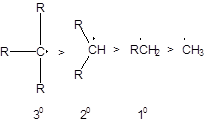
Benzylic and allylic free radicals are resonance stabilized hence are more stable than alkyl free radicals.
|
|
|
|


Thus greater the stability easier will be formation of the species. (Methyl radical) is
sp2 – hydridized (bearing three  C¾H bonds and singly occupied p – orbital) with HCH angle 1200 and three C ¾ H bonds coplanar. Thus when a methyl radical is formed in the homolytic cleavage of CH3 ¾ X bond, the carbon undergoes a geometric change from tetrahedral to planar and rehybridisation from sp3 to sp2.
Heterolytic (unsymmetrical) cleavage
When a covalent bond joining two atoms A and B breaks in such a way that both the electrons of the covalent bond (i.e. shared pair) are taken away by one of the bonded atoms, the mode of bond cleavage is called heterolytic cleavage. Heterolytic cleavage is usually indicated by a curved arrow which denotes a two electron displacement. For example
|
|
|
|
 (When B is more electronegative than A)
 (When A is more electronegative than B)
As shown above heterolytic fission results in the formation of charged species, i.e. cations and anions. It usually occurs in polar covalent bonds and is favoured by polar solvents.
In the formation of carbocation, we also find that sp3 hybridised carbon (in CH3 ¾X) changes to sp2 hybridised carbon.
An organic ion with a pair of available electrons and a negative charge on the central carbon atom is called carbanion and stability is in order
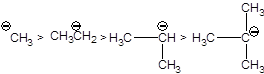
Electron attracting group (¾CN, > C = O) increases stability and electron – releasing group
(¾ CH3 etc) decreases stability of carbanion.
Benzyl carbanion is again stabilized by resonance.
|
|

 Exercise 7.
The greater the s-character in an orbital the ------------ is its energy
(A) Greater (B) Lower
(C) Both (D) None
REACTION INTERMEDIATES
Most of organic reactions occurs through the involvement of certain chemical species. These are generally short lived (10-6 seconds to a few seconds) and highly reactive and hence can not be isolated. These short lived highly reactive chemical species. Through which the majority of the organic reactions occur are called reactive intermediates. These intermediates are detected by spectroscopic methods or trapped chemically or their presence is confirmed by indirect evidence. On the other hand, synthetic intermediate are stable products which are prepared isolated and purified and subsequently used as starting materials in a synthetic sequence.
Carbocations (Earlier Called As Carbonium Ions)
Carbocations are the key intermediates in several reactions and particularly in nucleophilic substitution reactions and electrophilic addition reaction.
(a) Structure:
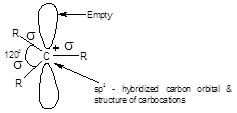
Generally in the carbocations the positively charged carbon atom is bonded to three others atoms and has no nonbonding electrons. It is sp2 hybridized with a planer structure and bond angles are of about 1200. There is a vacant unhybridised p orbital which (e.g in the case of  lies perpendicular to the plane of C ¾ H bonds.
|
|
(b) Stability:
There is an increase in carbocation stability with additional alkyl substitution. Thus one finds that addition of HX to three typical olefins decreases in the order
(CH3)2C = CH2 > CH3 ¾ CH = CH2 > CH2 = CH2
This is due to the relative stabilities of the carbocations formed in the rate determining step which in turn follows from the fact that the stability is increased by the electron releasing methyl group (+I), three such groups being more effective than two, and two more effective than one.
|
|
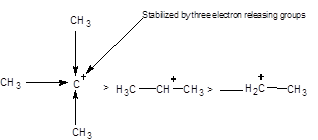
Stability of carbocations 30 > 20 > 10 > 
Electron release: Disperses charge, stabilizasion.
Further, any structural feature which tends to reduce the electron deficiency at the tricoordinate carbon stabilizes the carbocation. Thus when the positive carbon is in conjugation with a double bond. The stability is more. This is so, due to resonance the positive charge is spread over two atoms instead of being concentrated only on one. This explains the stability associated with the allylic cations. The benzylic cations are stable, since one can draw canonical forms as for allylic.
|
|

The benzyl cation stability is affected by the presence of substituents on the ring. Electron donating p – methoxy and p – amino group stabilize. The carbocation by 14 and 26 kcal/mole, respectively. The electron withdrawing groups like e.g, p – nitro destabilize by 20 kcal/mol.
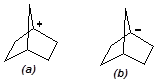
A heteroatom with an unshared pair of electrons when present adjacent to the cationic centre strongly stabilizes the carbocation. The methoxy methyl cation has been obtained as a stable solid 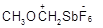 cylopropylmethyl cations are even more stable than the benzyl cations. This special stability is a result of conjugation between the bent orbitals of the cyclopropyl ring and the vacant p orbital of the cationic carbon. The carbocations are planar is shown by the fact these are difficult or impossible to form at bridgeheads, where they can not be planar.
The stability order of carbocation is explained by hyperconjugation. In vinyl cations , resonance stability lacks completely and therefore are very much less stable.
Stability µ hyperconjugated structures µ number of a hydrogen.
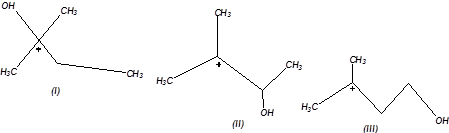
 Exercise 8.
Which of the following carbocations is most stable?
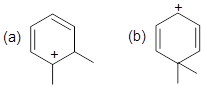
 Exercise 9.
Which of the following C – Cl bond is weaker.
(a) Ph – – CH3 (b) Ph – CH2 – CH2 – Cl

Exercise 10.
Arrange the following in the increasing order of C – Br bond energy.
(a) CH3 – CH2 – CH3
(b) CH3 – – CH2 – CH2 – CH3
(c) CH3 – CH2 – CH2 – CH2 – CH2 – Br
(d) CH2 = CH – Br
(e) Ph – CH2 – Br

Exercise 11.
Which of the following C – I bond is weak and why?
(i) CH3 – O – CH2 – I
(ii) CH3 – – CH2 – I
Carbanions
Chemical species bearing a negative charge on carbon and possessing eight electrons in its valence shell are called carbonions. These are produced by heterolylic cleavage of covalent bonds in which the shared pair of electrons remain with the carbon atom.
(a) Structure:
A carbanion posses an unshared pair of electron and thus represents a base. The best likely description is that the central carbon atom is sp3 hybridized with the unshared pair occupying one apex of the tetrahedron. Carbonions would thus have pyramidal structures similar to those of amines. It is believed that carbanions undergo a rapid interconversion between two pyramidal forms.
There is evidence for the sp3 nature of the central carbon and for its tetrahedral structure.
At bridgeheads carbon does not undergo reaction in which it is converted to a carbocation. However, the reactions which involve carbanions at such centre take place with ease, and stable bridgehead carbanion are known. In case this structure is correct and if all three R groups on a carbanion are different, the carbanion should give retention of configuration. However, this never happens and has been explained due to an umbrella effect as in amines. Thus the unshared pair and the central carbon rapidly oscillate from one side of the plane to the other.
(b) Stability and Generation:
The Grignard regent is the best known member of a broad class of substances, called organometallic compounds where carbon is bonded to a metal lithium, potassium sodium, zinc, mercury, lead, thallium almost any metal known. Whatever the metal it is less electronegative than carbon and the carbon metal bond like the one in the Grignard reagent is highly polar. Although the organic group is not a full fledged carbanion an anion in which carbon carries negative charge, it however, has carbanion character organometallic compounds can serve as a source form which carbon is readily transferred with its electrons. On treatment with a metal, in RX the direction of the original dipole moment is reversed (reverse polarization)
|
|
|
|
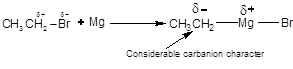
 Also acetylide ion
(c) Properties:
carbanions are nucleophilic and basic and in this behaviour these are similar to amines, since the carbanion has a negative charge on its carbon, to make it a powerful base and a stronger nucleophile than an amine. Consequently is enough basic to remove a proton from ammonia.
Illustration 4. Identify the stable carbanion in each pair
(a) CH3 – CH2 – CH2– and CH3 – – CH3
– CH3
(b)  –
– – CH3 and – CH2 –– H
(c) Ph – CH2– and Ph – CH2 – CH2–
Solution: (a) CH3 – CH2 – CH2– (because of inductive effect)
(b) –– CH3 (because of mesomeric effect)
(c) Ph – CH2– (because of resonance)
Free Radicals
A free radical is a species which has one or more unpaired electrons. In the species where all electrons are paired the total magnetic moment is zero. In radicals, however, since there are one or more unpaired electrons. There is a net magnetic moment and the radicals as a result are paramagnetic. Free radicals are usually defected by electron spin resonance, which is also termed electron paramagnetic resonance.
Simple alkyl radicals have a planar (trigonal) structure i.e., these have sp2 bonding with the odd electron in a p orbital. The pyramidal structure is another possibility when the bonding may be sp3 and the odd electron is in an sp3 orbital. The planar structure is in keeping with loss of activity when a free radical is generated at a chiral centre. Thus, a planar radical will be attacked at either face after its formation with equal probability to give enantiomers unlike carbocations, the free radicals can be generated at bridge. This shows that pyramidal geometry for radicals is also possible and that free radicals need to be planar
|
|
Pyramidal structure |
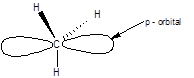
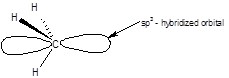
Stability
As in the case of carbocation, the stability of free radicals is tertiary > secondary > primary and is explained on the basis of hyperconjugation. The stabilizing effects in allylic radicals and benzyl radicals is due to vinyl and phenyl groups in terms of resonance structures. Bond dissociation energies shows that 19 kcal/mol less energy is needed to form the benzyl radicals from toluene than the formation of methyl radical from methane. The triphenyl methyl type radicals are no doubt stalbilized by resonance, however the major cause of their stability is the steric hindrance to dimerization..
|
|
DH = +85 kcal |
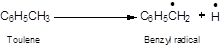
Ease of formation of alkyl free radicals, benzyl > 30 > 20 > 10 > > Vinyl
Illustration 5: Alkenes undergo electrophilic addition reaction and benzene undergoes electrophilic substitution whereas both proceeds through carbocation intermediate. Explain.
Solution: p electrons are available in case of alkanes whereas they are delocalized in case of benzene. After attack of electrophile a stable delocalized carboncation is formed on benzene ring. Whereas a carbocation which can rearrange is formed by addition of electrophile on alkane.
Exercise 12.
Which of the following statement is correct?
(A) Allyl carbonium ion (CH2=CH– ) is more stable than propyl carbonium ion
(B) Propyl carbonium ion is more stable than allyl carbonium ion
(C) Both are equally stable
(D) None
ELECTRONIC DISPLACEMENT IN COVALENT BONDS
The following four types of electronic effects operates in covalent bonds
(i) Inductive effect (ii) Electromeric effect
(iii) Resonance and mesomeric effect (iv) Hyperconjugation
Inductive Effect (Polar Nature Of Covalent Bonds)
The displacement of an electron (shared) pair along the carbon chain due to the presence of an electron withdrawing or electron releasing groups in the carbon chain is known as inductive effect (I – effect).
n It is a permanent effect which is transmitted along the chain.
C……> ……C…>….C……>G (G – Functional group)
n This permanent polarity is due to electron displacement due to difference in electronegativities.
n This effect weakens steadily with increasing distance from the substitution
(electron – withdrawing or electron – donating group) and actually diminishes down after three carbon atoms.
There are two types of inductive effect i.e. – I effect and +I effect.
Negative Inductive effect (¾ I Effect)
If the substituent attached to the end of the carbon chain is electron withdrawing (X). The effect is called – I effect.

¾I effect decreases as one goes away from groups (electron attacking)

C1(d+) > C2(dd+) > C3 (ddd+) and other third carbon charge is negligible.
¾I effect is in order.
NO2 > F > COOH > Cl > Br > I > OH > C6H5
Due to ¾I effect (electron – with drawing nature) electron density decreases, hence basic nature is decreased and acidic nature is increased.
Chloroacetic acid is stronger than acetic acid since Cl shows (-I) effect, electron – density is decreased and O – H bond is weakens causing ionisation of (-COOH) to a greater extent than 

 is a base due to lone pair on nitrogen. Phenyl group is electron – withdrawing. What happens to electron – density of nitrogen in aniline, Naturally electron – density is decreased. Hence aniline is weaker base than.
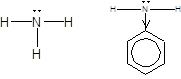
Similarly acidic nature of phenol is greater than  due to electron – withdrawing nature of phenyl group.
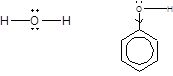
Positive inductive effect (+I effect):
If the substituent attached to the end of the carbon chain is electron – donating, the effect is called +I effect.
This is due to electron – releasing (Y). It develops a negative charge on the chain.

+I effect also decreases as we go away from group Y (electron – releasing)


So +I effect is in the order of

Due to electron – releasing group electron density is increased, hence basic nature is also increased and naturally acidic nature is decreased, thus
|
|
-I effect |
+I effect |
|
Acidic Nature |
|
|
|
Basic Nature |
|
|


Note:
Inductive effect is a permanent effect operating in the ground state of the organic molecules and hence is responsible for high melting point, boiling point and dipole moment of polar compounds.
Illustration 7. Take the following isomerica,b, g chlorobutyric acid
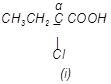

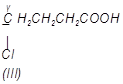
Arrange the acids increasing order of acid strength.
Solution: As we have stated, as we go away from the source, electron - withdrawing tendency decreases, hence acidic nature also decrease. Thus
(III) < (II) < (I)
Illustration 8. Which of the following carbonyl compound is more acidic?
(a) CH3 –– CH3 (b) CH3 –– H
Solution. (b) The acidity of a-hydrogen depends on +ve charge on the carbon atom to which it is attached. In an aldehyde the carbonyl carbon has more positive charge and hence more –I effect.
Illustration 9. CH3CO2H is a stronger acid than CH3CH2 – OH. Explain
Solution: CH3 – CO2H ¾® CH3 –– O– + H+
CH3 – CH2 – OH ¾®CH3 – CH2 – O– + H+
In EtO– the negative charge on O atom is increased by +I effect, whereas in CH3CO2–, the negative charge on O atom is decreased by delocalisation. Lesser the charge density on negatively charged atom, weaker is the base.
Electromeric Effect
In presence of an attacking reagent, there is complete transfer of  electrons from one atom to other to produce temporary polarity on atoms joined by multiple bonds, it is called Electromeric effect.

This effect is temporary and takes place only in the presence of a reagent. As soon as the reagent is removed, the molecule reverts back to its original position. Electromeric effect is of two types, i.e. 
Positive Electromeric effect (+E effect):
When  electrons transfer takes place C to C (as in alkenes, alkynes etc.), it is called positive electromeric effect (denoted by +


For example, addition of acids to alkenes
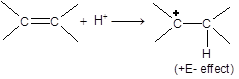
In this, there is also (+I) effect of  group which causes
  to C1. What do you think in the following case:

(+I) effect of  is larger than that of
  electron transfer is from
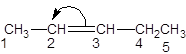
Negative Electromeric effect:
When electrons transfer takes places to more electronegative atom (O, N, S) joined by multiple bonds, it is called Negative Electromeric effect (denoted by -E).
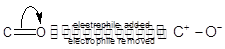
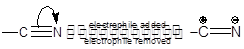
for example, the addition of cyanide ion to the carbonyl group.
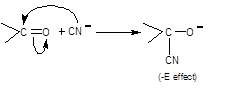
Resonance & Mesomeric Effect
There are many organic molecules which can not be represented by a single lewis structure. In turn, they are assigned more than one structure called canonical forms or contributing of resonating structures. The phenomenon exhibited by such compounds is called resonance. For example, 1, 3 – butadiene has following resonance structure.

and canonical forms of vinyl chloride are
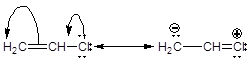
While drawing these canonical forms, the prime thing that has to be kept in mind is that the relative position of any of the atom should not change while we are allowed to change the relative positions of p - bonded electron pair or distribution of charge to other atoms. Also remember that it is not the case that some molecules have one canonical form and some have another form. All the molecules of the substance have the same structure. That structure is always the same all the time and is a weighted average of all the canonical forms. In real sense, these canonical forms have no expect in our imaginations. Now we are in a position to discuss about the conditions necessary for a compound to show resonance. The two essential conditions are
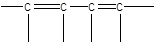
(a) There must be conjugation in the molecule. Conjugation is defined as the presence of alternate double and single bonds in the compound like
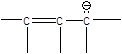
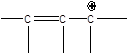
(b) The part of the molecules having conjugation must be essentially planar or nearly planar. The first condition of conjugation is not only confined to the one mentioned above but some other systems are also categorized under conjugation. These are
|
(i) |
|
(ii) |
|
(iii) |
|
|
(iv) |
|
(v) |
|
|
|
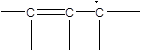
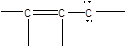
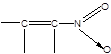
|
So, any molecules satisfying both the conditions will show resonance. For example, we consider phenol. The structure of phenol is
|
|
||
|
By looking at the structure, it must be clear to you that the compound possesses conjugation of the type |
|
||
|
|
As well as the category (iv) because the lone pairs on oxygen are in conjugation with unsaturated (sp2 hybridised) carbon of the ring. Since, oxygen atom is sp3 hybridized in phenol. |
|
|

The lone pairs on oxygen are nearly planar with respect to the PZ orbital of carbon linked to oxygen. Thus, both the conditions are fulfilled by phenol, therefore it does show resonance and its resonance structures are represented as
|
|
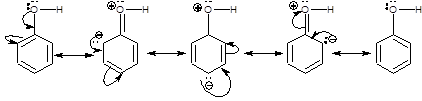
This has to be borne in mind that resonance always results in different distribution of electron density than would be the case if there were no resonance. It is a permanent effect, also referred as mesomeric effect.
Note:
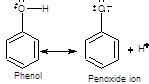
The acidity of phenol can be explained by resonance
|
|
|
|
|
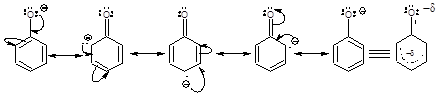
The above structure shows that the phenoxide ion formed is more resonance stabilised than phenol. Hence, the acidity of phenol is explained.
Similarly basicity of aniline can be explained.
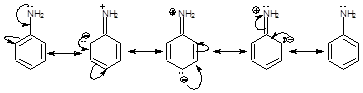
The above structure shows that the lone pair present on N – atom undergoes into resonance and is not available for donation. Hence, the basicity of aniline decreases and is less than aliphatic amine .
.
Resonance (mesomeric) effect is of two types.
(i) If the atom or group of atoms is giving electrons through resonance, it is called +R or +M effect. For example,
|
|
(+M effect of ¾NH2 group) |
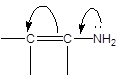
Other groups that shows +M effect are ¾NHR, ¾NR2, ¾OH, ¾OR, ¾NHCOR, ¾Cl, ¾Br, ¾I etc.
(ii) If the atom or group of atoms is withdrawing electrons through resonance, it is called ¾R or ¾M effect. For example,
|
|
(-M effect of ¾NO2 group) |
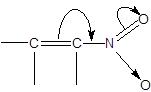
Other groups showing ¾M effect are ¾CN, ¾CHO, ¾COR, ¾CO2H, ¾CO2R, ¾CONH2, ¾SO3H, ¾COCl etc.
Now, let us consider resonance in nitrobenzene and its various canonical structures are
|
|
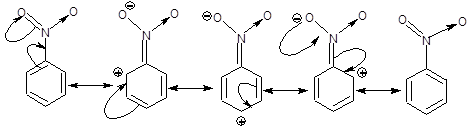
The ¾NO2 group in nitrobenzene has ¾M effect. In general, if any atom (of the group) attached to the carbon of benzene ring bears atleast one lone pair, then the group shows +M effect while if the atom (of the group) linked to the benzene carbon bears either a partial or full positive charge, then the group exhibits ¾M effect.
In drawing the canonical forms and deciding about their relative stabilities, following rules are give for your guidance.
(i) All the canonical forms must be bonafide lewis structures for example, none of them may have a carbon with five bonds.
(ii) All atoms taking part in the resonance must lie in a plane or nearly so. The reason for planarity is to have maximum overlap of the p – orbitals.
(iii) All canonical forms must have the same number of unpaired electrons. Thus
CH2 ¾ CH = CH ¾ CH2 is not a valid canonical form for 1, 3 ¾ butadien.
(iv) The energy of the hybrid (actual) molecule is lower than that of any canonical form. Obviously then, delocalization is a stabilizing phenomenon. The difference in energy between the hybrid and the most stable canonical structure is called resonance energy.
(v) All canonical forms do not contribute equally to the actual molecule. Each form contributes in proportion to its stability, the most stable form contributing the most.
(vi) Structures with more covalent bonds are generally more stable than those with fewer covalent bonds.
(vii) Structure with formal charges is less stable than uncharged structures. For charged structure, the stability is decreased by an increase in charge separation and the structure with two like charges on adjacent atoms are highly unfavourable.
(viii) Structures that carry a negative charge on a more electronegative atom are more stable than those in which the charge is on a less electronegative atom. For example,
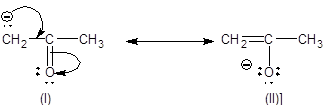
Structure (II) is more stable than (I). Similarly positive charges are best occupied on atoms of low electronegativity
(ix) Those structures in which octet of every atom (expect for hydrogen which have douplet) is complete are more stable than the others with non complete octets. For example,
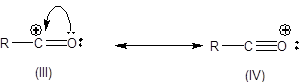
Structure (IV) is more stable than (III).
Resonance Energy:
The difference in energy between the hybrid and the most stable canonical structure is called as resonance energy
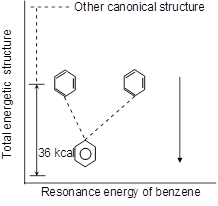
Illustration10. Why guanidine is basic in nature. Explain the site of protonation and provide resonating structures.
|
Solution: |
|

Guanidine behaves as strong base because it can provide electron pair easily resulting in three identical resonating structure. Site of protonation is sp2 hybridised N atom rather than sp3 hybridise N atom resulting in three symmetrical structures.
Illustration 11. Arrange the various resonating structures of formic acid in order of decreasing stability
|
Solution: |
|

Illustration 12. Explain why phenol is acid while aliphatic alcohols are not.
Solution: After loss of H+ ion from OH group of phenol the remaining part (Phenoxide ion) stabilizes by resonance, hence it will favour the loss of H+ ion and hence acidic in nature.
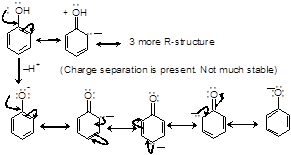
(No charge separation, more stabilization by Resonance)
Illustration 13. Why benzyl carbonium ion is more stable than ethyl carbonium ion
Solution: Due to resonance Benzyl carbonium ion is more stable than Ethyl carbonium ion.
Illustration 14. Among orthochlorophenol and orthofluorophenol, which will be a stronger acid and why?
Solution: The one having a weaker conjugate base will be a stronger acid. If the conjugate base has to be weak, the negative charge has to be delocalised to a larger extent.
In o-chlorophenol

Due to the availability of vacant orbitals in chlorine, the negative charge is delocalised to a larger extent. The same cannot take place in case of F as F does not have vacant orbitals. So, o-chlorophenol, having a weaker conjugate base, becomes a stronger acid.

Exercise 13.
Benzylamine is a stronger base than aniline. Explain.
Exercise 14.
Why is always the resonance effect dominating over the inductive effect?
 Exercise 15.
Unlike other aromatic amines, why is the following amine strongly basic?

Exercise 16.
Arrange the following alcohols in increasing order of acidity.
(a) CH2 = CH – OH
(b) CH3 – CH2 – OH
 Exercise 17.
|
(a) |
Write resonance structure of the given compound. |
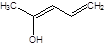
(b) Whether this pairs of compound are tautomers
|
|
|
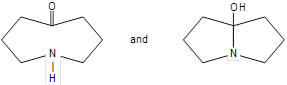
Hyperconjugation
n It is delocalisation of sigma electrons.
n Also known as sigma-pi – conjugation or no bond resonance
n Hyperconjugation is a permanent effect
Occurrence
Alkene, alkynes
Free radicals (saturated type) carbonium ions (saturated type)
Condition
Presence of a–H with respect to double bond, triple bond carbon containing positive charge (in carbonium ion) or unpaired electron (in free radicals)
 Example

Note:
Number of hyperconjugative structures = number of a-Hydrogen. Hence, in above examples structures i,ii,iii,iv are hyperconjugate structures (4-structures).
Effects of hyperconjugation
Bond Length:
|
Like resonance, hyperconjugation also affects bond lengths because during the process the single bond in a compound acquires some double bond character and vice-versa. E.g. C—C bond length in propene is 1.488 Å as compared to 1.334Å in ethylene. |
|
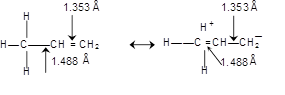
Dipole moment:
Since hyperconjugation causes these development of charges, it also affects the dipole moment of the molecule.
Illustration 15. Arrange the following species in increasing order of dipole moment.
 ,
, 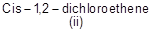 ,
,
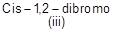 -1, 2-dichloroethene,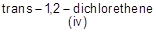
|
Solution: |
|
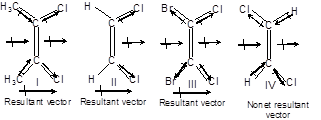
In I, there is addition of vector
In II, there will neither be addition nor subtraction of vector
In III, there is subtraction of vector
In IV, the vectors almost cancel each other. So the increasing order of dipole moment is IV < III < II < I.
Stability of carbonium Ions:
The order of stability of carbonium ions is as follows
Tertiary > Secondary > Primary
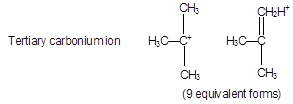
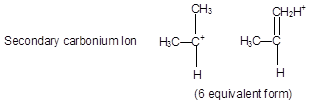
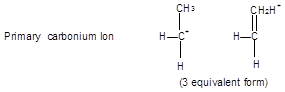
Above order of stability can be explained by hyperconjugation. In general greater the number of hydrogen atoms attached to a-carbon atoms, the more hyperconjugative forms can be written and thus greater will be the stability of carbonium ions.
Stability of Free radicals:
Stability of Free radicals can also be explained as that of carbonium ion

Directive influence of methyl group:
The o,p-directing influence of the methyl group in methyl benzene is attributed partly to inductive and partly to hyperconjugation effect.

(orientation influence of the methyl group due to +I effect )
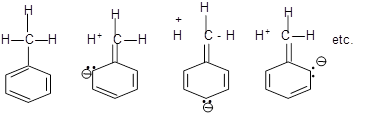
(Orientation influence of methyl group due to hyperconjugation)
The role of hyperconjugation in o,p,-directing influence of methyl group is evidenced by the part that nitration of p-iso propyl toluene and p-tert-butyl toluene from the product in which —NO2 group is introduced in the ortho position with respect to methyl group and not to isopropyl or t-butyl group although the latter groups are more electron donating than Methyl groups
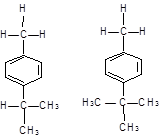
i.e., The substitution takes place contrary to inductive effect. Actually this constitutes an example where hyperconjugation overpowers inductive effect.
Illustration 16. Which among the following is most acidic?
|
(a) |
|
|
(b) |
|
|
(c) |
|
|
(d) |
|
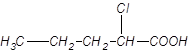
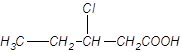
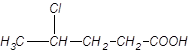

Solution: As the inductive effect of chlorine decreases with distance (a) will be most acidic because the carboxylate ion which results after the loss of H+ can be stabilized by electron withdrawing nature of chlorine (-I effect) which is strongest in (a) where chlorine atom is at a - carbon.
Illustration 17. Which among the following is most basic?
(a) CH3CH2NH2
(b) CH3CH = NH
(c) CH3 ¾ C º N
Solution: (a) is most basic because here nitrogen is sp3 hybridized i.e. p – character is greater than s – character (75% p and 25% s – character), orbital holding lone pair is more elongated than spherical, the hold of nitrogen nucleus over these electrons is less resulting in more basicity.
Illustration 18. Compare the acidic strength of the following
CH3COOH ClCH2COOH Cl2HCCOOH CCl3COOH
|
Solution: |
|
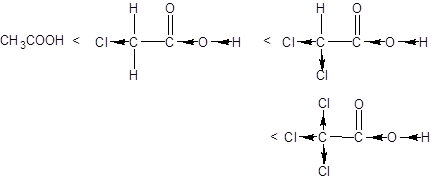
Increasing acidic strength due to increasing number of (¾I) effect group.
Illustration 19. Explain why aniline is less basic than ammonia.
Solution: The lone pair present at the nitrogen in aniline is delocalized in the ring (by resonance) and hence, it is not free for protonation, while in ammonia. It is present at nitrogen all the time, hence it is readily available for ptrotonation.
|
Illustration 20. |
|
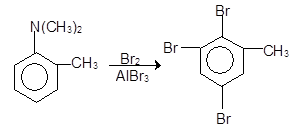
–N(CH3)2 and –CH3 both groups are o, p-directing but products are formed only under direction of –(CH3)2. Explain.
Solution: –N(CH3)2 group as well as –CH3 group are o–, p– directing and if we want to place both groups, none of the position will be available for SE.
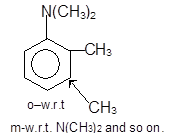
But o, p-directive effect of the stronger donor (–N(CH3)2) dominates over that of the weaker donor (–CH3), hence SE takes place at o-and p-position w.r.t. –N (CH3)2.
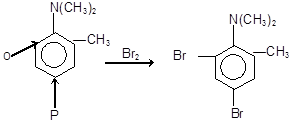
Illustration 21. 4- nitrophenol is more acidic than 3,5 - dimethyl –4-nitro-phenol. Explain.
Solution: It is explained in terms of inductive effect and hyperconjugation.
Illustration 22: The order of acidic strength of the following compound is
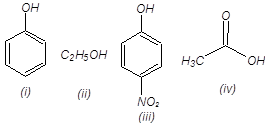
Solution: (iv) > (iii) > (i) > (ii)
Illustration23. Write the following Alkenes in increasing order of their stability with explanation
R2C=CR2, R2C=CHR, R2C=CH2, RCH=CH2, CH2=CH2
Solution Let R= CH3


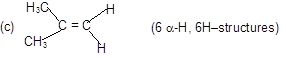
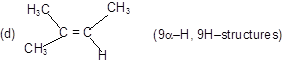

From (a) to (e) number of hyperconjugative structures increases, hence stability of alkene also increases, hence the correct order is
a < b < c < d < e
 Exercise 18.
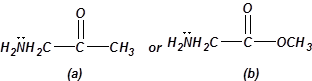
(i) Which one is more basic?
(ii) Why phenol is more acidic than alcohol?
(iii) Why aniline is less basic than aliphatic amines?
(iv) Which among the following is most acidic?
(a) CH3¾CH3 (b) CH2 = CH2 (c) HC º CH
Illustration 24. Identify the effects operating in each of the molecule.
(a) CH3Cl
(b) CH3 – CH = CH2
(c) CH3 – CH = CH –– H
(d) CH2 = CH – CH = CH2
Solution: (a) Inductive effect
(b) Inductive and hyperconjugative effects
(c) Inductive, hyperconjugative and mesomeric effects
(d) Mesomeric effect and inductive effect
MECHANISM OF ORGANIC REACTION
A chemical equation is only a symbolic representation of chemical reaction which indicates the initial reactants and final products involved in a chemical change. Reactants generally consist of two species.
(a) Substrate: One which is being attacked in a chemical reaction
(b) Reagents: The species which attack the substrate molecule
Substrate + Reagent ¾® Products

It is important to know not only what happens in a chemical reaction but also how it happens. Most of the reactions are complex and take place via reactive intermediates which may be or may not be isolated. The reaction intermediates are generally very reactive which readily react with other species present in the environment to form the products. The detailed step by step description of chemical reaction is called its mechanism. Mechanism is only a hypothesis to explain various facts regarding a chemical reaction.
Substrate ¾¾® Reactive intermediates –— Products
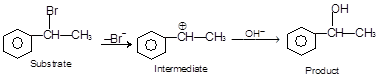
By knowing the mechanism we can predict the product of a chemical reaction, adjust the experimental conditions to improve the yield of the products or even alter the course of reaction to get the different products.
Most of the attacking reagents carry either positive charge (an electron deficient species) or a negative charge (electron rich species). The positively charged reagents attack the substrate at points of high electron density while (-vely) charged reagents attack the point of low electron density. The organic reactions essentially involve changes in the existing covalent bonds present in the molecules. These changes may involve electronic displacements in covalent bonds breaking of some of the existing bonds (bond fission), formation of new bonds as well as energy change accompanying the bond fission and bond cleavage.
We can understand the mechanism of various organic reactions in terms of following well established basic concepts.
(i) Electronic displacement in covalent bond
(ii) Fission (cleavage) of covalent bonds
(iii) Nature of attacking reagents
Types of Organic Reactions:
All organic reactions can be broadly classified into four catagories.
(a) Substitution reactions
(b) Addition reactions
(c) Elimination reactions and
(d) Rearrangement reactions
(a)Substitution Reactions
In these an atom or a group of atoms in an organic molecule is replaced by another atom or group of atoms without any change in the remaining part of the molecule. These reactions may be initiated by free radical, electrophile or nucleophile.
(i) Free radical substitution reaction:
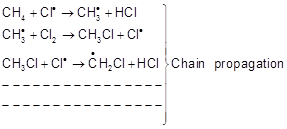
This substitution reaction is brought about by free radicals. For example chlorination of methane in presence of diffused sunlight. The mechanism of the reaction is as follows.
Cl : Cl ¾¾® 2Cl·Chain initiation
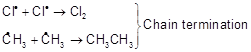
(ii) Nucleophilic substitution reoactions:
These reactions are brought about by nucleophile. The reaction can proceed either via SN1 or SN2 mechanism.
SN1 mechanism:
Rate determining step involves only the species. For example the reaction.
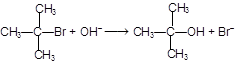
takes place as follows
1st step: (CH3)3CBr 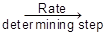

2nd step: Attack by nucleophile
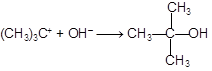
The stability of carbocation is the controlling factor for this mechanism the formation of 3° carbocation as an intermediate proceeds via this mechanism. In an optically active compound substitution at chiral centre through SN1 mechanism produces recemic mixture (No 100% recemization is observed?).
SN2 mechanism: Rate determining step involves two species and reaction proceeds through transition state.


Since 1° carbocation is less stable than the transition state formed above, the reaction involving 1° alkyl halides proceed via SN2 mechanism. During reaction configuration of carbon is inverted which is referred to as Walden inversion.
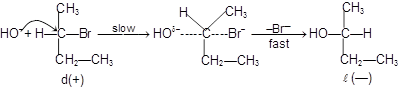
Points to Remember
n The higher the polarity of solvent greater the tendency for SN1 reaction.
n High concentration of the nucleophile favours SN2 reaction while low concentration favours SN1 reaction.
n Rearrangement of the carbocation (formed in SN1 reaction) leading to more stable carbocation is observed in SN1 reaction (discussed latter).
n In general SN2 mechanism is strongly inhibited by increasing steric bulk of the reagents. In such case SN1 mechanism is favoured.
(iii) Electrophilic substitution reactions:
The reaction initiated by an electrophile is known as electrophilic substitution reaction. Aromatic substitution reactions are the examples of this type of reaction.
C6H6 + Cl2 C6H5Cl + HCl
The mechanism of this reaction as follows.
Formation of electrophile: Cl : Cl + AlCl3 ¾® Cl+ + 
Electrophile attack:

Elimination of proton:

(b) Addition Reactions
Reactions which involve combination between two molecules to give a single molecule of the product are called addition reactions. Such reactions are typical of compounds containing multiple (double or tripe) bonds. Depending upon the nature of the attacking species (electrophiles, nucleophiles or free radicals) addition reactions are of the following types.
(i) Electrophilic addition reaction:
These reactions are brought about by electrophiles and are typical reactions of alkenes and alkynes.

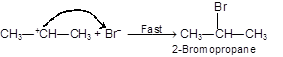
(ii) Nucleophilic addition reactions:
These reactions are brought about by nucleophiles. The characteristics reaction of aldehyde and ketone are nucleophilic addition reaction i.e., base catalysed addition of HCN to aldehydes or ketones.
HO– + HCN ¾¾® H2O + CN–
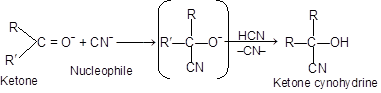
(iii) Free radical addition reactions:
Addition reactions brought about by free radicals are called free radical addition reactions for example addition of HBr to alkenes in presence of peroxides.
CH3—CH=CH2+HBr 
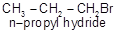
The reaction proceeds through following mechanism.
 2RO°
2RO°
RO· + HBr ¾¾® ROH + Br·
CH3—CH=CH2 + Br  CH3—·CH—CH2—Br
CH3—·CH—CH2—Br CH3—CH2CH2—Br + Br
Br· + Br·¾¾® Br2
Illustration 25. Identify the 1, 2- and 1-4 addition products of Free Radical addition of CBrCl3 to 1, 3-butadiene.
|
Solution: |
|
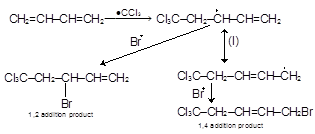
Illustration 26. Addition of HCl on 1, 3 butadiene gives two products. Explain.
Solution: Mechanism of addition of HCl on 1, 3-butadiene is as follows
|
Step:1
|
|
|
Step:2 |
|
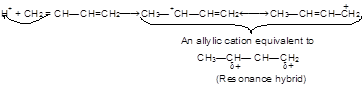

In step 1 proton adds to one of the terminal cabons of 1, 3 butadiene to form, as usual, the more stable carbonium ion, in this case a resonance stabilized allylic cation. Addition of one of the inner carbon atoms would have produced a much less stable primary cation that could not be stabilized by resonance;

In step (2), a chloride ion forms a bond to one of the carbon atoms of the allylic cation that bears a partial positive charge. Reaction at one carbon atom results in the 1, 2 – addition product, reaction at the other gives that 1,4 addition product.

Exercise 19.
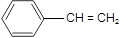
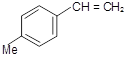
Arrange the following in increasing order of reactivity towards H+ addition.
|
(a) |
|
(c) |
|
|
(b) |
|
(d) |
|
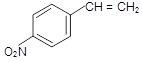
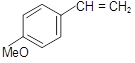
(c) Elimination Reactions
An elimination reaction is one which involves the loss of two atoms or groups of atoms from the same or adjacent atoms of a substrate molecule leading to formation of multiple (double or triple) bond. These are of two types.
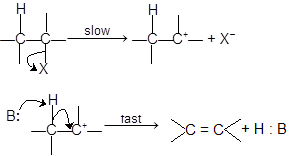
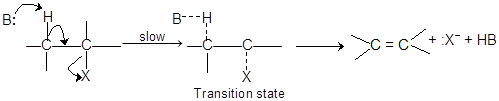
(i) b - elimination reactions. In these reactions, loss of two atoms or groups occurs from the adjacent atoms of the substrate molecule e.g., acid catalysed dehydration of alcohol and base catalysed dehydrogenation of alkyl halides.



E1 mechanism
E2 Mechanism
E1 — CB mechanism

(ii) a - Elimination – In these reactions loss of two atoms or groups occurs from the same atom of the substrate molecule. E.g., base catalysed dehydrohalogenation of chloroform to form dichlorocarbene.
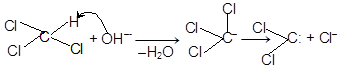
Dichlorocarbene is the reactive intermediate involved in carbylamine reaction and
Reimer – Tieman reaction.
(d) Rearrangement Reaction
These reactions involve the migration of an atom or a group of atoms from one atom to another within the same molecule.
Some reactions involving rearrangement.

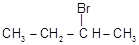
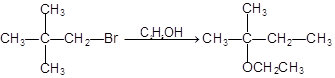
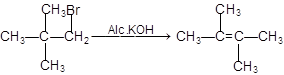
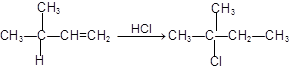
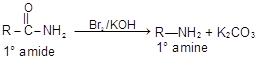
1, 2 Hydride shift

1, 2 Methyl shift
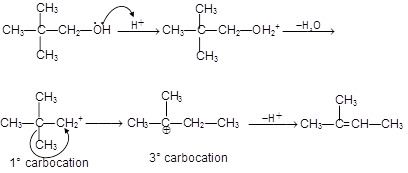
Illustration 27. Can you think why the below given is order of bases reaction with conc. HCl
(in presence of anhydrous ZnCl2, mixture is called Lucas’s reagent).

Solution: Naturally the one which is the strongest base, will react faster

It is simply a reaction between acid and a base and the strongest base will be reacting fastest. This is called Luca’s test of making distiction between 10, 20 and 30 alcohol.
Illustration 28. Give the mechanism
|
(i) |
|
|
|
(ii) |
|
|
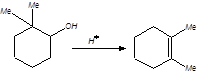
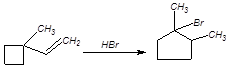
|
Solution: (i) |
|
|
|
(ii) |
|
|
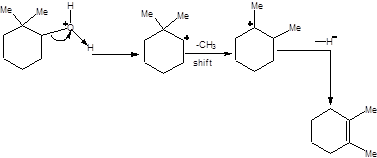
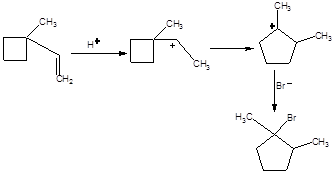
Rearrangement of carbocation through ring expansion.

Exercise 20.
(i) Which of the following intermediate is unstable?
(ii) Arrange the following carbocation in the order of decreasing stability
|
(a) |
|
|
|
(b) |
Why |
|
 is more stable than
  while both are primary carbocations?
Exercise 21.
Explain the following observations.
(i) CH3 – I  CH3OH + I–
(ii) CF3 – I CF3H + IO–