MONOSACCHARIDES
The monosaccharides are the basis of carbohydrate chemistry since all carbohydrates are either monosaccharides or are converted into monosaccharides on hydrolysis. The monosaccharides are polyhydroxy aldehydes or polyhydroxy ketones. There are, therefore, two main classes of monosaccharides.
-
The Aldoses, which contain an aldehyde group

-
The Ketoses, which contain a ketone group (—
 —)
—)
The aldoses and ketoses are further divided into sub-groups on the basis of the number of carbon atoms in their molecules, as trioses, tetroses, pentoses, hexoses, etc. To classify a monosaccharide completely, it is necessary to specify both, the type of the carbonyl group and the number of carbon atoms present in the molecule. Thus monosaccharides are generally referred to as aldotrioses, aldotetroses, aldopentoses, aldohexoses, ketohexoses, etc.
|
The aldoses and ketoses may be represented by the following general formulas.
|
|
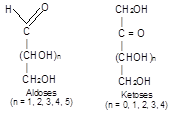
|
Glucose and fructose are specific examples of an aldose and a ketose.
|
|
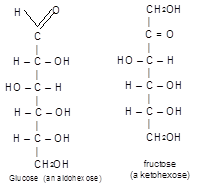
Trioses
|
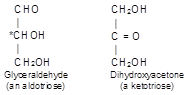
D and L Terminology: The simplest of all carbohydrates that fit the definition we have given for carbohydrates are the trioses, glyceraldehyde and dihydroxyacetone. Glyceraldehyde is aldotriose, and dihydroxyacetone is a ketotriose. |
|
|
Glyceraldehyde contains one asymmetric carbon atom (marked by an asterisk) and can thus exist in two optically active forms, called the D-form and the L-form. Clearly,the two forms are mirror cdn1.askiitians.com/Images/subject that cannot be superimposed, that is they are enantiomers. |
|
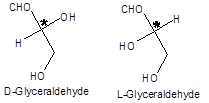
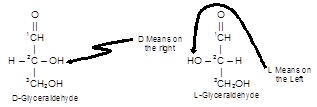
The two forms of glyceraldehyde are especially important because the more complex monosaccharides may be considered to be derived from them. They serve as a reference point for designating and drawing all other monosaccharides. In carbohydrate chemistry, the Fischer projection formulas are always written with the aldehyde or ketone groups at the top of the structure. By definition, if the hydroxyl group on the asymmetric carbon atom farthest from aldehyde or ketone group projects to the right, the compound is a member of the D-family. If the hydroxyl group on the farthest asymmetric carbon projects to the left, the compound is a member of the L-family. The maximum number of optical isomers of a sugar is related to the number of asymmetric carbon atoms in the molecule and may be calculated by the following simple equation.
Maximum Number of Optical Isomers = 2n,where n = the number of asymmetric carbon atoms.
Since glyceraldehyde contains only one asymmetric carbon atom, the number of optical isomer is 21. We know that 21 is = 2, and we have seen that there are indeed two different glyceraldehydes.
Aldotetroses
|
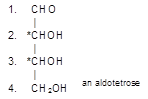
If we examine the general formula of an aldotetrose, we see that they contain two asymmetric carbon atoms (marked by asterisks). This means that 22 or 4 optical isomers are possible. They may be represented as the following two pairs: |
|
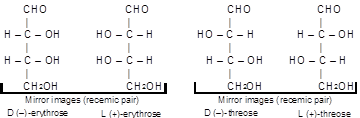
All four isomers have been prepared synthetically. The D- and L-erythrose are mirror cdn1.askiitians.com/Images/subject, that is, they are enantiomers. They have exactly the same degree of rotation but in opposite directions. Equal amounts of the two would constitute a racemic mixture, that is, a mixture that would allow a plane-polarised light to pass through the solution unchanged but could be separated into detrorotatory and laevorotatory isomers. The same comments hold for D- and L-threose. However, D-erythrose and L-threose are not cdn1.askiitians.com/Images/subject, that is, they are diastereomers (optical isomers that are not mirror cdn1.askiitians.com/Images/subject are called diastereomers), and the degree of rotation of each would probably differ.
Aldopentoses
|
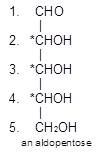
If we examine the general formula of an aldopentose, we see that they contain three asymmetric carbon atoms. This means that 23 or 8 optical isomers are possible. These are: |
|
Aldohexoses
|
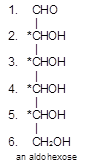
If we examine the general formula of aldohexose, we see that it contains four asymmetric carbon atoms. This means that 24 or 16 optical isomers are possible. D and L forms of altrose, allose glucose, mannose, galactose, talose, arabinose and idose Only three of the sixteen possible aldohexoses are found in nature (all sixteen isomers have been prepared synthetically). They are D-glucose, D- mannose, and D-galactose. No one of these three optical iosmers is a mirror image of any of the others, so all three are diastereomers of each other. |
|
Epimers
|
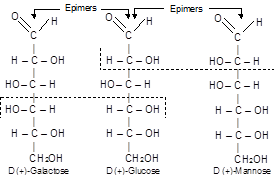
A pair of diastereomers that differ only in the configuration about of a single carbon atom are said to be epimers. e.g D(+)- glucose is epimeric with D(+) -mannose and D(+) -galactose as shown below:
|
|
Cyclic structure of Monosaccharides
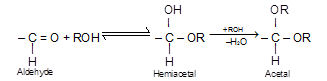
We know that aldoses (and ketoses) react with alcohols to give first hemiacetals (and hemiketals) and then acetals (and ketals), i.e.

|
Since monosaccharides contain a number of hydroxyl groups and an aldehyde or a keto group, therefore, any one of the –OH groups (usually C4 or C5 in aldohexoses and C5 or C6 in ketohexoses) may combine with the aldehyde or the keto group to form intramolecular hemiacetal or hemiketal. |
|
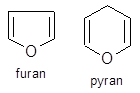
As a result, the open chain formulae do not represent the actual structures of the monosaccharides. Their actual structures are cyclic involving five or six membered rings containing an oxygen atom. The five membered ring containing one oxygen atom because of its similarity with furan is called the furanose form and the six membered ring containing one oxygen atom because of its resemblance with pyran is called the pyranose form. In nut shell, all the monosaccharides (pentoses and hexoses) in the free state always exist in the pyranose form. However, in the combined state some monosaccharides such as ribose, 2-deoxyribose, fructose etc., usually exist in the furanose form.
Cyclic Structure of Glucose – Anomers
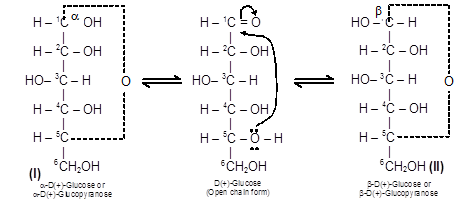
We have discussed above that monosaccharides have cyclic hemiacetal or hemiketal structures. To illustrate, let us first consider the example of D-glucose. During hemiacetal formation C5 – OH of glucose combines with the C1 – aldehydic group. As a result, C1 becomes chiral or asymmetric and thus has two possible arrangements of H and OH groups around it. In other words, D-glucose exists in two stereoisomeric forms, i.e., a-D-glucose and b-D-glucose as shown below:
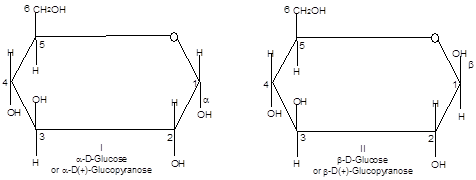
In a-D-glucose, the OH group at C1 is towards right while in b-D-glucose, the OH group at C1 is towards left. Such a pair of stereoisomers which differ in configuration only around C1 are called anomers and the C1carbon is called Anomeric carbon (or glycosidic carbon. The cyclic structures of monosaccharides can be better represented by Haworth Projection formulae. To get such a formula for any monosaccharide (say a-and b-D-glucose), draw a hexagon with its oxygen atom at the upper right hand corner. Place all the groups (on C1, C2, C3 and C4) which are present on left hand side in structures I and II, above the plane of the ring and all those groups on the right hand side below the plane of the ring.
The terminal – CH2OH group is always placed above the plane of the hexagon ring (in D-series). Following the above procedure, Haworth Projection Formulae for a-D-glucose (I) and b-D-glucose (II) are obtained as shown below:
Cyclic structure of Fructose
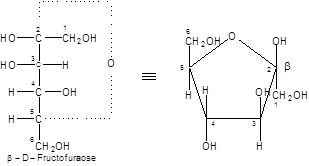
Like glucose, fructose also has a cyclic structure. Since fructose contains a keto group, it forms an intramolecular hemiketal. In the hemiketal formation, C5– OH of the fructose combines with C2-keto group. As a result, C2becomes chiral and thus has two possible arrangements of CH2OH and OH group around it. Thus, D-fructose exists in two stereoisomeric forms, i.e., a-D-fructopyranose and b-D fructopyranose. However in the combined state (such as sucrose), fructose exists in furanose form as shown below: