Isoelectric Point
What happens when a solution of an amino acid is placed in an electric field depends upon the acidity or basicity of solution. In quite alkaline solution.

Anions (II) exceed cations (III), and there is a net migration of amino acid toward the anode. In quite acidic solution cations (III) are in excess, and there is a net migration of amino acid towards the cathode. If (II) and (III) are exactly balanced, there is no net migration; under such conditions any one molecule exists as a positive ion and as a negative ion for exactly the same amount of time and any small movement in the direction of one electrode is subsequently cancelled by an equal movement back towards the other electrode. The hydrogen ion concentration of the solution in which a particular amino acid does not migrate under the influence of an electric field is called the isoelectric point of that amino acid.
An amino acid shows its lowest solubility in a solution at the isoelectric point, since here there is the highest concentration of the dipolar ion. As the solution is made more alkaline or more acidic, the concentration of one of the more soluble ions, II or III increases.
If an amino acid has amino group and one carboxyl group, it has two pK values. The isoelectric point (PI) of this amino acid has the average value of the both pK values.
We take example of glycine.
H3+N ¾ CH2 ¾ COOH  H3N+ ¾ CH2 ¾ COO– + H+ …(1)
Conjugated acid (CA) Dipolar Ion (DI)
At equilibrium
H3N+ ¾ CH2 ¾ COO– H2N ¾ CH2 ¾ COO– + H+ …(2)
DI Conjugated Base (CB)
At equilibrium 
[CA] = 
[CB] = 
At isoelectric point [CA] = [CB]
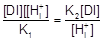 Where
Where  = conc. of [H+] at isoelectric point.
or,  = K1 K2
or, 2log [Hi+] = log K1 + log K2
or –2 log (Hi+] = - log k1 – logK2
or 2pHi = pK1 + pK2
or pHi = 
NUCLEIC ACIDS
Nucleic acids are biologically important polymers which are present in all living cells, also called as polynucleotides because repeating structural unit is nucleotide.
There are two types of nucleic acids
(i) DNA (deoxyribonucleic acid)
(ii) RNA (Ribonucleic acid)
Composition of nucleic acids
1. A phosphate group
2. Sugar
3. Nitrogenous bases
1. Phosphate Group: Phosphate group in nucleic acid is:

Phosphate group is bonded to a hydroxyl group of sugar.
2. Sugar: Two types of sugars present in nucleic acids.
RNA (D – ribose)
DNA (D – deoxyribose)
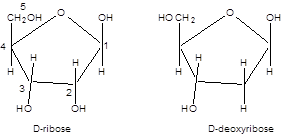
3. Nitrogenous bases: Two types
(i) Purines – Adenine (A) and Guanine (G)
(ii) Pyrimidines – Cytosine (C), thymine (T) and uracil (U)
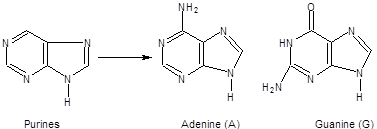
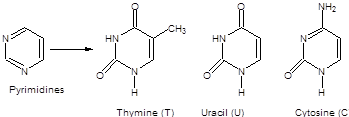
Illustration 13. Chargaff’s rule states that in an organism.
(A) Amount of adenine (A) is equal to that of thymine (T) and the amount of guanine (G) is equal to that of cytosine (C).
(B) Amount of adenine (A) is equal to that of guanine (G) and amount of thymine (T) is equal to that of cytosine.
(C) Amount of adenine (A) is equal to that of cytosine (C) and the amount of thymine (T) is equal to that of guanine (G).
(D) Amounts of all bases are equal.
Solution: According to Chargaff’s rule.
Total amount of purines is equal to the total amount of pyrimidines
(A + G = C + T), hence (A) is correct.
 Exercise 7.
Give the products expected when D – glucose reacts with each of the following reagents. Assume that glucose is present in pyranose form
(A) Tollen’s reagent (B) HCl
(C) CH3OH, dry HCl (D) Acetic anhydride
NUCLEOSIDES AND NUCLEOTIDES
Nucleosides: Nucleoside contains only two basic components of nucleic acids (a pentose sugar and a nitrogenous base). During their formation, 1- position of pyrimidine or 9 – position of purine moiety is linked to C1 of sugar (ribose or deoxyribose) by b - linkage.
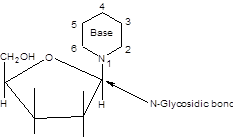
General structure of a nucleoside
Depending upon the type of sugar present, nucleosides are of two types:
(i) Ribonucleosides and
(ii) Deoxyribonucleosides
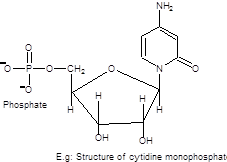
Nucleotides: Nucleotides contains all the three basic components of nucleic acids. Nucleotides are nucleoside monophosphates.
They are of two types depending upon the type of sugar – Ribonucleotides and Deoxyribonucleotides. Nucleotide may be represented as follows.
|
|
DNA |
|
RNA |
|
1. |
Sugar present in DNA is 2-deoxyribose. |
1. |
Sugar is D-ribose. |
|
2. |
It contains cytosine and thymine as pyrimidine. |
2. |
It contains cytosine and uracil as pyrimidine. |
|
3. |
It has double stranded a - helix structure. |
3. |
It has single stranded a - helix. |
|
4. |
DNA occurs in the nucleus of cell. |
4. |
RNA occurs in cytoplasm of the cell. |
|
5. |
Controls transmission of hereditary material. |
5. |
It control the synthesis of proteins. |
Structure of DNA
Primary structure and its double helix: Sequence in which four nitrogen bases are attached to the sugar phosphate backbone of a nucleotide chain is called primary structure.
|
|
|
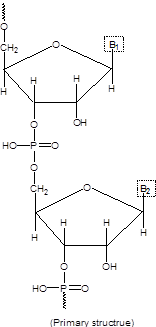
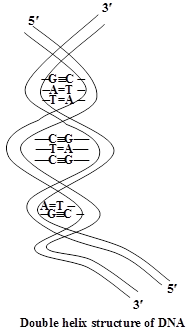
Watson and crick in 1953 proposed that DNA polymers form a duplex structure consisting of two strands of polynucleotide chain coiled around each other in the form of a double helix. Bases of one strand of DNA are paired with bases on the other strand by means of hydrogen bonding. According to Chargaff rule – Thymine and adenine can be joined by 2 hydrogen bonds (T = A) while cytosine and guanine can be joined by three hydrogen bonds.
|
|
|
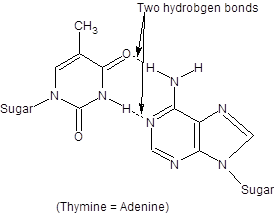
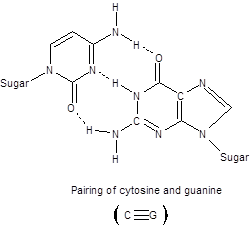
Structure of RNA is similar to DNA except that it is a single strand structure.
Biological functions of nucleic acids
Important functions are
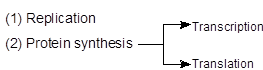
1. Replication
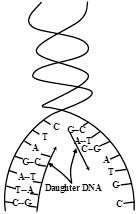
Process by which a single DNA molecule produces two identical copies of itself is called replication. Replication of DNA is an enzyme catalyzed process. In this process, two strands of DNA helix unwind and each strand serves as a template or pattern for the synthesis of a new strand. Newly synthesized complementary strand is an exact copy of the original DNA. In this way hereditary characteristics are transmitted from one cell to another.
|
|
|
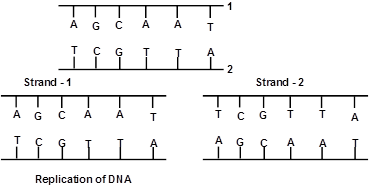
Protein Synthesis

(i) Transcription
|
It is the process of synthesis of RNA (mRNA) by using DNA as template. This process is similar to replication process. Differ in following ways.
In transcription, ribose nucleotide assemble along the uncoiled template instead of deoxyribose nucleotide and base uracil (U) is substituted for the base thymine (T).
Synthesis of RNA or DNA always takes place in 5¢ - 3¢ direction. Process is catalyzed by an enzyme RNA polymerase. In this way DNA transfers its genetic code to mRNA. |
|
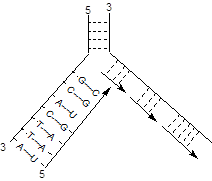
After synthesis, RNA detaches from DNA and moves from nucleus to the cytoplasm where it acts as template for protein synthesis. DNA returns to its double helix structure.
(ii) Translation
It is the process of synthesis of protein. This process is directed by mRNA in the cytoplasm of cell with the help of tRNA (transfer RNA) and ribosomal particles (RNA – protein complex).
The process occurs with the attachment of mRNA to ribosome particle mRNA then gives the message of the DNA and dictates the specific amino acid sequence for the synthesis of protein.
4 bases in mRNA act in the form of triplets and each triplet acts as a code for a particular amino acid. This triplet is called codon. There may be more than one codon for same amino acid. E.g. amino acid methionine has code AUG while glycine has 4 codons GGU, GGC, GGA, GGG.
These codon expressed in mRNA is read by tRNA carrying anticodon and is translated into an amino acid sequence. This process is repeated again and again thus proteins are synthesized. After completion, it is released from ribosome.
|
|

Protein synthesis is a fast process and about 20 amino acids are added in one second. It may be noted that translation is always unidirectional but transcription can sometimes be reversed. (RNA is copies into DNA) This is called reverse transcription (occurs in Retroviruses).
Genetic Code
Segment of DNA is called gene and each triplet of nucleotides is called a codon that specifies one amino acid. This relationship between nucleotide triplets and amino acids is called genetic code. E.g.
