INTRODUCTION
Old Definition
The group of compounds known as carbohydrates received their general name because of early observations that they often have the formula Cx(H2O)y - that is, they appear to be hydrates of carbon.
Limitations of the old definition:The above definition could not survive long due to the following reasons:
- A number of compounds such as rhamnose, (C6H12O5) and 2-deoxyribose (C5H10O4) are known which are carbohydrates by their chemical behaviour but cannot be represented as hydrates of carbon.
- There are other substances like formaldehyde (HCHO, CH2O) and acetic acid [CH3COOH, C2 (H2O)2] which do not behave like carbohydrates but can be represented by the general formula, Cx(H2O)y.
New definition
Carbohydrates are defined as polyhydroxy aldehydes or polyhydroxy ketones or substances which give these on hydrolysis and contain at least one chiral carbon atom. It may be noted here that aldehydic and ketonic groups in carbohydrates are not present as such but usually exist in combination with one of the hydroxyl group of the molecule in the form of hemiacetals and hemiketals respectively.
Classification
The carbohydrates are divided into three major classes depending upon whether or not they undergo hydrolysis, and if they do, on the number of products formed.
Monosaccharides: The monosaccharides are polyhydroxy aldehydes or polyhydroxy ketones which cannot be decomposed by hydrolysis to give simpler carbohydrates. Examples are glucose and fructose, both of which have molecular formula, C6H12O6. 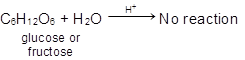
Oligosaccharides: The oligosaccharides (Greek, oligo, few) are carbohydrates which yield a definite number (2-9) of monosaccharide molecules on hydrolysis. They include,
-
Disaccharides, which yield two monosaccharide molecules on hydrolysis. Examples are sucrose and maltose, both of which have molecular formula, C12H22O11.


- Trisaccharides, which yield three monosaccharide molecules on hydrolysis. Example is raffinose, which has molecular formula, C18H32O16.

-
Tetrasaccharides, etc.
Polysaccharides: The polysaccahrides are carbohydrates of high molecular weight which yield many monosaccharide molecules on hydrolysis. Examples are starch and cellulose, both of which have molecular formula, (C6H10O5)n.

In general, the monosaccharides and oligosaccharides are crystalline solids, soluble in water and sweet to taste. They are collectively knownas sugars. The polysaccharides, on the other hand, are amorphous, insoluble in water and tasteless. They are called non-sugars. The carbohydrates may also be classified as either reducing or non-reducing sugars. All those carbohydrates which have the ability to reduce Fehling’s solution and Tollen’s reagent are referred to as reducing sugars, while others are non-reducing sugars. All monosaccharides and the disaccharides other than sucrose are reducing sugars.
Illustration 1: The reaction of glucose with acetic anhydride & tollen’s reagent suggest that it is
-
a penta hydroxyl aldehyde
-
hydrate of carbon
-
a polyhydroxy ketone
-
an alcohols
Solution: (A)
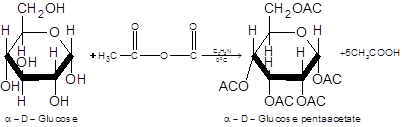
This confirm the presence of -OH group in glucose on separate carbons.

Confirm the presence of CHO group.
Exercise 1:
Give the structure of disaccharide from the following:
-
It does not reduce fehling reagent and does not mutarotate
-
It is hydrolysed by maltase or emulsion to D – glucose and D – fructose
-
Methylation and hydrolysis give 2, 3, 4, 6, tetra-o-methyl D-glucopyranose and a tetramethyl D-fructose