DISACCHARIDES
Carbohydrates which upon hydrolysis give two molecules of the same or different monosaccharides are called disaccharides. Their general formula is C12H22O11. The three most important disaccharides are sucrose, maltose, and lactose. Each one of these on hydrolysis with either an acid or an enzyme gives two molecules of the same or different monosaccharides as shown below:



Disaccharides may also be considered to be formed by a condensation reaction between two molecules of the same or different monosaccharides with the eliminatioin of a molecule of water. This reaction involves the formation of an acetal from a hemiacetal and an alcohol – in which one of the monosaccharides acts as the hemiacetal while the other acts as the alcohol.
Sucrose
It is formed by condensation of one molecule of glucose and one molecule of fructose. Unlike maltose and lactose, it is non-reducing sugar since both glucose (C1 - a) and fructose (C2 - b) are connected to each other through their reducing centres. Its structure is shown below:
|
Hydrolysis:(Invert Sugar or Invertose). Hydrolysis of sucrose with hot dilute acid yields
Sucrose is dextrorotatory, its specific rotation being +66.5%, D-glucose is also dextrorotatory, [a]D = +53°, but D-fructose has a large negative rotation, [a]D = -92°. Since D-fructose has a greater specific rotation than D-glucose, the resulting mixture is laevorotatory. Because of this the hydrolysis of sucrose is known as the inversion of sucrose, and the equimolecular mixture of glucose and fructose is known is invert sugar or invertose. |
|
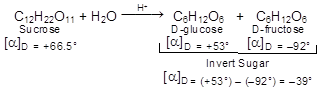
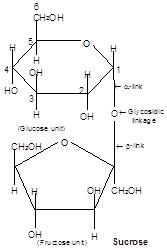
Illustration 4. The correct haworth projection of sucrose is
|
(A) |
|
(B) |
|
|
(C) |
|
(D) |
|
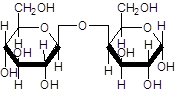
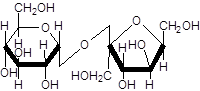
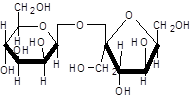
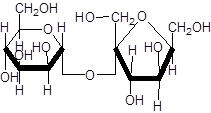
Solution: (B) Sucrose is composed of a -D- glucose & b - D – fructose.
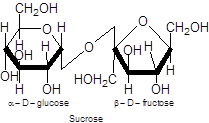
Illustration 5. When sucrose is heated with conc. HNO3 the product is
(A) sucrosenitrate (B) oxalic acid
(C) formic acid (D) citric acid
Solution: (A)
POLYSACCHARIDES
Polysaccharides are formed when a large number (hundreds to even thousands) of monosaccharide molecules join together with the elimination of water molecule. Thus, polysaccharides may be regarded as condensation polymers in which the monosaccharides are joined together by glycosidic linkages. Some important polysaccharides are:
1. Cellulose 2. Starch
3. Glycogen 4. Gums and
5. Pectins
Starch
It is a polymer of glucose. Its molecular formula is (C6H10O5)n where the value of
n (200 – 1000) varies from source to source. It is the chief food reserve material or storage polysaccharide of plants and is found mainly in seeds, roots, tubers, etc. Wheat, rice, potatoes, corn, bananas etc., are rich sources of starch.
Starch is not a single compound but is a mixture of two components – amylose (10 to 20%) and amylopectin (20 to 80%). Both amylose and amylopectin are polymers of
a-D-glucose.
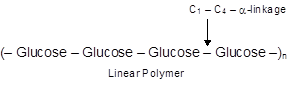
Amylose is a linear polymer of a-D-glucose. It contains about 200 glucose units which are linked to one another through a-linkage involving C1 of one glucose unit with C4 of the other as shown below:
Amylopectin, on the other hand, is a highly branched polymer. It consists of a large number (several branches) of short chains each containing 20-25 glucose units which are joined together through a-linkages involving C1 of one glucose unit with C4 of the other. The C1 of terminal glucose unit in each chain is further linked to C6 of the other glucose unit in the next chain through C1 – C6 a-linkage. This gives amylopectin a highly branched structure as shown below.-
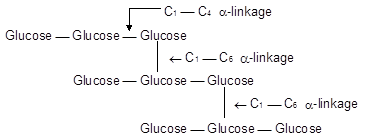
Hydrolysis: Hydrolysis of starch with hot dilute acids or by enzymes gives dextrins of varying complexity, maltose and finally D-glucose. Starch does not reduce Tollen’s reagent and Fehling’s solution.
Uses: It is used as a food. It is encountered daily in the form of potatoes, bread, cakes, rice etc. It is used in coating and sizing paper to improve the writing qualities. Starch is used to treat textile fibres before they are woven into cloth so that they can be woven without breaking. It is used in manufacture of dextrins, glucose and ethyl alcohol. Starch is also used in manufacture of starch nitrate, which is used as an explosive.
Illustration 6. Nature of glycosidic linkage present in amylopectin
(A) a - 1, 6 linkage (B) a - 1, 4 linkage
(C) b - 1, 4 linkage (D) both (A) and (B)
Solution: (B)
Amylopectin is a branched chain saccharides consist of a - D – glucose unit join straight chain by a, 1, 4 linkage & both the straight chain are ionized a - 1, 6 linkage.
|
Illustration 7. |
|
|||
|
|
(A) |
|
(B) |
|
|
|
(C) |
|
(D) |
|
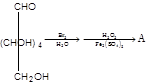
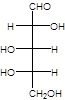


|
Solution: |
|
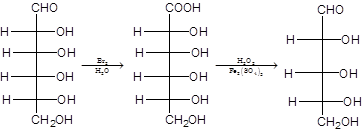
Hence (B) is correct answer.

Exercise 4.
C4H8Cl2 (A) on hydrolysis forms C4H8O (B) which forms an oxime, but does not reduce the Fehling solution. (B) also gives Iodoform test. Identify (A) and (B) and explain reaction.
 Exercise 5.
Explain the terms anomers and epimers taking example from carbohydrate chemistry.
Exercise 6.
The acidic group in glycine is
(A) ¾COOH (B) ¾COO-
(C) ¾NH2 (D) ¾NH3+
AMINO ACIDS
Introduction
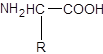
(i) Amino acids are organic compounds of both, an amino group & carboxylic group.
(ii) They are represented by general formula:
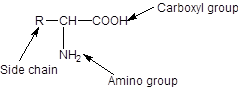
(iii) These amino acids are very important because they are the building blocks of protein.
(iv) Protein is the natural polymer moving a - amino acids as monomer.
(v) With the exceptions of glycine. All the other amino acids have chiral carbon & have two optically active isomers.
(vi) All naturally occurring amino acids are in L – series in which ¾NH2 group on the left and ¾OH group in the right as L – glyceraldehydes.
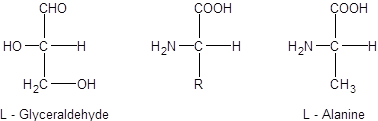
Illustration 8. Which among the following statements are true for glycine?
1. It exists in crystalline form 2. It is optically active
3. It is soluble in water 4. It can form Zwitter ions
(A) 1, 2 and 3 (B) 1, 2 and 4
(C) 1, 3 and 4 (D) 2, 3 and 4
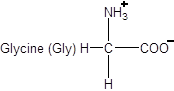
Solution: (C) It is ionic so it exists in crystalline form. Because it is ionic so it soluble in water. Because acidic and basic groups are present in the same molecule, so internal salt formation occurs to form dipolar ion NH3+ ¾ CH2 ¾ COO-
Classification
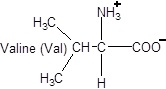
Amino acid with non – polar side chain
|
(i) |
|
(ii) |
|
|
(iii) |
|
(iv) |
|
|
(v) |
|
(vi) |
|
|
(vii) |
|
|
|
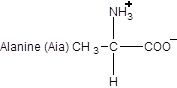
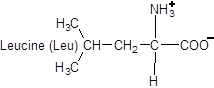
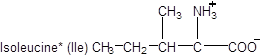
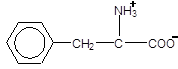
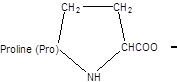
Essential amino acids
(a) These must be supplied to our diet as are not synthesized in body.
(b) Some of them are
(1) Valine (2) Leucine (3) Isoelucine (4) Phenylalanine (5) Arganine (5) Threonine
(6) Tryptophan (7) Methionine (8) Lysine (9) Arginine (10) Histadine
Note: Histidine and arginine are essential i.e. can be syntrhesized but not in quantities sufficient to permit normal growth.
Non – Essential Amino acids
These amino acids are synthesized in body.
Some of them are
These are as follows:
(1) Glycine (2) Alanine (3) Tyrosine (4) Serine (5) Cystine (6) Proline (7) Hydroxyprocine
(8) Cysteine (9) Aspartic acid (10) Glutonic acid
Synthesis of a - amino acids
Protein can be hydrolyzed by refluxing with dilute hydrochloric acid to give a mixture of a - amino acids. The resulting mixture can be separated by
(a) fractional crystallization.
(b) Fractional distillation of their ester followed by hydrolysis (Fischer’s method)
(c) Selective precipitation as salt with phosphotungstic and picric acid.
(d) Distribution of amino acid between n – butanol saturated with water (Dakin’s method).
(e) Column, paper and gas chromatography.
(f) Electrophoresis.
By amination of a - halo acid
|
(i) |
|
|
(ii) |
|


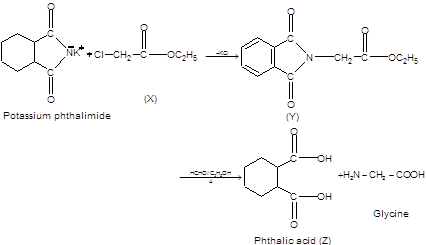
By Gabriel synthesis
 By Strecker Synthesis
|
(i) |
|
|
(ii) |
|
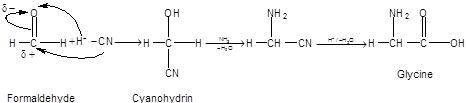
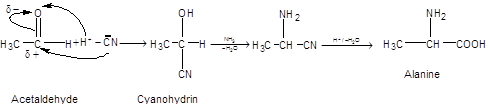
Note: Generally the aldehyde is treated with a mixture of ammonium chloride and potassium cyanide in aqueous solution.


|
Illustration 9. |
|
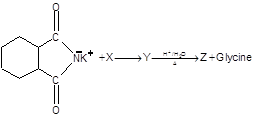
Compound X, Y, Z are
|
(A) |
|
|
(B) |
|
|
(C) |
|
|
(D) |
All are correct |
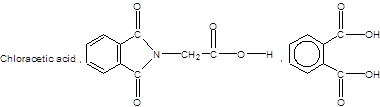
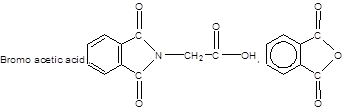
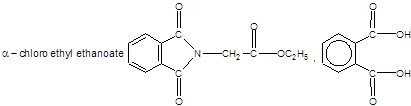
Solution: (C)
Physical properties of amino acid
(i) Amino acids are generally, crystalline substance having sweet taste.
(ii) They melt with decomposition at higher temperature (more than 200°C).
(iii) They are soluble in water but insoluble in organic solvents.
ZWITTER ION
(i) Amino acids contain both acidic carboxyl group (-COOH) and basic amino group in the same molecules.
(ii) In aqueous solution, the acidic carboxyl group can lose a proton and basic amino group can gain a proton in a kind of internal acid – base reaction.
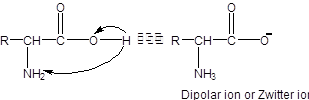
(iii) The product of this internal reaction is called a Dipolar or a Zwitter ion.
(iv) The Zwitter ion is dipolar, changed but overall electrically neutral and contain both a positive and negative charge.
(v) Amino acid in the dipolar ion form are amphoteric in nature.
(vi) Depending upon the pH of the solution, the amino acid can donate or accept proton.
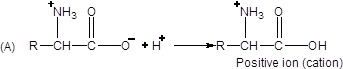
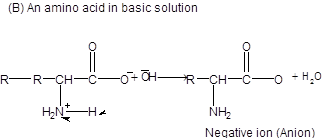
Illustration 10. In acidic medium, amino acids are present as
|
(A) |
|
(B) |
|
|
(C) |
|
(D) |
|
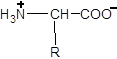
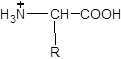
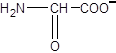
Solution: (C)
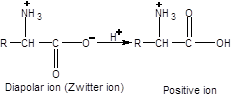
ISOELECTRIC POINT
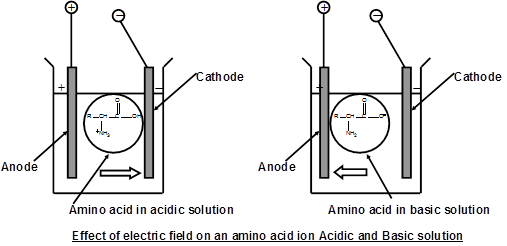
(i) When ionized form of amino acid is placed in an electric field it will migrate towards the opposite electrode.
(ii) Depending upon the pH of the medium following three thing may happen.
(a) In acidic medium, the cation move towards cathode.
(b) In basic medium, the anion move towards anode.
(c) The Zwitter ion does not move towards any of the electrodes.
(iii) At a certain pH (i.e. H+ concentration), the amino acid molecules show no tendency to migrate towards any of the electrodes and exists as a neutral dipolar ion, when placed in electric field is known as isoelectric point.
(iv) All amino acids do not have the same isoelectric point & it depends upon the nature of
R – linked to a- carbon atom.
Illustration 11. Pick out incorrect statement
(A) In an electrolysis experiment, a - amino acids do not towards any of the electrode at the isoelectric point.
(B) p-aminobenzenesulphonic acid is a dipolar ion; while p-aminobenzoic acid does not
(C) Sulphanilic acid is soluble in base, but not in acid
(D) H3N+CH2COOH (pka = 2.4) is more acidic than RCH2COOH (pKa = 4 – 5)
Solution: (A) The pH at which |Anion| = |Cation| is called isoelectric point. At isolectric point, a - amino acids to not migrate when field is applied.
(B) -SO3H is strongly acidic and donates H+ to weakly basic arylamino group. ArCOOH is not acidic enough to transfer H+ to the arylamino group.
(C) In p- H3N+ C6H4SO3-, H3N+ is acidic enough to transfer H+ to bases to give the soluble anion p – H2N – C6H4SO3- – SO3 is too feebly basic and cannot accept H+ from acids.
(D) a - H2N+ group increases acidity, because of its electron – withdrawing inductive effect.
Hence (D) is correct.
Isoelectric point of some amino acid
|
Amino acid |
Isoelectric point |
|
Neutral amino acids |
(pH 5.5 to 6.3) |
|
Glycine |
5.7 |
|
Alanine |
6.1 |
|
Valine |
6.0 |
|
Serine |
5.7 |
|
Threonine |
5.6 |
|
Acidic amino acids |
(pH » 3) |
|
Aspartic acid |
2.8 |
|
Glutamic acid |
3.2 |
|
Basic amino acids |
(pH » 10) |
|
Lysine |
9.7 |
|
Arginine |
10.8 |
(v) Amino acids have minimum aqueous solubility at isoelectric point.
|
|
Chemical Properties
Amino acids show the following characteristic reactions.
1.Reaction of the carboxyl group.
2.Reaction of the amino group.
3.Reaction involving both the carboxyl and the amino group.
Reaction of the carboxyl group
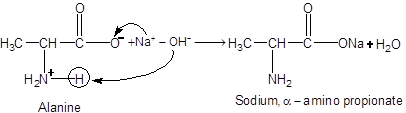
Reaction with base
|
(i) |
|
|
(ii) |
|
|
|
Mechanism: |
|
|
|


Esterification

Note: HCl first converts the dipolar ion into an acid which is subsequently esterified.
Decarboxylation


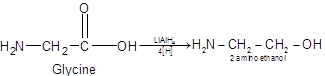
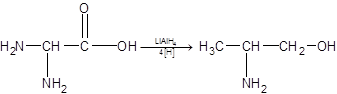
Reduction
Reaction with strong acid

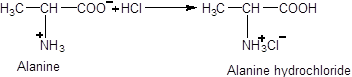
Acetylation



Reaction with Nitrous acid

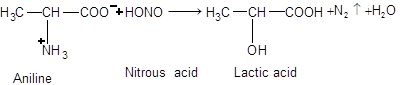
Note: (i) This reaction forms the basis of the “van slyke method” for the estimation of amino acids.
(ii) The nitrogen is evolved (one half comes from the amino acid) quantitatively and its volume measured.
Reaction with Nitrosyl halide

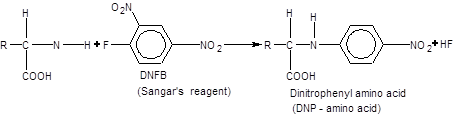
Reaction with 2, 4 – Dintrofluorobenzene (DNFB)
Reaction involving both the carboxyl & the amino group
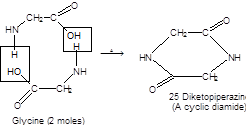
Effect of heat
a - amino acids undergo dehydration on heating (200°C) to give diketo piperazines.
PEPTIDES & PROTEINS
Introduction
(i) Proteins are formed by joining the carboxyl group of one amino to the a - amino group of another acid.
(ii) The bond formed between two amino acids by the elimination of water molecules is called peptide linkage.
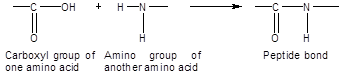
(iii) The product formed by linking amino acid molecules through peptide linkage ¾CO ¾ NH ¾ is called a peptite.
(iv) When two amino acids combined in this way the resulting product is called a dipeptide.
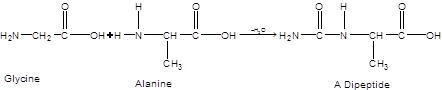
(v) Peptide are further designated as tri, tetra or penta peptides accordingly as they contain three, four or five amino acid molecules, same or different.
(vi) In a peptide the amino acid that contains the free amino group is called the N – terminal residue (written on L.H.S).
(vii) The amino acid that contains the free carboxyl group is called the C – terminal residue (written on R.H.S).
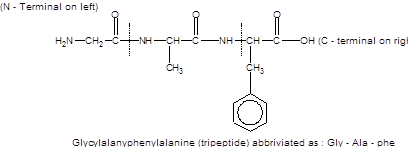
(viii) If a large number of a - amino acids (100 to 1000) are joined by peptide bonds the resulting polyamide is called polypeptide.

(ix) By convention a peptide having molecular weight upto 10,000 is called polypeptide.
(x) While a peptide having a molecular mass more than 10,000 is called a protein. ‘
Structure of Proteins
(i) Proteins have three dimensional structures.
(ii) There are number of factors which determine the exact shape of proteins.
Structure of Proteins
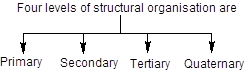
Primary structure
(i) This type of structure was given by Friedrich Sanger in 1953 in Insulin.
(ii) Primary structure is conformed by single polypeptide chain in a linear manner.
(iii) All amino acid are attached in a straight chain by peptide bond.
Secondary structure
(i) The fixed configuration of polypeptide skeleton is referred to as the secondary structure of protein.
(ii) It gives information
(a) About the manner in which the protein chain is folded and bent.
(b) About the nature of the bond which stabilizes this structure.
(iii) This structure of protein is mainly of two types
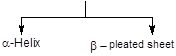
(A) a-Helix
(a) The chain of a-amino acids coiled as a right handed screw (called a-helix) because of the formation of hydrogen bond.
(b) The spiral is held together by H-bonds between N–H and C = O group vertically adjacent to one another.
(c) X-Ray studies have shown that there are approximately 3.6 amino acid unit for each turn in helix.
(d) Such proteins are elastic i.e., they can be stretched.
(e) On stretching weak H-bonds break up and the peptide act like a spring.
(f) The hydrogen bonds are reformed on releasing the tension.
e.g. Myosin, Keratin, Tropomysin.
(B) Beta-pleated sheet
(a) Polypeptide chains are arranged side by side.
(b) The chains are held together by a very large number of hydrogen bond between
C = O and NH of different chains.
(c) These sheets can slide over each other to form a three dimensional structure called a beta pleated sheet.
e.g. Silk has a beta pleated structure.
Tertiary structure
(i) It refers to the arrangement and interrelationship of the twisted chain of protein into specific layer or fibres.
(ii) This tertiary structure is maintained by weak interatomic force such as, H-bonds hydrophobic bond, van der Waals’ force and disulphide bonds (eg Insulin).
e.g. Protein of tobacco mosaic virus (TMV); Myoglobin; Hemoglobin
Quarternary structure
(i) When two or more polypeptide chain united by the force other than covalent bond i.e., peptide and disulphide bonds.
(ii) It refers to final three dimensional shape that results from twisting bonding and folding of the protein helix.
(iii) It is most stable structure.
Classification of Proteins
There are two methods for classifying proteins.
(i) Classification according to Composition
(ii) Classification according to Functions
Illustration 12. Secondary structure of proteins is due to
(A) peptide bond (B) hydrogen bond
(C) covalent bond (D) co-ordinate bond
Solution: Hydrogen bond.
Classification according to Composition
Simple proteins
(i) Simple proteins are those which yield only a-amino acids upon hydrolysis.
(ii) Simple proteins are composed of chain of amino acid unit only joined by peptide linkage.
Examples are:
Egg (albumin); Serum (globulins); Wheat (Glutelin); Rice (Coryzenin)
Conjugated proteins
(i) Conjugated proteins are those which yield a - amino acids plus a non protein material on hydrolysis.
(ii) The non protein material is called the prosthetic group.
Example:
Casein in milk (prosthetic group is phosphoric acid); Hemoglobin (prosthetic group is Nucleic acid); Chlolesterol (prosthetic group – lipid).
According to molecular shape, proteins are further classified into two types.
(A) Fibrous protein
(a) These are made up of polypeptide chain that are parallel to the axis & are held together by strong hydrogen and disulphide bonds.
(b) They can be stretched & contracted like thread.
(c) They are usually insoluble in water.
Example:
Keratin (hair, wool, silk & nails); Myosin (muscle)
(B) Globular Proteins
(a) These have more or less spherical shape (compact structure).
(b) a - amino helix are tightly held bonding; H – bonds, disulphide bridges, ionic or salt bridges:
Examples:
Albumin (egg)
Classification According to functions
The functional classification includes following groups.
Structural proteins
These are the fibrous proteins such as collogen (skin, cartilage & bones) which hold living system together.
Blood proteins
(i) The major proteins constituent of the blood are albumin hemoglobin & fibrinogen.
(ii) Their presence contribute to maintenance of osmotic pressure, oxygen transport system & blood coagulation respectively.
Tests of protein
Biuret test
(i) On adding a dilute of copper sulphite to alkaline solution of protein, a violet colour is developed.
(ii) This test is due to the presence of peptide  linkage.
Millon’s test
(a) Millon’s reagent consists of mercury dissolved in nitric acid (forming a mixture of mercuric & mercurous nitrates).
(b) When millon’s reagent is added to a protein, a white ppt is formed, which turn brick red on heating.
(c) This test is given by protein which yield tyrosine on hydrolysis (due to the presence of phenolic group).
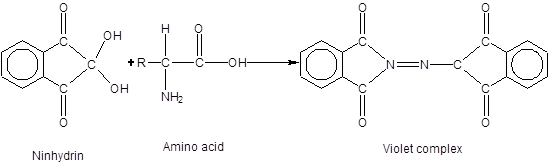
Nihydrin test
(i) This test is given by all proteins.
(ii) When protein is boiled with a dilute solution of ninhydrin, a violet colour is produced.
Uses of Proteins
(i) Protein constitute as essential part of our food, meat, eggs, fish, cheese provide protein to human beings.
(ii) Casein (a milk protein) is used in the manufacture of artificial wool & silk.
(iii) Amino acid needed for medicinal use & feeding experiment, are prepared by hydrolysis of proteins.
(iv) Gelatin is used in desserts, salad’s, candies bakery goods etc.
(v) Leather is obtained by tanning the protein of animal hides.
(vi) Hemoglobin present in blood is responsible for carrying oxygen and CO2.
(vii) Hormones control various process.
(viii) Enzymes are the proteins produces by living system & catalyse specific biological reaction.
Example:
Ureases (Urea ® CO2 + NH2)
Pepsin (Protein ® Amino acid)
Trypsin (Protein ® Amino acid)
Carbonic anhydride (H2CO3 ® H2O + CO2)
Nuclease (RNA, DNA ® Nucleotides)