SILVER AND ITS METALLURGY
Occurrence : It occurs in free state. The chief and important ore of silver is silver glance (Ag2S) which is present as such or is associated with galena, PbS.
CYANIDE PROCESS (MAS ARTHUR FORREST) PROCESS
The finally powdered ore after being concentrated by froth floatation process is treated with dilute (0.7%) NaCN solution and a current of air is blown into it. The silver present in the ore dissolves forming a complex soluble salt sodium argentocyanide.
Ag2S + 2NaCN → 2AgCN + Na2S
AgCN + NaCN → Na[Ag(CN)2]
Ag2S + 4NaCN → 2Na[Ag(CN)2]
or Ag2S + 4CN– → 2[Ag(CN)2]–1 + S–2
The reaction is reversible and in order to prevent backward reaction it is essential to remove sodium sulphide from the sphere of action. The oxygen of the air converts sodium sulphide into sodium sulphate and free sulphur and thus makes the above reaction irreversible.
4Na2S + 5O2 + 2H2O → 2Na2SO4 + 4NaOH + 2S
In case the ore is silver chloride then, too, it goes into solution forming sodium argentocyanide.
AgCI + 2NaCN → Na[Ag(CN)2] + NaCI
or AgCI + 2CN– → [Ag(CN)2]– + CI–
The solution of sodium argent cyanide, obtained as above, is treated with finally powdered zinc. Zinc being more electropositive than silver displaces it from the solution. A black precipitate of silver is thus obtained.
2Na[Ag(CN)2] + Zn → Na2[Zn(CN4)] + 2Ag↓
The precipitated silver is mixed with potassium nitrate and fused when the impurities are oxidized and removed as a scum from the molten metal. On cooling a compact shining mass of silver is formed.
This is the best method of extracting silver from its ore especially when the % of silver is low.
REFINING OF SILVER
Silver so obtained is purified by electrolytic process. It consists of:
Cathode Pure Ag
Anode Impure Ag
Electrolyte AgNO3 solution containing 1% HNO3
On passing electric current pure silver is deposited on cathode while same amount dissolves out from anode. The more electro positive metals like copper and zinc remain in solution while less electro positive gold comes down as anode mud.
Reaction: AgNO3 ↔ Ag+ + NO–3
Ag+ + e– → Ag (Cathode)
GOLD AND ITS METALLURGY
OCCURRENCE
Native state: It is generally found in free state because it is a noble metal. The two important sources are
- Quartz veins: In this state, the fine particles of gold along with silver and platinum remain embedded.
- Alluvial sands: This is present in those rivers, which passes over auriferous rocks.
Combined state: Its compounds in nature are few. Bismuth surite AuBi, Calaverite AuTe2.
EXTRACTION
Gold is extracted from quartz veins and alluvial sands by the following methods:
- Amalgamation process
- Cyanide process
- Chlorination process
Cyanide process (Max Arthur Forrests):
This is very good process for the removal of traces of gold from tailings of amalgamation process of from even poorer ores. It is based on the fact that gold dissolves in dilute solution (0.3%) of sodium cyanide in presence of atmosphere oxygen with the formation of complex cyanide.
4Au + 8NaCN + 2H2O + O2 → 4Na[Au(CN)2] + 4NaOH
Sod. aurocyanide
or 4Au + *CN– + 2H2O + O2 → 4[Au(CN)2]– + 4OH–
Alternative method :
The finely powdered ore from the stamp mill or tailings of amalgamation process is taken in large wooden vats provided with perforated false bottom covered with coconut mattings. It is then treated with 0.3% NaCN solution in presence of excess of air for about 24 hours. The solution of sodium aurocyanide so obtained is treated with metal zinc when gold being less electropositive precipitated out.
2Na[Au(CN)2] + Zn → 2Au↓ + Na2[Zn(CN)4]
or 2[Au(CN)2]–1 + Zn → 2Au↓ + [Zn(CN)4
The precipitates gold is treated with dil. H2SO4 to remove excess of zinc.
MAGNESIUM AND ITS METALLURGY
The compound known as Epsom salt (Magnesium sulphate) was isolated from spring water in Epsom (England) in 1795. Davy isolated the metal in the impure state in 1809 electrolytically and called it “Magnium”, which was later changed to Magnesium.
Magnesium is extracted by
- Modern Electrolytic method
- Electrolysis of MgO
- Reduction of MgO
- Sea water
MODERN ELECTROLYTIC METHOD
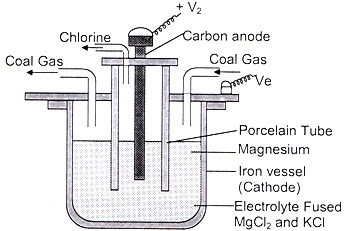
From fused MgCI2 :Magnesium is obtained by the electrolysis of fused MgCI2but the process is met with the following difficulties:
- Fusion temperature of MgCI2 is quite high.
- It is not good conductor of electricity.
- MgCI2 may be hydrolysed by water present in carnallite to form magnesium hydroxy chloride.
MgCI2 + H2O ↔ Mg(OH) CI + HCI
- On electrolysis of MgCI2, Mg metal liberated at cathode may come in contact with chlorine which is liberated at anode.
- O2 and N2 of the air present in the vessel may react with molten metal.
To overcome the above difficulties:
- The electrolyte used is fused MgCI2 to which some NaCI has also been added. The later reduces the melting point, increases the conductivity of the electrolyte and prevents the hydrolysis of magnesium chloride.
- The air of the apparatus is displaced by an inert gas such as coal gas or hydrogen.
- The electrolysis is carried out in iron cell which acts as cathode. A graphite aode is surrounded by a porcelain hood to escape chlorine.
On electrolysis magnesium is liberated and being lighter floats on the surface of the electrolyte and is drawn off. It is about 92.0% pure.
From fused Magnesium Chloride by Electrolysis :
Magnesium is also obtained by the electrolysis of magnesium chloride dissolved in used mixture of magnesium, potassium and sodium chlorides at 950oC, Magnesium is liberated at cathode while chlorine is evolved at anode.