METALLURGICAL EXTRACTION METHODS
These methods are divided into three groups:
- Pyrometallurgy
- Hydrometallurgy
- Electrolytic Reduction
PYROMETALLURGY
It involves the use of elevated temperature and changes in the chemical composition of the entire body of ore. Basic processes of pyrometallurgy are
- Calcination
- Roasting
- Smelting
- Distillation
CALCINATION
It is a process in which the ore is subjected to the action of heat but is confined to those operations only in which matter is simply expelled or the physical structure altered when heat is applied.
CaCO3 → CaO + CO2↑ (Calcined ore is left)
(Lime stone)
AI2O3.2H2O → AI2O3 + 2H2O↑
(Bauxite)
CuCO3.Cu(OH)2 → 2CuO + H2O↑ + CO2↑
(Malachite)
MgCO3 → MgO + CO2↑
(Magnesite)
2Fe2O3.3H2O → 2Fe2O3 + 3H2O↑
(Limonite)
ROASTING
In the process, the ore is heated either alone or in the presence of some substances of that volatile impurities are removed and some chemical changes also take place during this process. It can be of two types.
Oxidised roasting: Ores when heated in presence of O2 get converted into their oxides and impurities are converted into their volatile form, which do escape.
- 4FeS2 + 11O2 → 2Fe2O3 + 8SO2
-
2PbS + 3O2 → 2PbO + 2SO2
- HgS + O2 → Hg + SO2
- 2ZnS + 3O2 → 2ZnO + 2SO2
- 2Cu2S + 3O2 → 2Cu2O + 2SO2
Roasting or calcinations can be carried out in a reverberatory furnace.
Chlorinating roasting : This is done especially in the case of silver ore.
- Ag2S + NaCI → 2AgCI + Na2S
SMELTING
The process of extracting metal from its fused (molten) state is called smelting. The roasted or calcined ore containing metal oxide is missed with a reducing agent and heated to a high temperature. In this case, a less electropositive metal ore of Pb, Zn, Fe etc. are treated with powerful reducing agent such as C, H2, CO etc. Depending upon the nature of the oxide and metal, the extraction of metal can be carried out by the following reducing agents.
Carbon reduction process: Carbon, the cheapest available reducing agent usually in the form of coke is employed in the extraction of the lead, zinc, iron and tin etc. The oxides of the metals (either naturally occurring or obtained by calcinations of the naturally occurring carbonates or roasting of the sulphies) are mixed with coke and heated in a suitable furnace. Carbon or carbon monoxide reduces the oxide to free metal. For example,
- ZnO + C → Zn + CO
- ZnO + CO → Zn + CO2
- PbO + C → Pb + CO
- PbO + CO → Pb + CO2
- Fe2O3 + 3C → 2Fe + 3CO
- Fe2O3 + 3CO → 2Fe + 3CO2
- MnO2 + 2C → Mn + 2CO
- Mn2O3 + 3C → 2Mn + 3CO
- SnO + C → Sn + CO
- SnO + CO → Sn + CO2
Calcium cannot be extracted from CaO by carbon reduction process. Explain why?
During reduction, additional substance called flux is also added to the ore. It combined with impurities to form easily fusible product known as slag.
Impurities + Flux → Fusible product (slag)
Flux is a substance that is added to the ore during smelting (a) to decrease the melting point (b) to make the ore conducting and (c) to remove all the impurities (basic and acidic).
FeO + SiO2 → FeSIO3 (fusible slag)
Impurity acidic flux
SiO2 + CaO → CaSIO3 (fusible slag)
Impurity basic flux
Alumina is a bad conductor of electricity but when cryolite (flux) is added, it becomes a good conductor and the melting point is decreased. Hence, CaF2, KF, cryolite etc are neutral flux.
If FeO is present in the ore as impurity, then what type of flux is added to remove it?
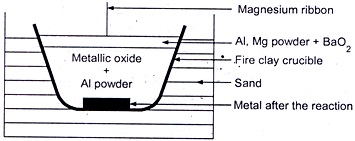
Reduction by another metal (Aluminium): If the temperature needed for carbon to reduce an oxide is too high for economic or practical purposes, the reduction may be effected by another highly electropositive metal such as aluminium, which liberates a large amount of energy (1675 kJ mol–1) on oxidation to AI2O3. This process of reduction of a metal oxide to metal with the help of aluminium powder is called aluminothermy or Goldschmidt Aluminothermic Process or Thermite process.
This process is employed in the case of those metal, which have very high melting points and are to be extracted from their oxides. A mixture of concentrated oxide ore and aluminium powder, commonly called as thermite is taken in a stell containing magnesium powder and barium peroxide. During the reaction, aluminium gets oxidized to AI
2O3while metal oxides releases metals.- 3Mn3O4 + 8AI → 9Mn + 4AI2O3
- 3MnO2 + 4AI → 3Mn + 2AI2O3
- B2O3 + 2AI → 2B + AI2O3
- Cr2O3 + 2AI → 2Cr + AI2O3
Sr and Ba are obtained by the reduction of their oxides by aluminium in vacuum.
Magnesium is used in a similar way to reduce oxides. In certain cases where the oxide is too stable to reduce, electropositive metals are used to reduce metal halides. Titanium (for supersonic aircrafts) zirconium (used in atomic reactors) are obtained by the reduction of their tetrachlorides with metallic sodium or magnesium.
TiCI4 + 2Mg  Ti + 2MgCI2
TiCI4 + 4Na → Ti + 4NaCI
Self-reduction process
The cations of the less electropositive metals like Pb, Hg, Sb and Cu may be reduced without the use of any additional reducing agent. Elevated temperature and anion or anions associated with the metal may bring about this change.
For example, in the extraction of mercury, the sulphide ore (cinnabar) is heated in a current of air when the following reactions take place.
2HgS + 3O2 → 2HgO + 2SO2
2HgO + HgS → 3Hg + SO2
(self reduction reaction)Similarly, in the extraction of copper, the sulphide and the oxide interact at an elevated temperature to give the metal.
Cu2S + 2Cu2O → SO2+ 6CU (self reduction reaction)
Similar reactions take place in the self-reduction process for the extraction of lead.
2PbS + 3O2 → 2PbO + 2SO2
PbS + 2PbO → 3Pb + SO2 (self reduction eaction)
Reduction of oxides with hydrogen
Certain metallic oxides can be reduced using molecular hydrogen. Because of inflammable nature of hydrogen, it is used in very few cases. Molybdenum and tungsten are obtained by reducing their oxides by hydrogen at elevated temperatures.
- Co3O4 + 4H2 → 3Co + 4H2O
- GeO2 + 2H2 → Ge + 2H2O
- 2NH4[MoO4] + 7H2 → 2Mo + 8H2O + 2NH3
- 2NH3[WO4] + 7H2 → 2W + 8H2O + 2NH3
This method is not widely used because many metals react with hydrogen at elevated temperature, forming hydrides. There is also a risk of explosion from hydrogen and oxygen present in the air.
ILLUSTRATION 2
Why is it advantageous to roast a sulphide ore to the oxide before reduction?
Solution :
2MS + C→ CS2 + 2M ; MS + H2 → H2S + M
The free energies of formation of most sulphides are greater than those for CS2 and H2S. So, the net reactions have unfavorable free energy of formations. Thus, neither carbon nor hydrogen is a suitable reducing agent for metal sulphides. Aluminium cannot be used, as reaction with metal sulphide would produce aluminum sulphide, which is not so exothermic. So, sulphide ores are preferentially converted to oxide ores as any reduction method (reduction by C, H2, AI etc.) could then be conveniently used.
DISTILLATION
HYDROMETALLURGY
It is based on dissolving the metal sought in aqueous solutions of acids or alkalis and subsequent precipitation. Basic processes of hydrometallurgy are
- Leaching
- Thickening
- Precipitation
LEACHING
This a chemical method of concentration. Here the powdered ore is treated with certain reagents, which dissolves the ore leaving behind impurities. The impurities left undissolved are removed by filtration. Leaching method is used for concentrating ores of aluminium, silver, gold etc. For example, bauxite (AI2O3.2H2O), is concentrated by this method. Crude bauxite contains ferric, oxide, titanium oxide and silica. These impurities are removed by making use of the amphoteric nature of alumina. Finely powdered bauxite is treated with an aqueous solution of caustic soda at 420-440 K under pressure for several hours. Alumina present in bauxite dissolves forming soluble sodium aluminate.
AI2O3 + 6NaOH → 2Na3AIO3 + 3H2O
The impuritie remain unaffected and separate as insoluble red mud, which is filtered off. The filtrate is diluted and a little freshly precipitated aluminium hydroxide is added which causes the precipitation of aluminum hydroxide. This is filtered and calcinated to get highly pure alumina.
Na3.AIO3 + 3H2O → AI(OH3) + 3NaOH
2AI(OH)3
 AI2O3 + 3H2O
Leaching is also used to concentrate silver and gold ores and is known as Mac Arthur Forrest cyanide process.
4Ag + 8NaCN + 2H2O + O2 → 4Na[Ag(CN)2] + 4NaOH
(Sodium argentocyanide)
4Au + 8NaCN + 2H2O + O2 → 4Na[Au(CN)2] + 4NaOH
(Sodium aurocyanide)
Now, Ag and Au can be recovered easily from the solution by the addition of electropositive metal like zinc.
2Na[Ag(CN)2] + Zn → Na2[Zn(CN)4] + 2Ag↓
2Na[Au(CN)2] + Zn → Na2[Zn(CN)4] + 2Au↓
Soluble complexes
THICKENING
Prior to precipitation, it is sometimes advantageous to concentrate the solution. This is especially true to learn materials, the leached solution of which are usually diluted or contain large amount of impurities. This concentration is called thickening. It is accomplished by means of ion-exchange method.
PRECIPITATION
ELECTROLYTIC REDUCTION
The strongest possible reducing agent is an electron. Any ionic material may be electrolysed and reduction occurs at the cathode. This is excellent method and gives very pure products but electricity is quite expensive. Electrolysis may be performed in aqueous solution provided that the products do not react with water.
This process is mainly used in the extraction of alkali and alkaline earth metals. In the case of highly electropositive metals, isolation by chemical agents is extremely difficult. In such cases, the metal is obtained by electrolysis of fused salts. Under such conditions, the ions readily mover to the oppositely charged electrodes and are distinguished and discharged over there. Some other salts may have to be added to lower the melting point of the compound taken.
In other solvent: Electrolysis can be carried out in solvents other than water. Fluorine reacts violently with water, and it is produced by electrolysis of KHF2 dissolved in anhydrous HF. (The reaction has many technical difficulties (i) HF is corrosive (ii) hydrogen produced at the cathode must be kept separate from the fluorine produced at the anode otherwise explosion may occur (iii) water must be rigorously excluded (iv) fluorine produced attacks the anode and the reaction vessel).
In fused melts: Elements that react with water are often extracted from fused melts of their ionic salts. These melts are frequently corrosive and involve large fuel bills to maintain the high temperature required. Aluminium is obtained by electrolysis of a fused mixture of AI2O3 and cryolite. Na3[AIF6]. Both sodium and chlorine are obtained from the electrolysis of fused NaCI: In this case up to two-thirds by weight of CaCI2 is added as an impurity to lower the melting point from 803oC to 505oC.
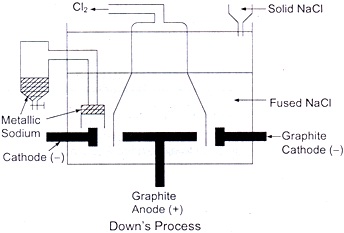
An example of this is the manufacture of sodium by electrolysis of a fused mixture of sodium and calcium chlorides (Down’s process). The cell and electrodes used should not be effected by the electrolyte or the products. Hence a steel cell, a graphite anode an iron cathode are employed. The various reactions that take place are,
On fusion, NaCI ↔ Na+ + CI– (ions become mobile)
On electrolysis, (i) At the cathode (negative electrode): Na+ + e– → Na (reduction)
(ii) At the anode (positive electrode) : CI– → CI + e– (oxidation); CI + CI → CI2
The products obtained react readily, hence a suitable arrangement has to be made to keep them separate.