IRON AND ITS METALLURGY
CONCENTRATION OF THE ORE
- Dressing of the ores: The iron ores are first broken into small pieces 3-5 cm in size.
- Roasting or Calcination: During roasting S, As, P are oxidized to the respective oxides.
S + O2 → SO2↑
4As + 3O2 → 2As2O3↑
FeCO3 decomposes as,
FeCO3 → FeO + CO2↑
Fe2O3.3H2O loses water
Fe3O4 is decomposed to ferrous oxide and ferric oxides.
Fe3O4 → FeO + Fe2O3
Ferrous oxide reacts with silica to forms ferrous silicate at high temperature.
FeO + SiO2 → FeSiO3
But the conversion of FeO into Fe2O3 will prevent the formation of FeSiO3. Thus the mass of the ore becomes porous causing the increase in the effective surface area.
- Smelting in the Blast furnace: Blast furnace is a shaft furnace made of steel plate of 20-30 in with 4-4.6 diameter.
EXTRACTION OF CAST IRON
Iron is usually extracted from the haematite. Concentrated ore after calcinations is reduced with carbon i.e. smelted in the blast furnace.
Reactions taking place in the blast furnace are
- Zone of combustion:
C + O2 → CO2
(Coke)
CO2 + C → 2CO; ΔH = +ve (Newmann’s inversion reaction)
- Zone of reduction:
The following reduction reactions are called indirect reduction, which is done by CO, which is unstable at higher temperature (See Ellingham diagram).
Fe2O3 + 3CO → 2Fe + 3CO2
FeO + CO → Fe + CO2
- Zone of slag formation:
CaCO3 → CaO + CO2
- Zone of fusion (lower part of furnace):
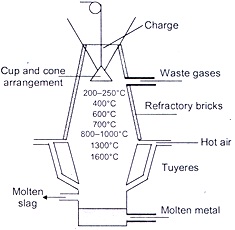
Molten iron is heavier than from molten slag. The two liquids are periodically tapped off. The molten iron tapped off from the furnace is solidified into blocks called ‘plags’.
PREPARATION OF WROUGHT IRON
This is done by heating cast iron with haematite (Fe2O3) which oxidizes C to CO, S to SO2, Si to SiO2, P to P4O10 and Mn to MnO
Fe2O3 + 3C → 2Fe + 3CO
Where CO and SO2 escape, manganous oxides (MnO) and Silica (SiO2) combine to form slag.
MnO + SiO2 → MnSiO3
Similarly phosphorous pentoxide combines with haematite to form ferric phosphate slag.
2Fe2O3 + P4O10 → 4FePO4
Bosh :
The diameter of the furnace gradually increases from the top down wards. Widest part of the furnace is called Bosh. At above 2m tuyers are there through which hot air blast is blown into the furnace.
Hearth:
Below the bosh this region exists. (1) slag notch is at higher height and (2) tap hole for metal passage at lower position from the bottom. At the top of the furnace the hopper is there which is cup and cone arrangement. Through this charge is introduced ill the course bed in the furnace is 4/5th the of the furnace. How air at 700oC is forced into the furnace through the tuyers. The thermal gradient inside exists from 1800oC (hearth) to 400oC–900oC in the upper region. Near the both the temperature varies from 1200o-1300o chemical reactions which take place are:
- At 1200oC near the tuyers,
C + O2 → CO2; CO2 + C → 2CO
- Above bosh 600o-900oC, ferric oxide is partially reduced by CO as
Fe2O3 + 3CO ↔ 2Fe + 3CO2↑
- CaCO3
 CaO + CO2
 CO2 + C
Fe2O3 + 3C → 2Fe + 3CO
CaO + SiO2 → CaSiO3 (slag)
- The reaction at 1500oC, MnO2 is reduced to Mn
MnO2 + 2C → Mn + 2CO
Ca3(OH)2 → CaO + P2O5
2P2O5 + 10C → P4 + 10CO
-
Collection of Cast iron: Metal is cast into ingots or in the ladle for further refining like steel making.
-
Wrought Iron: Minimum % of carbon is 0.1 – 0.1% and other impurities like S, P, Mn, Si less than 0.3%
-
Manufacturing process: Cast iron is taken in pudding furnace and melted by hot blast of air. The chemical reactions, which occur, are
S + O2 → SO2↑; 3S + 2Fe2O3 → 4Fe + 3SO2↑
3Si + 2Fe2O3 → 4Fe + 3SiO2
Mn + Fe2O3 → 2Fe + 3MnO
MnO + Fe2O3 → MnSiO3 (slag)
3C + Fe2O3 → 2Fe + 3CO
4P + 5O2 → 2P2O5; Fe2O3 + P2O5 → 2FePO4 (slag)
The impurities are removed from ion, the melting point of the metal rises and it becomes as semi solid mass. Metal taken out from the furnace in the form of balls with the help of rubbles. The balls are then beaten under hammer to separate out the slag. The product thus formed is thus called wrought iron.
Some Important Alloy
|
Sl. No. |
Name |
Composition |
|
1. |
Stainless steel |
Fe, Cr, Ni |
|
2. |
Invar |
Fe, Ni |
|
3. |
Alnico |
Fe, AI, Ni, Co |
|
4. |
Brass |
Cu, Zn |
|
5. |
Bronze |
Cu, Zn, Sn |
|
6. |
Gun Metal |
Cu, Sn |
|
7. |
Bell Metal |
Cu, Sn |
|
8. |
German Silver |
Cu, Zn, Ni |
|
9. |
Solder, pewter |
Pb, Sn |
|
10. |
Babbitt metal |
Sn, Sb, Cu |
TIN AND ITS METALLURGY
The chief ore of tin is cassiterite or tin stone, SnO2. It also contains silica and wolframite (iron tungstate, FeWO4), iron pyrites and arsenical pyrites and sometimes copper pyrites. The ore is concentrated, and then smelted to give crude tin which is finally refine.
ROASTING
The impure tin stone is roasted in current of hot air in an inclined revolving tube-furnace, when arsenic and sulphur are expelled as volatile oxides; most of the iron is converted to the magnetic oxide, Fe3O4 and copper forms oxide and sulphate.
SMELTING
The black tin is mixed with one-fifth of its weight of crushed anthracite coal and some line and fluorspar to act as a flux and smelted at 1200o – 1300oC in a reverberatory furnace when the tin oxide is reduced to the metal. The molten tin and slag form two layers are run out separately.
SnO2 + 2C → Sn + 2CO
The liquid tin is cast into ingots or else refined to a higher purity.
A good amount of tin goes into the slag, because of the amphoteric nature of tin dioxide the slag may contain 10 to 25% tin. Tin is recovered from the slag by smelting it at a much higher temperature with carbon, flux and some scrap iron to decompose the tin oxide.
SnSiO3 + CaO + C → Sn + CaSiO3+ CO
SnSiO3 + Fe → Sn + FeSiO3 ; SnO2 + 2C → Sn + 2CO
REFINING
The crude tin is refined by liquation or sweating i.e. by heating the ingots on the sloping hearth of a reveraberatory furnace, when the easily fusible tin (melting point 232o) melts and runs away leaving behind to dross of an alloy of tin with iron, copper, tungsten and arsenic. Bi and Pb because of their low melting points go with tin and remain in the sweated tin.
The liquated tin is further treated by poling, i.e. the liquid tin stirred with poles of green wood so that a large surface is exposed to the air, when the remaining impurities are oxidized and separated as scum on the surface and are skimmed off. The tin so obtained is of over 99% purity. The scum and dross contain much tin and are worked up by smelting.