FURNANCES USED IN METALLURGY
Some of the principal furnaces used are the following:
KILNS
These are the structures of enclosures in which the materials are mixed with proper fuel, free access of air is permitted but no fusion takes place. The kilns are sometimes heated by gas or by the waste heat from other furnaces.
BLAST FURNACES
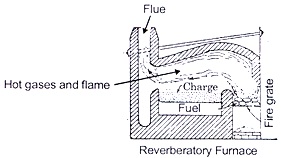
REVERBERATORY FURNACE
These are the furnaces in which the fuel is burnt in a separate part of the structure, the flame and got gases only coming into contact with the material treated. The chamber in these furnaces is horizontal and is divided into two equal parts by a bridge like partition. The smaller part is the fireplace, closed with fire-bars below.
The larger portion is the laboratory of the furnace, the bottom of which is known as the bed or hearth. The materials are placed on this bed for treatment. Opposite to the fireplace at the other end, is the fine bridge which communicates with stack or chimney. The root of the furnace gradually takes a bend towards the flue end and the whole concave bend deflects or reverberates the flame and hot gases from the fire downwards, the roof comprising the concave bend becomes heated and radiates heat on the bed. As the fuel does not come directly in contact with the material, the reverberatory furnace can be utilized both for reduction and oxidation processes. If reduction be desired the material is mixed with a reducing agent.
MUFFLE FURNACES
It is sometimes described for certain reasons to exclude the products of combustion as well as the fuel and this is accomplished in muffle furnaces. The muffle is a chamber surrounded by the fire or by flues through which the products of combustion and hot gases from the fire pass. These furnaces are used for annealing and gold and silver assaying.
REGENERATIVE FURNACES
The heat carried away to the flues by the escaping gases is again utilized in these furnaces. A flowing column of air is heated by the hot flue gases, the air is then brought back to the fire and returned to the furnace. This means an economy of fuel. Most of the furnaces are fitted up with regenerative systems.
ELECTRIC FURNACES
Such furnaces are largely used where cheap power is available and very high temperatures are required and also for electrolytic reductions. The furnaces may be classified as (a) Induction furnaces, in which the charge lying on the furnace bed or in a crucible constitutes the secondary coil of an induction unit, and the induced current produced by making and breaking the primary circuit, heat up the material, (b) Resistance furnaces in which the heat generated by resistance I the circuit is utilized. In some of the furnaces, the body of the furnace itself is made of a resistance material. Small furnaces may be prepared by heat is generated by arcs and thereby, a temperature of over 3000oC current and the arc is struck between them and the charge.
Besides these, there are many types of furnaces such as Bessemer converter, Heroult’s furnace etc. which are used in metallurgy.