ALUMINIUM AND ITS METALLURGY
Aluminium is the most abundant metal in the earth’s crust. Aluminium does not occur free in nature, but its compounds are numerous and widely distributed.
The chief and important ore from which aluminium is exclusively and profitably obtained is Bauxite, AI2O3.2H2O. The extraction of the metal from bauxite involves the three main steps.
- Purification of Bauxite
- Electrolytic reduction of Alumina, (AI2O3)
- Purification of AI.
PURIFICATION OF BAUXITE
Bauxite is either white or brown in colour depending upon the presence of too much SiO2; TiO2 or Fe2O3 respectively. The purification is carried out as below
- Hall’s dry process:
Bauxite is fused with sodium carbonate. Sodium meta aluminate, NaAIO2, is produced which is soluble in water. It is extracted with water. The impurities present viz. ferric oxide and silica, are left behind.
AI2O3 + Na2CO3 → 2NaAIO2 + CO2
The water extract is heated to 50o — 60oC and a current of carbon dioxide is passed through it. Aluminium hydroxide is ignited to obtain pure alumina.
2NaAIO2 + 3H2O + CO2 → 2AI (OH)3↓ + Na2CO2
2AI(OH)3 → AI2O3 + 3H2O
- Baeyer’s process
(For ores containing much Fe2O3): The calcined bauxite is digested with strong NaOH solution at 150o under pressure when alumina (AI2O3) dissolves out leaving behind oxides of iron, titanium as residue.
AI2O3 + 2NaOH → 2NaAIO2 + H2O
Sod. aluminate
The mass is filtered and the filtrate is stirred with freshly precipitated AI(OH)3. Sodium meta-aluminate in the filtrate is hydrolysed and is changed into aluminium hydroxide as precipitated.
2AI(OH)3 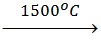 AI2O2 + 3H2O
- Serpeck’s process (for ores contained much of silica, SiO2):
The ore is heated with carbon at 1800oC and nitrogen is passed over it. Aluminium nitride is formed which on hydrolysis with water yield AI(OH)3. This is separated and calcined to get alumina.
AI2O3 + 3C+ N2 → 2A/N + 3CO↑
Bauxite
A/N + 3H2O → AI(OH)2↓ + NH3↑
2AI(OH)3 → AI2O3 + 3H2 O
SiO2 + 2C → Si + 2CO
Silica is present as impurity is reduced by carbon to silicon, which volatilizes at the high temperature.
Electrolytic reduction of pure AI2O3 (Hall and Heroult’s process, 1886)
Aluminium metal has great affinity for oxygen and thus the reduction of its oxide by carbon is not possible under ordinary conditions. It does take place at very high temperature and AI metal formed reacts with carbon forming aluminium carbide (AI4C3).
The reduction is however, possible electrolytically, but is encountered with the following difficulties.
- Pure AI2O3 is a bad conductor of electricity and has high melting point i.e., above 2000oC.
-
If electrolysis of fused alumina is carried out, metal aluminium formed will vaporize off as its boiling point is about 1800o
C.
PRINCIPLE OF EXTRACTION
Alumina is mixed with cryolite (Na3AIF3), fluorspar (CaF2) in the ratio 20 : 60 whereby, it not only becomes good conductor but also fuses at about 900oC which is much below the b.p. of aluminium.
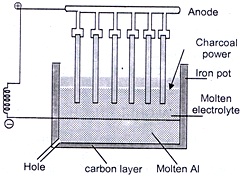
The electrolysis of the fused mass is carried out in an iron box, which lined with gas carbon. The lining serves as the cathode, the anode consists of carbon rods dipped in the fused mass. The fused electrolyte is kept covered with a layer of powdered coke to prevent any action of air. The voltage employed in the electrolysis is 5.3 volts. The current passed (about 50,000 amperes) serves to purposes: (i) heating and (ii) electrolysis. Thus the fused mass is automatically kept at 900oC during electrolysis.
Aluminium is obtained at the cathode and being heavier than the electrolyte sinks to the bottom and is tapped off periodically from the tap hole. Oxygen liberated at the anode attacks carbon rods and forms CO and CO2. During electrolysis the concentration of the electrolyte goes on falling thereby increasing the resistance of the cell which is indicated by the glowing of a lamp placed parallel. Much of the alumina is then added and the process is made continuous.
The probable reactions may be given as
4A/F3 → 4Al3+ + 12F–
12F– → 12F + 12e–
12AI2O3 + 12F → 4AIF3 + 3O2
4C + 3O2 → 2CO + 2CO2
4AI3+ + 12e– → 4AI At cathode At anode
PURIFICATION
Aluminium as produced by the electrolysis of AI2O3 is 90% pure. It can be refined further up to 99.9% purity by Hoope’s process.
The electrolytic cell consists of an iron tank lined with carbon. It is filled with three liquids differing in specific gravity. The upper layer is of pure fused aluminium and serves as cathode.
The bottom layer is that of impure metal in the fused state and serves as anode. The central layer is that of molten mixture of the fluorides of AI, Ba and Na and serves as an electrolyte.

On passing electric current, pure aluminium goes to the top layer from the central layer and an equivalent amount of the metal from the bottom layer passes into the central layer. There is thus gradual transference of aluminium from bottom layer to the top and the impurities are left behind. Crude aluminium is added from time to time.
Aluminium is not extracted directly from bauxite. Explain why?
PROPERTIES OF ALUMINIUM
Physical :
- It is a bluish white metal with a brilliant luster.
- It is a light metal and its density is 2.7.
- Its melting point and boiling point are 658.7oC and 1800oC respectively.
- It is good conductor of heat and electricity.
- It forms alloys with other metals.
Chemical:
- Action of air: It is not affected by dry air but in moist air a film of oxide is formed on the surface. It burns in oxygen producing oxide.
4AI + 3O2 → 2AI2O3 + 77/2 kcals.
2AI + N2 → 2AIN
- Action of water: Pure Aluminium is not affected by pure water but impure metal is corroded by water containing some impurities.
It decomposes by boiling water evolving hydrogen.
2AI + 6H2O → 2AI(OH)3↓ + 3H2
- Action of acids:
2AI + 6HCI → 2AICI3 + 3H2
2AI + 3H2SO4 → 2AI2(SO4)3 + 3H2
(b) Hot and concentrated H2SO4 produces sulphur dioxide.
2AI + 6H2SO4 → 2AI2 (SO4)3 + H2
(c) Concentrated HNO3 does not react with AI as AI forms a self protecting coating of AI2O2 which renders HNO3 unreactive towards AI. This is called passivity of AI.
- Action of alkalies : When AI-powder is boiled with NaOH solution, H2 is liberated and soluble aluminates are formed.
2AI + 2MOH + 2H2O → 2MAIO2 + 3H2
meta aluminate
2AI + 6MOH → 2M3AIO3 + 3H2 (M = Na, K)
meta aluminate
- Action of halogens : When halogens are passed over heated aluminium halides are formed.
2AI + 3CI2 → 2AICI3
- Action of nitrogen : Aluminium when heated with nitrogen gas gives aluminium nitride.
2AI + N2 → 2AIN
- Displacement of other metals : Aluminium displaces copper, zinc and lead from the solutions of their salts because these metals are less electropositive than AI. (see electrochemical series).
3ZnSO4 + 2AI → AI2(SO4)3 + 3Zn
USES OF ALUMINIUM
- Aluminium, being very light, is used in householf utensils, aeroplane parts, precision and surgical instruments etc.
- Since it is unattached by nitric acid, is used in chemical plants and also for transporting nitric acid.
- Aluminium foil is used for packing chocolates, cigarettes etc.
- Alums are used as mordents in dyeing and points.
- Mixed with oil, it is used in steam piped and other metal objects.
- It is used as a reducing agent for the production of certain metals such as chromium, iron, manganese etc.
- Alumina is used for making refractory bricks and ultramarine.
ALUMINIUM ALLOYS
Aluminium forms a number of useful alloys, which are given as follow;
|
Alloy |
Approximate composition |
Uses |
|
(1) Aluminium bronze |
AI 10%, Cu 90% |
For hard, non-corrodible vessels |
|
(2) Duralumin |
AI 95%, Cu3% Mn1% Mg1% |
Aeroplanes and automobile parts |
|
(3) Magnalium |
AI 90%, Mg10% |
Balance beams |
|
(4) Y-alloy |
AI 92.5%, Cu 4%, Ni 2%, Mg 1.5% |
Aeroplanes, non-corrodible vessels. |
GOLDSCHMIDTS’ ALUMINOTHERMIC PROCESS
The evolution of enormous quantities of heat in the oxidation of aluminium is used in thermite welding of metals. This process is also known as Goldschmidts aluminothermic process.
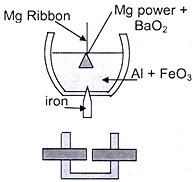
A mixture containing 3 parts of ferric oxide and one part of aluminium powder is placed in a crucible lines with magnesite and having a plug hole (see figure). This is covered with a layer of mixture of magnesium power and barium peroxide, with a magnesium ribbon inserted into it to act as a fuse. The broken ends of a rail or a girder etc. are brought nearer and thoroughly cleaned and surrounded by a
fire-clay mould. When the magnesium ribbon fuse is ignited, the reaction.
2AI + Fe2O3 → AI2O3 + 2Fe
(ΔH = 3230 kJ)
Starts producing tremendous amount of heat as a result of which the iron melts. This white hot molten iron is tapped from the crucible into the mould. The heated ends of the iron rods (to be welded) actually, melt and mix with the molten metal added, giving a firm and strong weld.