A joint is the point where two or more bones meet. There are three main types of joints; Fibrous (immoveable), Cartilaginous (partially moveable) and the Synovial (freely moveable) joint.
Fibrous joints
Fibrous (synarthrodial): This type of joint is held together by only a ligament. Examples are where the teeth are held to their bony sockets and at both the radioulnar and tibiofibular joints.
Cartilaginous
Cartilaginous (synchondroses and sympheses): These joints occur where the connection between the articulating bones is made up of cartilage for example between vertebrae in the spine.
A cartilagenous joint between two vertebrae
Synchondroses are temporary joints which are only present in children, up until the end of puberty. For example the epiphyseal plates in long bones. Symphesis joints are permanant cartilagenous joints, for example the pubic symphesis.
Synovial Joints
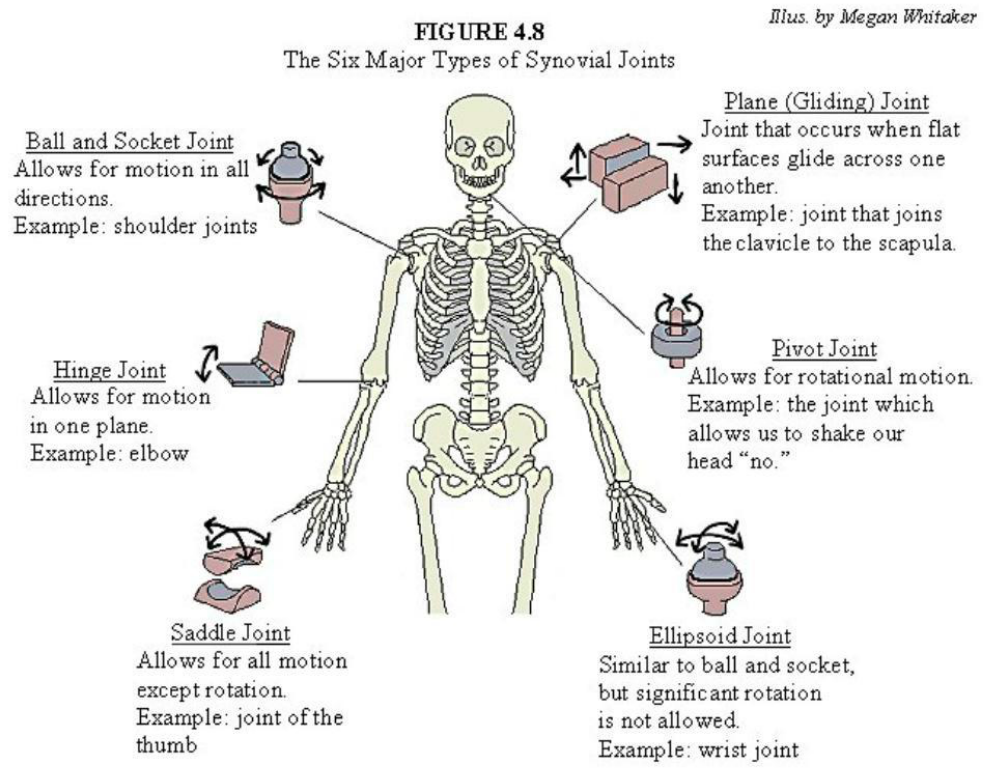
Synovial (diarthrosis): Synovial joints are by far the most common classification of joint within the human body. They are highly moveable and all have a synovial capsule (collagenous structure) surrounding the entire joint, a synovial membrane (the inner layer of the capsule) which secretes synovial fluid (a lubricating liquid) and cartilage known as hyaline cartilage which pads the ends of the articulating bones. There are 6 types of synovial joints which are classified by the shape of the joint and the movement available.
Types of Synovial Joint
- The hinged joint is found at the elbow and the knee and movements available are flexion and extension.
- The pivot joint is found at the top of the spine (atlas and axis bones) and allows rotation of the neck.