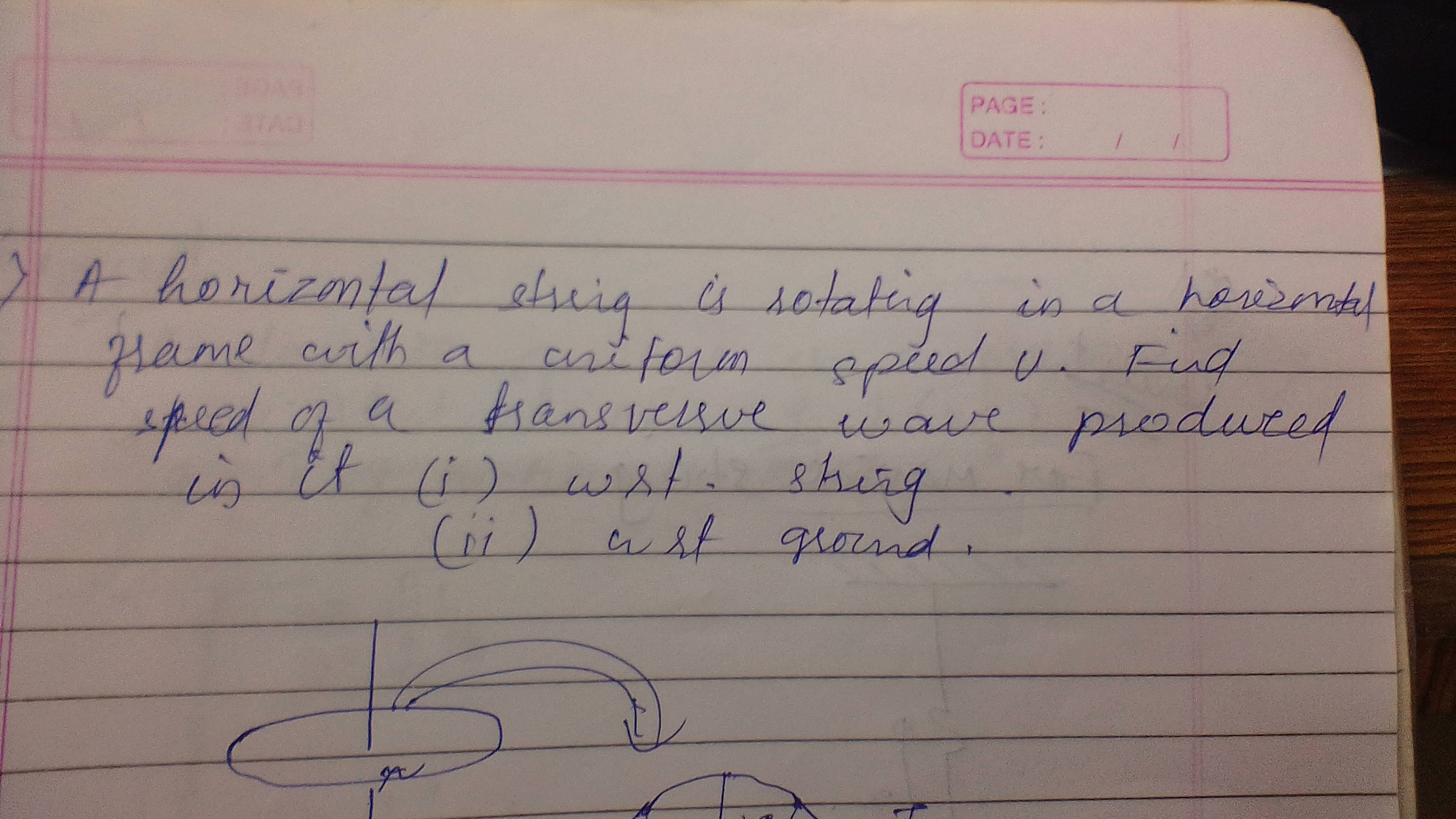
To determine the speed of a transverse wave produced in a rotating horizontal string, we need to consider the dynamics of the system and how the rotation affects wave propagation. Let's break this down step by step.
Understanding the System
Imagine a string that is fixed at both ends and is rotating around a vertical axis. The string is moving with a uniform speed, denoted as v. When a transverse wave is generated on this string, it travels along the length of the string. The key here is to analyze how the rotation influences the wave speed.
Wave Speed in a String
The speed of a transverse wave on a string is generally given by the formula:
Where:
- T is the tension in the string.
- μ is the linear mass density of the string (mass per unit length).
Effect of Rotation on Tension
In our scenario, the tension in the string is affected by the centrifugal force due to its rotation. As the string rotates, each segment of the string experiences an outward force that increases the tension. The tension can be expressed as:
Where T_0 is the initial tension (if any), and F_c is the centrifugal force acting on the string segment. The centrifugal force for a small segment of the string can be calculated as:
Here, m is the mass of the segment, ω is the angular velocity, and r is the distance from the axis of rotation.
Calculating Angular Velocity
The angular velocity ω can be related to the linear speed v by the formula:
Substituting this into our expression for centrifugal force gives us:
- F_c = m * (v/r)² * r = (m * v²) / r
Final Expression for Tension
Now, we can substitute this back into our tension equation:
Wave Speed with Respect to Ground
Now that we have the tension, we can substitute it into the wave speed formula:
- v_wave = √((T_0 + (m * v²) / r) / μ)
This equation gives us the speed of the transverse wave on the rotating string with respect to the ground. The wave speed is influenced by both the initial tension and the additional tension created by the centrifugal force due to rotation.
Example Calculation
Let’s say we have a string with a linear mass density of μ = 0.01 kg/m, an initial tension of T_0 = 5 N, and it is rotating with a linear speed of v = 2 m/s at a radius of r = 1 m. First, we calculate the mass of a segment:
- m = μ * Δx (for a small segment Δx)
Assuming Δx = 1 m, we have m = 0.01 kg. Now, substituting into the tension equation:
- F_c = (0.01 kg * (2 m/s)²) / 1 m = 0.04 N
Then the total tension becomes:
- T = 5 N + 0.04 N = 5.04 N
Finally, substituting back into the wave speed formula:
- v_wave = √(5.04 N / 0.01 kg/m) = √(504) ≈ 22.4 m/s
Thus, the speed of the transverse wave produced in the rotating string with respect to the ground is approximately 22.4 m/s.