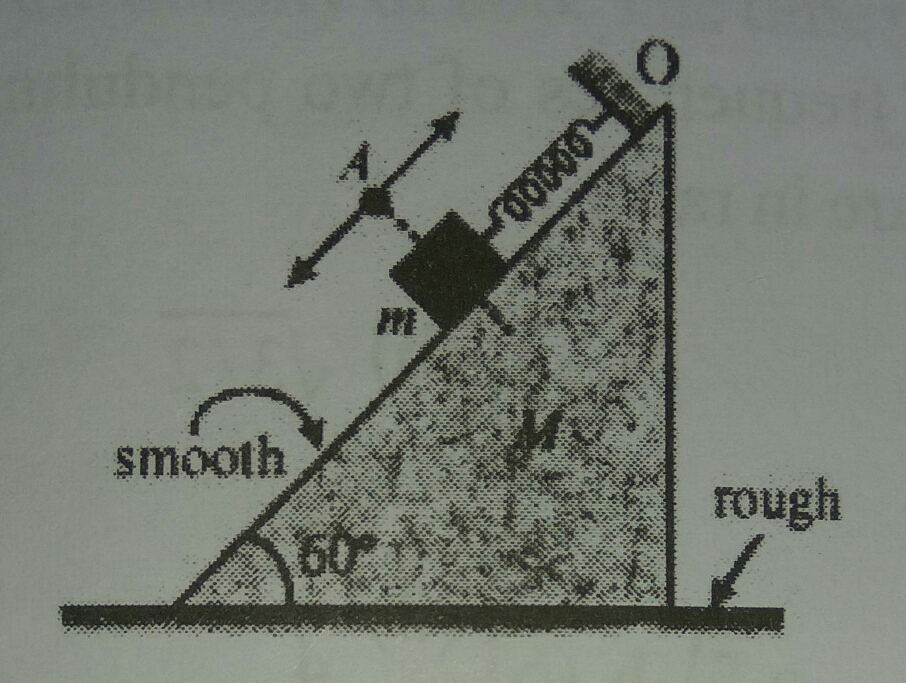
To analyze the situation of a block oscillating on a smooth inclined wedge, we need to consider the forces acting on both the block and the wedge. The problem involves understanding the dynamics of the system, particularly how the oscillation of the block affects the wedge, especially given the presence of friction on the horizontal surface beneath the wedge.
Understanding the Forces at Play
First, let’s break down the forces acting on the block and the wedge. The block of mass m is on an inclined plane with an angle of 60°. The wedge of mass M is on a rough horizontal surface, which means friction will play a role in its motion.
Forces on the Block
The block experiences gravitational force acting downward, which can be decomposed into two components:
- Perpendicular to the incline: mg cos(60°)
- Parallel to the incline: mg sin(60°)
Since the wedge is smooth, there is no friction between the block and the wedge, allowing the block to slide freely down the incline. The force causing the block to oscillate is related to its linear frequency f and amplitude A.
Forces on the Wedge
The wedge will experience a reaction force due to the block's weight and its motion. As the block oscillates, it exerts a force on the wedge, which can be calculated using Newton’s third law. The horizontal component of the force exerted by the block on the wedge can be expressed as:
F_horizontal = m * a
Where a is the acceleration of the block along the incline, which can be derived from its oscillatory motion:
a = (2πf)²A
Frictional Force on the Wedge
The frictional force acting on the wedge is crucial in determining whether the wedge will move or remain stationary. The maximum static frictional force can be given by:
F_friction_max = u * N
Where N is the normal force acting on the wedge. The normal force can be calculated as:
N = M * g
Thus, the maximum static frictional force becomes:
F_friction_max = u * M * g
Equating Forces
For the wedge to remain stationary while the block oscillates, the horizontal force exerted by the block must be less than or equal to the maximum static frictional force:
m * (2πf)²A ≤ u * M * g
This inequality shows the relationship between the mass of the block, the amplitude of oscillation, the frequency, and the coefficient of static friction. If the left side exceeds the right side, the wedge will start to slide.
Final Thoughts
In summary, the force of friction acting on the wedge is determined by the coefficient of static friction and the normal force. The oscillation of the block introduces a dynamic component that must be balanced by the frictional force to prevent the wedge from sliding. Understanding these relationships helps us analyze the stability of the system effectively.