
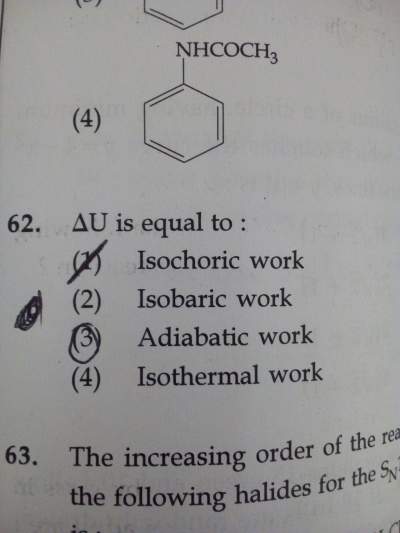
Please explain this question....
Rounded one is the correct answer...
Please explain this question....
Rounded one is the correct answer...
Rounded one is the correct answer...

Harsha Sanchez , 9 Years ago
Grade 12th pass
 Physical Chemistry> Please explain this question.... Rounded ...
 1 Answers
It seems like you're looking for clarity on a specific question, particularly one where the rounded answer is deemed correct. Let's break down the concept of rounding and how it applies to various scenarios, which will help clarify why the rounded answer is the right choice.
Rounding is a mathematical technique used to simplify numbers while maintaining their approximate value. This is particularly useful in everyday situations where exact figures are not necessary, such as estimating costs or measuring distances.
Rounding typically occurs when:
The basic rule of rounding is straightforward: if the digit to the right of the rounding place is 5 or greater, you round up. If it’s less than 5, you round down. For example:
Now, let’s consider your specific question. If you have a number that you need to round, the process will depend on the context. For instance, if you were calculating a total cost of items that came to 19.76, rounding to the nearest whole number would yield 20, which is more practical for transactions.
Rounding is prevalent in various fields:
Choosing the rounded answer can simplify communication and understanding. It allows for easier comparisons and decisions without getting bogged down by excessive detail. In many cases, the rounded figure is sufficient for making informed choices.
In summary, rounding is a valuable tool that helps us manage numbers in a way that is both practical and efficient. Whether in financial calculations, scientific measurements, or everyday estimations, knowing when and how to round can significantly enhance clarity and usability of data. If you have a specific example or scenario in mind, feel free to share, and we can delve deeper into that context!
 Approved
Prepraring for the competition made easy just by live online class.

Full Live Access

Study Material

Live Doubts Solving

Daily Class Assignments

Last Activity: 3 Years ago
Last Activity: 3 Years ago
Last Activity: 4 Years ago