

Grade 12Organic Chemistry
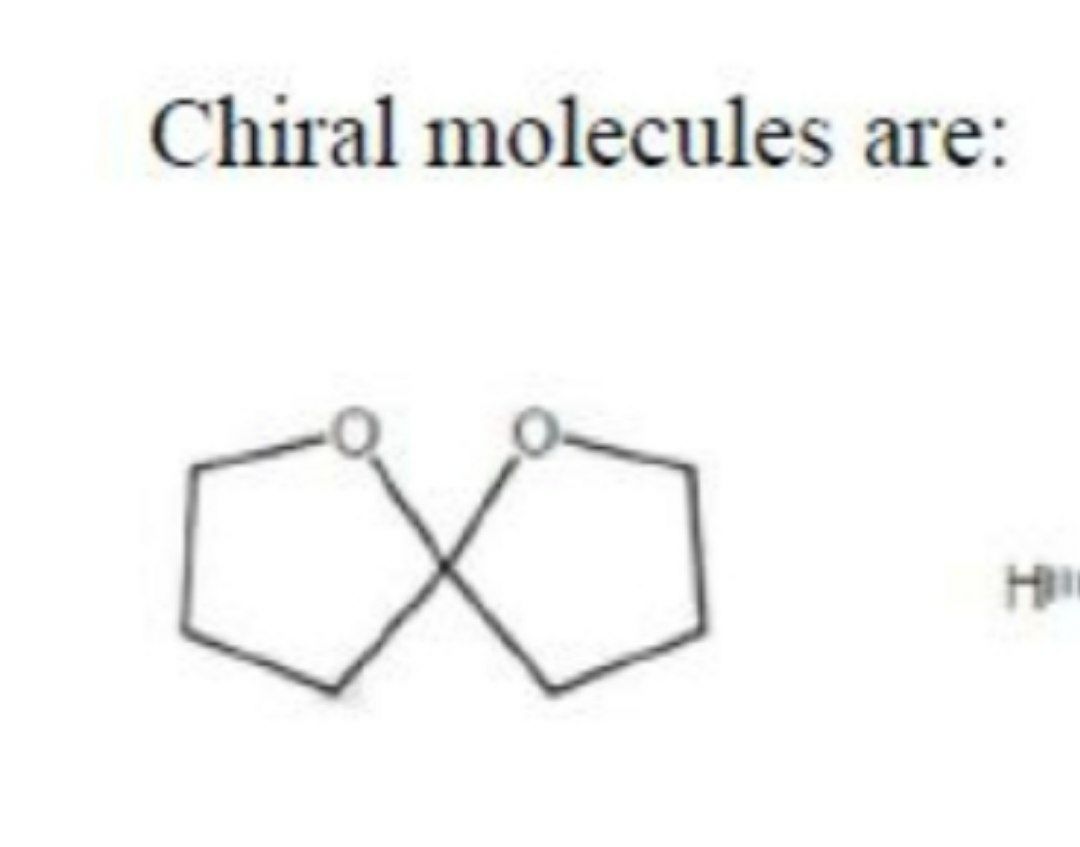
why is this molecule chiral, even though it’s having plane of symmetry?
why is this molecule chiral, even though it’s having plane of symmetry?


 Approved Tutor Answer0 Years ago
Chirality in molecules is a fascinating topic in chemistry, and it can sometimes lead to confusion, especially when we encounter molecules that seem to possess symmetry yet are still classified as chiral. To clarify this, let’s delve into the concept of chirality and how it relates to symmetry.
Chirality refers to the property of a molecule that makes it non-superimposable on its mirror image. Think of your hands: they are mirror images of each other, but you cannot perfectly align one hand over the other. This is a classic example of chirality in three-dimensional space.
Symmetry in chemistry often refers to the presence of certain planes or axes that divide a molecule into two identical halves. A plane of symmetry is a hypothetical plane that divides a molecule into two mirror-image halves. However, the presence of a plane of symmetry does not automatically imply that a molecule is achiral.
Now, let’s address the core of your question: a molecule can be chiral even if it has a plane of symmetry under certain conditions. This typically occurs in cases where the molecule has multiple stereocenters or when the arrangement of substituents around a stereocenter creates a situation where the overall molecule lacks a true mirror image.
Consider a molecule like 2,3-butanediol. This molecule has two stereocenters. If you look at one enantiomer of 2,3-butanediol, it has a plane of symmetry when viewed in isolation, but the two enantiomers (R and S forms) are not superimposable on each other. This is because the spatial arrangement of the groups around the stereocenters leads to distinct three-dimensional shapes that cannot be aligned perfectly.
To visualize this, imagine two different configurations of a molecule where the groups around the stereocenters are arranged differently. Even if a plane of symmetry exists in one configuration, the other configuration will not align with it, demonstrating chirality.
In summary, chirality is determined by the spatial arrangement of atoms in a molecule rather than just the presence of symmetry. A molecule can exhibit chirality despite having a plane of symmetry due to the specific arrangement of its substituents and the presence of stereocenters. This nuanced understanding of chirality is crucial in fields like pharmaceuticals, where the different enantiomers of a chiral drug can have vastly different biological effects.

Last Activity: 3 Years ago
Last Activity: 3 Years ago
Last Activity: 4 Years ago