

Grade 12th passOrganic Chemistry
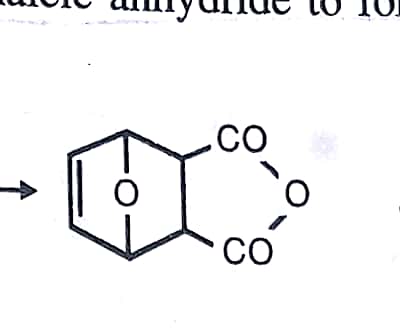
Why furan show diels alder reaction but thiophene and pyrrole not? What is the name of the above compound?
Why furan show diels alder reaction but thiophene and pyrrole not? What is the name of the above compound?


 Approved Tutor Answer7 Years ago
furan is less aromatic than pyrrole, so it much more readily acts like a diene.
to see this, consider what it takes to force furan and pyrrole into an aromatic configuration.
for pyrrole, the amine nitrogen's lone pair has to delocalize across the pi system. the nitrogen has to leave its normal sp3 configuration and adopt an sp2 so the lone pair can fill a p orbital and be co-planar with the rest of the pi system. then and only then does the ring get its 6 electrons. the nitrogen doesn't mind adopting an sp2 configuration -- it happens often enough (even in things like amides, the amide nitrogen adopts an sp2 config fairly readily). and it certainly doesn't mind sharing its lone pair. in fact it's ability to donate a lone pair is essentially what controls all of the amine's chemistry.
so pyrrole is "pretty aromatic."
but furan is a different story. you can think of the oxygen in furan adopting an sp2 configuration while it's still got two sigma bonds. "homey don't play that." and it has to delocalize one of its lone pairs across the whole ring, essentially taking on significant "O+" character as well as an sp2 config. it's almost taking on the character[istics] of a protonated carbonyl. and in fact, that's exactly how you should think about furan, as a diene that formed from protonating an allylic carbonyl, which then tautomerized into a dienol.
....and dienols are, of course, activated towards DA reactions with dienophiles.
So furan has both the characteristics of an aromatic, as well as the characteristics of an activated diene, while pyrrole simply has the characteristics of an aromatic.
thus furan is way more reactive towards dienophiles, and participates lovingly in a diels alder cycloaddition.

Explain why propanol has higher boiling point than that of butane
Last Activity: 3 Months ago
Reducing agent and their application in APi manufacturing 30 side
Last Activity: 3 Months ago
Last Activity: 4 Years ago