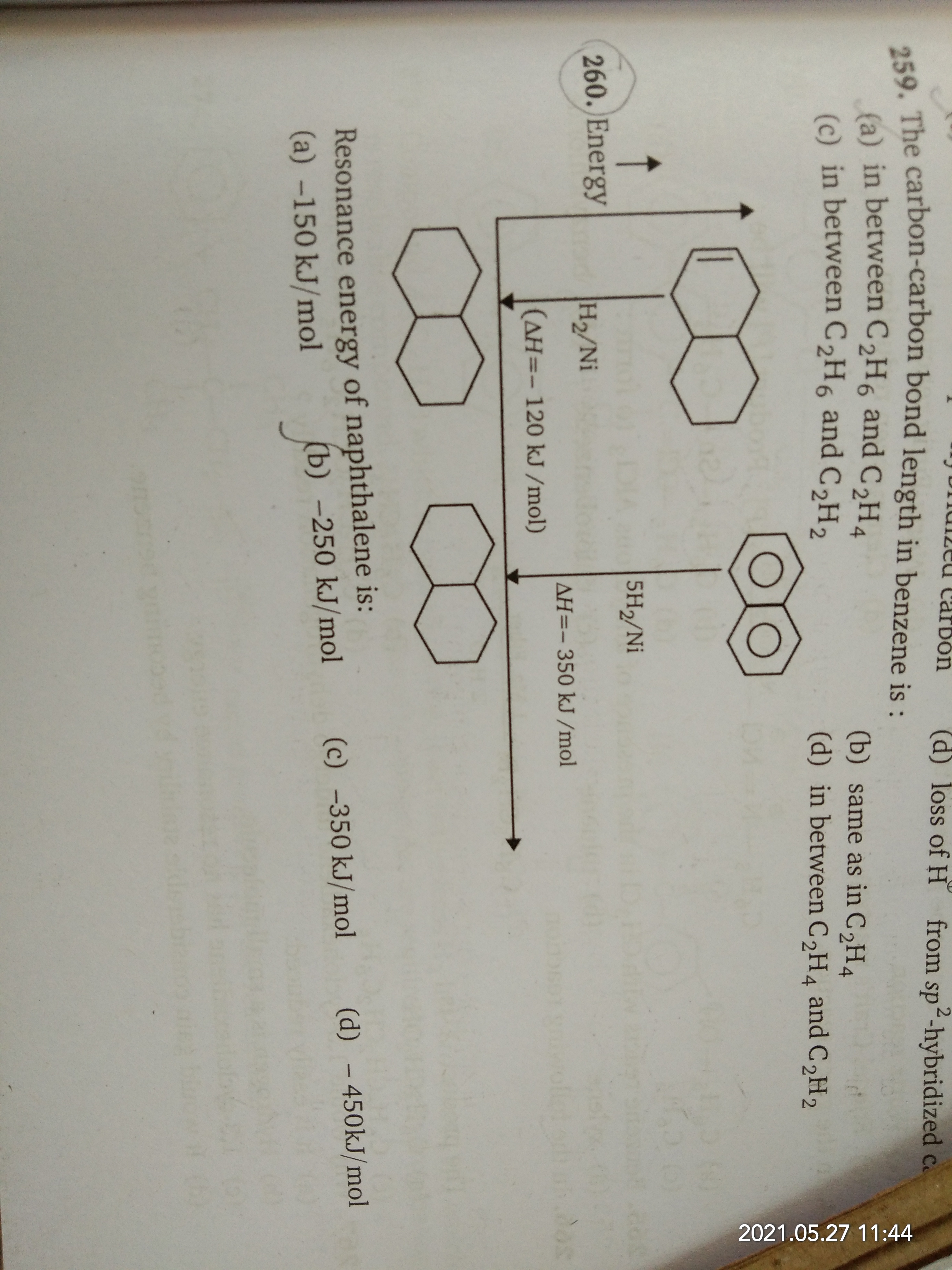
Resonance energy is a fascinating concept in chemistry, particularly when discussing aromatic compounds like benzene. To understand why the resonance energy per benzene ring is often cited as 250 kJ/mole, despite the heat released during hydrogenation being 350 kJ/mole, we need to delve into the nature of benzene's stability and its resonance structures.
Defining Resonance Energy
Resonance energy refers to the extra stability that a molecule gains due to the delocalization of electrons across multiple resonance structures. In the case of benzene, it has a unique structure where six carbon atoms form a ring, with alternating double bonds. However, these double bonds are not fixed; instead, the electrons are delocalized, which means they are spread out over the entire ring rather than being localized between specific pairs of atoms.
Understanding the Heat of Hydrogenation
The heat of hydrogenation is the amount of energy released when a compound reacts with hydrogen to become saturated. For benzene, the theoretical heat of hydrogenation, if it were to behave like a typical alkene (with three double bonds), would be about 360 kJ/mole. However, when benzene is actually hydrogenated, the heat released is only 208 kJ/mole. This discrepancy arises because benzene is more stable than expected due to resonance.
Calculating Resonance Energy
To find the resonance energy, we can use the following relationship:
- Heat of hydrogenation of hypothetical cyclohexatriene (360 kJ/mole)
- Actual heat of hydrogenation of benzene (208 kJ/mole)
The difference between these two values gives us the resonance energy:
Resonance Energy = Heat of hydrogenation (hypothetical) - Heat of hydrogenation (actual)
Substituting the values:
Resonance Energy = 360 kJ/mole - 208 kJ/mole = 152 kJ/mole
Why the 250 kJ/mole Figure?
The value of 250 kJ/mole for resonance energy is often cited in literature as an average or rounded figure that accounts for various factors, including experimental variations and the specific conditions under which measurements are taken. It reflects a more generalized understanding of the stability provided by resonance in benzene and its derivatives.
Conclusion
In summary, while the heat released during hydrogenation of benzene is 208 kJ/mole, the resonance energy is derived from the difference between the expected and actual heat of hydrogenation. The commonly cited value of 250 kJ/mole serves as a useful approximation that highlights the significant stability benzene gains from its resonance structures. This concept is crucial for understanding the behavior of aromatic compounds in organic chemistry.