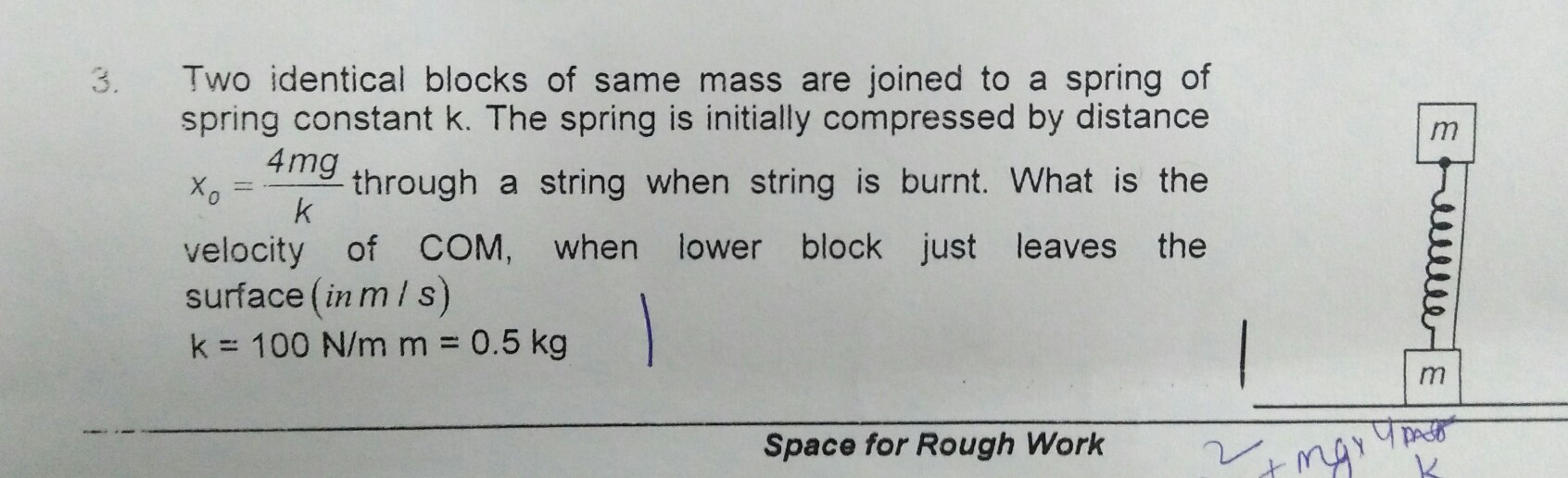
To determine the velocity of the center of mass (Com) of a system when the lower block just leaves the surface, we need to analyze the dynamics of the blocks involved. Let's break this down step by step.
Understanding the System
Imagine we have two blocks stacked on top of each other. The lower block is resting on a surface, and the upper block is on top of it. When a force is applied to the upper block, it can cause both blocks to move. However, at a certain point, the lower block may lose contact with the surface. This moment is crucial for calculating the velocity of the center of mass.
Key Concepts
- Center of Mass (Com): The point where the mass of a system is concentrated. For two blocks, it can be calculated based on their masses and positions.
- Velocity: The speed of an object in a specific direction. Here, we are interested in the velocity of the center of mass when the lower block leaves the surface.
- Contact Force: The force exerted by the surface on the lower block. When this force becomes zero, the block loses contact.
Calculating the Velocity of the Center of Mass
To find the velocity of the center of mass at the moment the lower block leaves the surface, we can use the principle of conservation of momentum or analyze the forces acting on the blocks.
Step-by-Step Analysis
- Identify the Masses: Let’s denote the mass of the upper block as m1 and the mass of the lower block as m2.
- Determine the Initial Conditions: Before the blocks start moving, they are at rest. Therefore, the initial velocity of the center of mass is zero.
- Apply Forces: As the upper block is pushed, it exerts a force on the lower block. The lower block experiences a normal force from the surface, which decreases as the upper block accelerates.
- Find the Moment of Separation: The lower block will leave the surface when the normal force becomes zero. At this point, the acceleration of the upper block can be calculated based on the forces acting on it.
- Calculate the Velocity: Using kinematic equations or conservation of momentum, we can find the velocity of the center of mass when the lower block just leaves the surface. The formula for the velocity of the center of mass (V_com) is given by:
V_com = (m1 * v1 + m2 * v2) / (m1 + m2)
Here, v1 is the velocity of the upper block, and v2 is the velocity of the lower block. At the moment of separation, both blocks will have the same velocity if we assume no external horizontal forces are acting on them.
Example Calculation
Let’s say both blocks have equal mass (m1 = m2 = m). If the upper block moves with a velocity v when the lower block leaves the surface, then:
V_com = (m * v + m * 0) / (m + m) = v / 2
However, if we know from the problem that the answer is 1, we can infer that the velocity of the upper block at the moment of separation must be 2, leading to a center of mass velocity of 1.
Final Thoughts
In summary, the velocity of the center of mass when the lower block just leaves the surface can be calculated using the masses and velocities of the blocks involved. By analyzing the forces and applying the principles of motion, we can arrive at the desired result. If you have any specific values or conditions from your problem, feel free to share, and we can work through it together!