The figure below shows the vector diagram, representing

vectors and

.
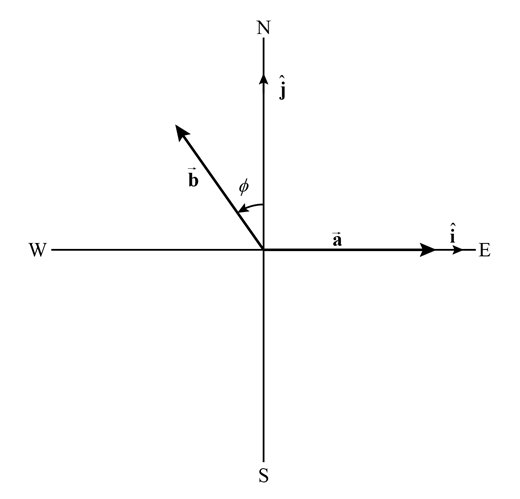
To add the vectors, we need to resolve vector
into its components along the unit vectors

and

respectively. The unit vector
points towards the north while the unit vector
points toward the east direction (as can be seen from the figure above).
We assume that the angle subtended by vector
is

such that vector
is
degrees west of north. We also assume that the magnitude of vector
be represented by b whereas the magnitude of vector
is represented by a .
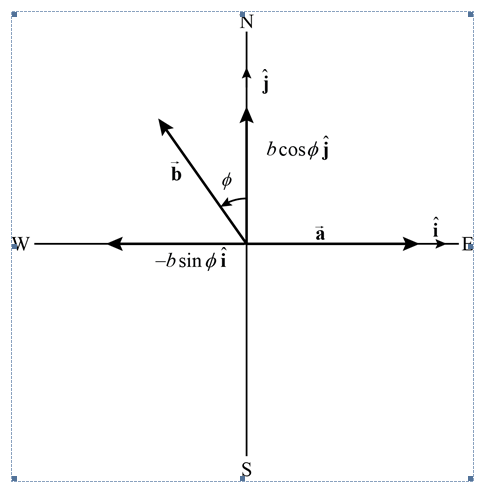
Therefore the vector component of vector
towards the north, along the unit vector


is given as whereas the vector component along the west, opposite to the direction of unit vector

is

(refer figure below).
Given:


Therefore one can write the vector
as:

Where is the component of vector
along the unit vector
.
Since vector
points in the east, along the unit vector
, the value of component

is equal to the magnitude of vector that is a .
Substituting the given values, we have

…… (1)
The vector is given as:
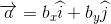


Substituting the given values, we have


…… (2)
The negative sign in the component

of vector
indicates that the component points opposite to the direction of unit vector
that is along west.
(a) The addition of vector
and vector
is given as:

…… (3)
Since there is no component of vector
along the unit vector
, we have .

From equations (1) and (2), we have



Substituting the above values in equation (3), we have


Therefore the vector is .

Let us assume that the vector makes an angle with the horizontal. One can calculate the value of using the relation given below as:
Substituting the value of , , and from above, we have
The positive angle shows that the angle is measured counterclockwise with respect to horizontal.
Therefore vector makes an angle of with the horizontal.
The difference of vector and vector is given as:
…… (4)
Since there is no component of vector along the unit vector , we have .
From equations (1) and (2), we have
Substituting the given values in equation (4), we have
Therefore the vector is .
Let us assume that the vector makes an angle with the horizontal. One can calculate the value of using the relation given below as:
Substituting the value of , , and from above, we have
The negative sign above shows that the angle is measured clockwise with respect to the horizontal.
Therefore vector makes an angle of with the horizontal.


