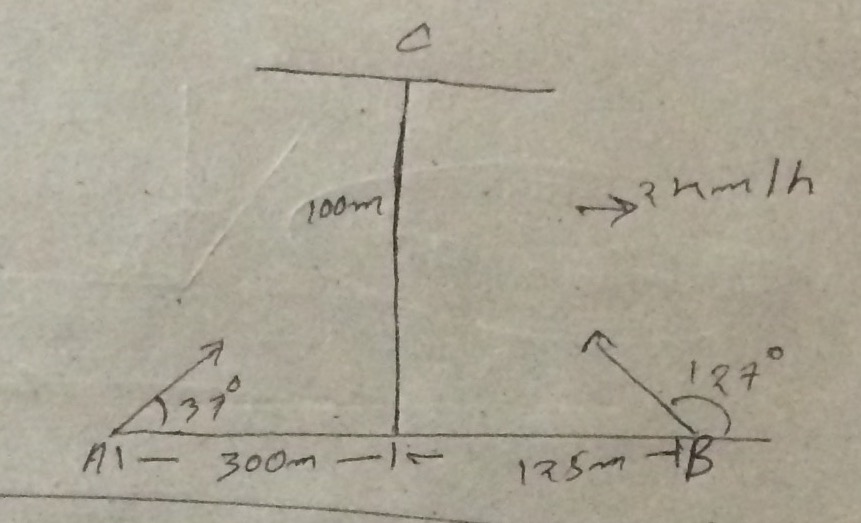
To determine the winner of the race between swimmers A and B, we need to analyze their velocities and the effects of the river's current on their paths. Let's break down the problem step by step.
Understanding the Swimmers' Velocities
Both swimmers have a relative velocity of 5 km/h with respect to the water. However, the river is flowing at a speed of 2 km/h, which affects their effective velocities on the ground. The angles at which they swim also play a crucial role in determining their resultant velocities.
Calculating A's Velocity
Swimmer A swims at an angle of 37 degrees to the direction of the river flow. We can break down A's velocity into two components:
- Downstream Component: This is the component of A's velocity that works with the river's current.
- Cross-stream Component: This is the component of A's velocity that works against the river's current.
Using trigonometry, we can calculate these components:
- Downstream Component = 5 km/h * sin(37°) + 2 km/h
- Cross-stream Component = 5 km/h * cos(37°)
Calculating these values:
- Downstream Component ≈ 5 * 0.6018 + 2 ≈ 3.009 km/h
- Cross-stream Component ≈ 5 * 0.7986 ≈ 3.993 km/h
Now, we can find A's effective speed on the ground:
- Effective Speed of A = √(Downstream Component² + Cross-stream Component²)
Calculating this gives:
- Effective Speed of A ≈ √(3.009² + 3.993²) ≈ √(9.054 + 15.936) ≈ √24.99 ≈ 5 km/h
Calculating B's Velocity
Swimmer B swims at an angle of 127 degrees to the river flow. We can similarly break down B's velocity:
- Downstream Component = 5 km/h * sin(127°) + 2 km/h
- Cross-stream Component = 5 km/h * cos(127°)
Calculating these values:
- Downstream Component ≈ 5 * 0.8387 + 2 ≈ 4.1935 km/h
- Cross-stream Component ≈ 5 * (-0.5150) ≈ -2.575 km/h
Now, we can find B's effective speed on the ground:
- Effective Speed of B = √(Downstream Component² + Cross-stream Component²)
Calculating this gives:
- Effective Speed of B ≈ √(4.1935² + (-2.575)²) ≈ √(17.56 + 6.635) ≈ √24.195 ≈ 4.92 km/h
Determining Time to Cross the River
The river is 100 meters wide, which we need to convert into kilometers for consistency:
- Width of the river = 0.1 km
Now, we can calculate the time taken by each swimmer to cross the river:
- Time taken by A = Width of river / Cross-stream Component of A
- Time taken by B = Width of river / Cross-stream Component of B
Calculating these times:
- Time taken by A ≈ 0.1 km / 3.993 km/h ≈ 0.025 hours ≈ 90 seconds
- Time taken by B ≈ 0.1 km / (-2.575) km/h (since B's cross-stream component is negative, it indicates he is being pushed downstream) ≈ 0.1 km / 2.575 km/h ≈ 0.0389 hours ≈ 140 seconds
Final Analysis
From our calculations:
- Swimmer A takes approximately 90 seconds to reach the other bank.
- Swimmer B takes approximately 140 seconds to reach the other bank.
Thus, the results indicate that:
- Option (A) A will win the race is correct.
- Option (B) B will win the race is incorrect.
- Option (C) The time taken by A to reach the point C is incorrect (it is not 165 seconds).
- Option (D) The time taken by B to reach the point C is incorrect (it is not 150 seconds).
In conclusion, swimmer A wins the race, and the correct answer is option (A).