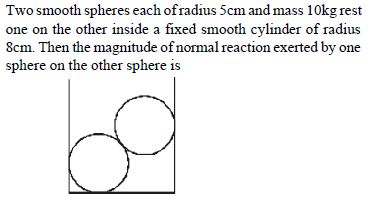
To determine the magnitude of the normal reaction exerted by one sphere on the other, we need to analyze the forces acting on the spheres. In this scenario, we have two smooth spheres, each with a radius of 5 cm and a mass of 10 kg, resting one on top of the other inside a fixed smooth cylinder with a radius of 8 cm. Let's break this down step by step.
Understanding the Forces at Play
When the two spheres are resting on each other, the force of gravity acts on both spheres. The weight of each sphere can be calculated using the formula:
- Weight (W) = mass (m) × gravitational acceleration (g)
Assuming the gravitational acceleration (g) is approximately 9.81 m/s², we can calculate the weight of one sphere:
- W = 10 kg × 9.81 m/s² = 98.1 N
Analyzing the Top Sphere
The top sphere experiences two main forces:
- The downward gravitational force (its weight), which we've calculated as 98.1 N.
- The normal reaction force (N) exerted by the bottom sphere, acting upwards.
Since the top sphere is at rest and not accelerating, we can apply Newton's first law, which states that the sum of the forces acting on an object at rest is zero. Therefore, we can set up the following equation:
Substituting the weight we calculated:
From this, we find that:
Conclusion on the Normal Reaction
The normal reaction exerted by the bottom sphere on the top sphere is equal to the weight of the top sphere, which is 98.1 N. This means that the bottom sphere must exert an upward force of 98.1 N to support the weight of the top sphere, ensuring that both spheres remain in equilibrium within the cylinder.
In summary, the magnitude of the normal reaction exerted by one sphere on the other is 98.1 N. This analysis illustrates how forces interact in a static system and highlights the importance of understanding equilibrium in physics.