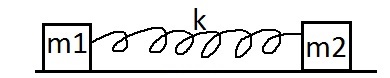
To tackle the problem of finding the maximum extension \( x_m \) in the spring when block \( m_2 \) receives a horizontal velocity \( v_0 \), we need to analyze the dynamics of the system involving both blocks and the spring. Let's break it down step by step.
Understanding the System
We have two blocks, \( m_1 \) and \( m_2 \), connected by a spring with stiffness \( k \). Initially, both blocks are at rest. When block \( m_2 \) is given a velocity \( v_0 \), it starts moving while block \( m_1 \) remains stationary for a brief moment. The spring will stretch as \( m_2 \) moves, and we want to find out how far it stretches at its maximum point.
Conservation of Momentum
Since there are no external horizontal forces acting on the system, we can apply the principle of conservation of momentum. Initially, the momentum of the system is zero because both blocks are at rest. When block \( m_2 \) moves with velocity \( v_0 \), the total momentum of the system can be expressed as:
- Initial momentum: \( 0 \)
- Final momentum: \( m_2 v_0 + m_1 v_1 \)
Setting these equal gives us:
0 = \( m_2 v_0 + m_1 v_1 \)
From this, we can solve for the velocity \( v_1 \) of block \( m_1 \):
\( v_1 = -\frac{m_2 v_0}{m_1} \)
Energy Considerations
As the spring stretches, kinetic energy is converted into potential energy stored in the spring. At maximum extension \( x_m \), the relative velocity between the two blocks becomes zero, meaning they momentarily move together. The kinetic energy of the system before the spring starts to stretch can be expressed as:
Kinetic Energy (initial) = \( \frac{1}{2} m_2 v_0^2 \)
At maximum extension, the kinetic energy of the system is transformed into potential energy stored in the spring:
Potential Energy (spring) = \( \frac{1}{2} k x_m^2 \)
Setting Energies Equal
At the point of maximum extension, we can equate the initial kinetic energy to the potential energy in the spring:
\( \frac{1}{2} m_2 v_0^2 = \frac{1}{2} k x_m^2 \)
We can simplify this equation by canceling the \( \frac{1}{2} \) from both sides:
\( m_2 v_0^2 = k x_m^2 \)
Solving for Maximum Extension
Now, we can solve for \( x_m \):
\( x_m^2 = \frac{m_2 v_0^2}{k} \)
Taking the square root of both sides gives us:
\( x_m = \sqrt{\frac{m_2 v_0^2}{k}} \)
Final Expression
Thus, the maximum extension \( x_m \) in the spring when block \( m_2 \) receives a horizontal velocity \( v_0 \) is given by:
\( x_m = \sqrt{\frac{m_2 v_0^2}{k}} \)
This formula shows how the mass of block \( m_2 \), its initial velocity, and the spring constant \( k \) all influence the maximum extension of the spring. The greater the mass or velocity, the more the spring will stretch, while a stiffer spring (higher \( k \)) will result in less extension.