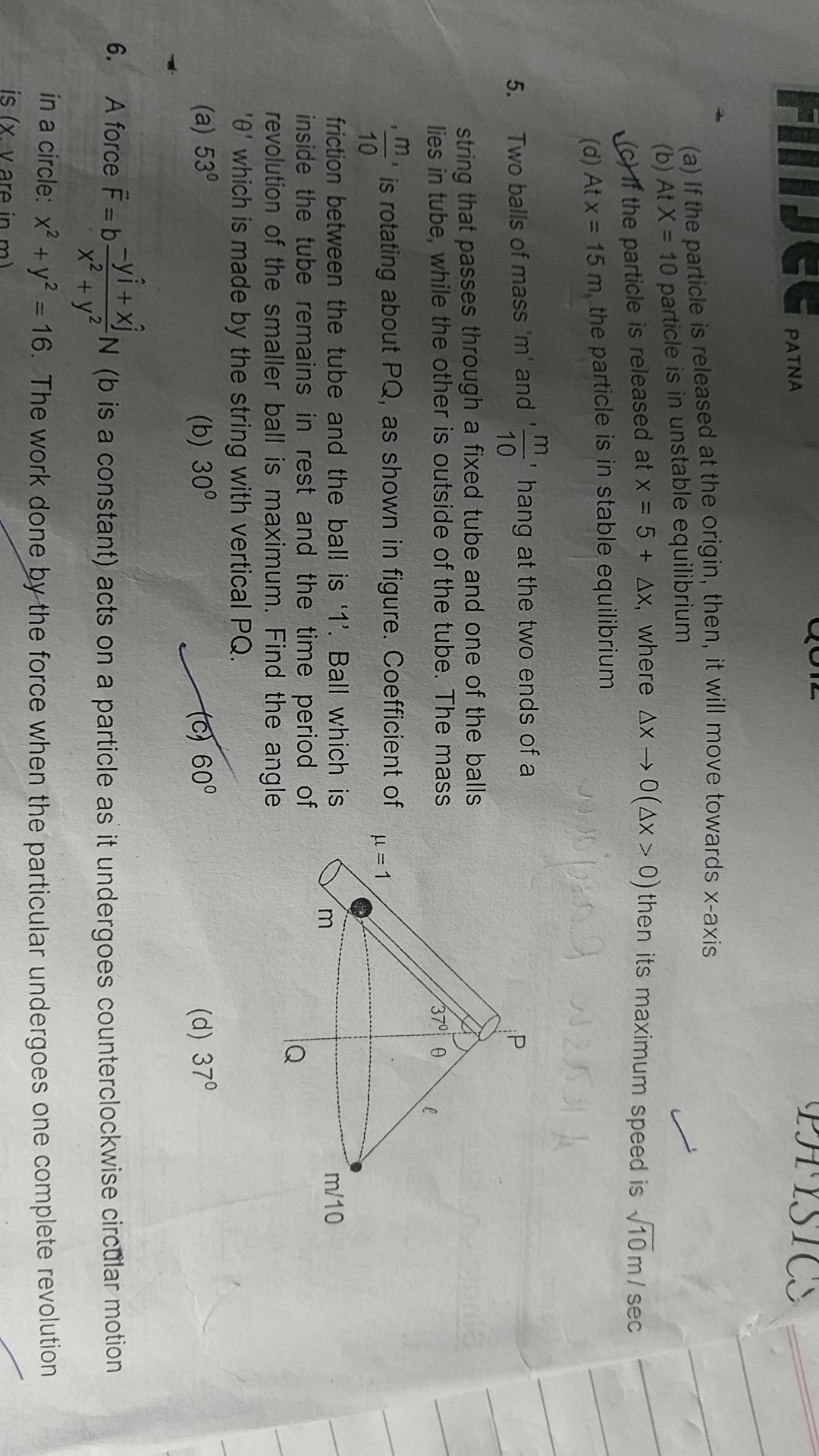
To understand the scenario you've described, we need to analyze the forces acting on the two balls and how they interact through the string. This situation involves concepts from mechanics, particularly tension, gravitational force, and equilibrium. Let's break it down step by step.
Setting the Scene
Imagine we have two balls: one with mass \( m \) hanging outside a tube and the other with mass \( \frac{m}{10} \) resting inside the tube. The string connects these two balls, passing through a fixed tube. The ball inside the tube is subject to gravitational force, but its motion is constrained by the tube's walls.
Forces Acting on the Balls
- Ball Outside (Mass = m): This ball experiences the force of gravity pulling it downwards, which is equal to \( mg \), where \( g \) is the acceleration due to gravity.
- Ball Inside (Mass = m/10): This ball also experiences a gravitational force, but it is much smaller, calculated as \( \frac{mg}{10} \).
Analyzing the System
Since the balls are connected by a string, the tension in the string plays a crucial role in determining their motion. When the system is in equilibrium, the forces acting on both balls must balance out. Let's denote the tension in the string as \( T \).
Equations of Motion
For the ball outside the tube, the forces can be expressed as:
For Ball Outside:
At equilibrium, the tension \( T \) must balance the weight of the ball:
T = mg
For the ball inside the tube, the forces can be expressed as:
For Ball Inside:
Here, the tension \( T \) must balance the weight of the ball:
T = \frac{mg}{10}
Finding the Relationship Between Tensions
Since both equations represent the tension in the string, we can set them equal to each other:
mg = \frac{mg}{10}
This leads to a contradiction unless we consider the system's dynamics. If the ball outside is in equilibrium, the ball inside must also be in a state of equilibrium, but the forces acting on them are different due to their masses.
Understanding the Motion
If the ball outside is released, it will accelerate downwards due to its greater mass. The ball inside will also move, but at a different rate due to its smaller mass. The acceleration of the system can be derived using Newton's second law, where the net force equals the mass times acceleration.
Conclusion on the System's Behavior
This setup illustrates the principles of tension and gravitational forces in a connected system. The heavier ball will accelerate downwards, pulling the lighter ball upwards, but the acceleration will not be the same for both due to their differing masses. This scenario can lead to interesting dynamics, such as oscillations or even the potential for the lighter ball to be lifted off the ground if the system is set in motion.
In summary, the interaction between the two balls through the string demonstrates fundamental principles of mechanics, including tension, gravitational force, and the effects of mass on motion. Understanding these concepts is crucial for analyzing more complex systems in physics.