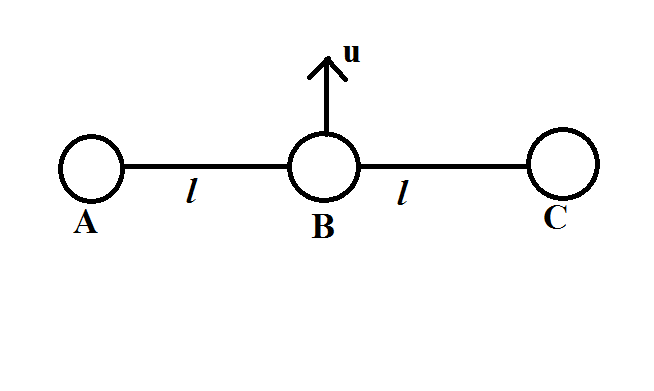
To solve the problem of three identical balls connected by light, inextensible strings on a smooth horizontal table, we need to analyze the motion of the balls when ball B is given an initial velocity. Let's break this down step by step.
Understanding the System
We have three balls: A, B, and C. They are arranged in a line, with ball A on one end, ball B in the middle, and ball C on the other end. The strings connecting them are light and inextensible, meaning they do not stretch and have negligible mass. When ball B is given a velocity, it will start moving, and this motion will affect the other balls due to the strings connecting them.
Initial Conditions
At time t=0, ball B is imparted a velocity \( v_B \). Balls A and C are initially at rest. Since the table is smooth, we can ignore friction, and the only forces acting on the balls are the tensions in the strings connecting them.
Analyzing the Motion
When ball B moves, it pulls ball A towards it through the string. Since the strings are inextensible, the motion of ball A will be directly related to the motion of ball B. The same applies when ball A moves towards ball B and subsequently affects ball C.
Using Conservation of Momentum
Since there are no external forces acting on the system, we can apply the principle of conservation of momentum. Initially, the total momentum of the system is zero because all balls are at rest except for ball B. When ball B moves, it imparts some of its momentum to ball A through the tension in the string.
Momentum Calculation
- Let the mass of each ball be \( m \).
- The initial momentum of the system is \( 0 \) (since A and C are at rest).
- When ball B moves with velocity \( v_B \), its momentum is \( mv_B \).
- Let the velocity of ball A when it collides with ball C be \( v_A \).
At the moment of collision between balls A and C, the total momentum of the system must still equal zero:
Equation Setup
The momentum of ball B plus the momentum of ball A must equal the momentum of ball C:
Since ball C is at rest initially, we can write:
\( mv_B + mv_A = 0 \)
From this, we can derive:
\( v_A = -v_B \)
Final Velocity of Ball A
This means that the velocity of ball A when it collides with ball C will be equal in magnitude but opposite in direction to the velocity of ball B. If ball B was moving to the right with a velocity \( v_B \), then ball A will be moving to the left with a velocity \( v_A = -v_B \).
Conclusion
In summary, when ball B is imparted a velocity \( v_B \), the velocity of ball A when it collides with ball C will be \( -v_B \). This result illustrates the interconnected nature of the system due to the inextensible strings, demonstrating how the motion of one ball directly influences the others.