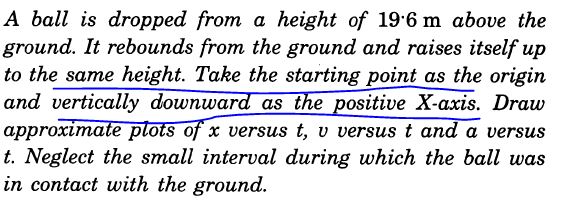
When tackling problems involving motion, especially in physics, understanding the direction of movement is crucial. In the context of HC Verma's question, the terms "vertically upward" and "vertically downward" refer to the direction of the object's motion, which can significantly affect how we interpret the graphs of position (x vs. t), velocity (v vs. t), and acceleration (a vs. t). Let's break this down step by step.
Understanding Motion in One Dimension
In one-dimensional motion, particularly in vertical motion, we often define a coordinate system where one direction is positive and the other is negative. For instance, if we consider upward motion as positive, then downward motion would be negative. This convention is essential when plotting graphs and interpreting the results.
Graphing Position vs. Time (x vs. t)
When you plot the position (x) against time (t), the graph will show how the object's position changes over time. If the object moves upward, the graph will slope upwards, indicating an increase in position. Conversely, if the object moves downward, the graph will slope downwards, indicating a decrease in position. The significance of the direction is reflected in the slope of the graph:
- Upward Motion: Positive slope indicates increasing position.
- Downward Motion: Negative slope indicates decreasing position.
Velocity vs. Time (v vs. t) Analysis
Next, when considering the velocity (v) vs. time (t) graph, the direction of motion again plays a vital role. The velocity is positive when the object moves upward and negative when it moves downward. The graph will show:
- Positive Velocity: The graph is above the time axis, indicating upward motion.
- Negative Velocity: The graph is below the time axis, indicating downward motion.
Acceleration vs. Time (a vs. t) Insights
Finally, the acceleration (a) vs. time graph indicates how the velocity of the object changes over time. If the object is in free fall, for instance, the acceleration due to gravity is acting downward, which we typically take as negative. Thus:
- Constant Acceleration: If the object is accelerating downward (like in free fall), the acceleration graph will be a constant negative value.
- Deceleration: If the object is moving upward and slowing down, the acceleration will also be negative, but the velocity will still be positive until it reaches its peak.
Putting It All Together
In summary, the terms "vertically upward" and "vertically downward" are not just descriptive; they define the sign conventions for your graphs. When you plot the graphs of x vs. t, v vs. t, and a vs. t, you must consider these directions to accurately interpret the motion of the object. If you find that this information doesn't seem useful in solving the problem, it might be because you're not yet fully integrating these concepts into your analysis. Always remember that the direction of motion influences the signs of your values, which in turn affects the shape and interpretation of your graphs.
By keeping these principles in mind, you'll be better equipped to analyze motion problems and understand the significance of directional terms in physics.