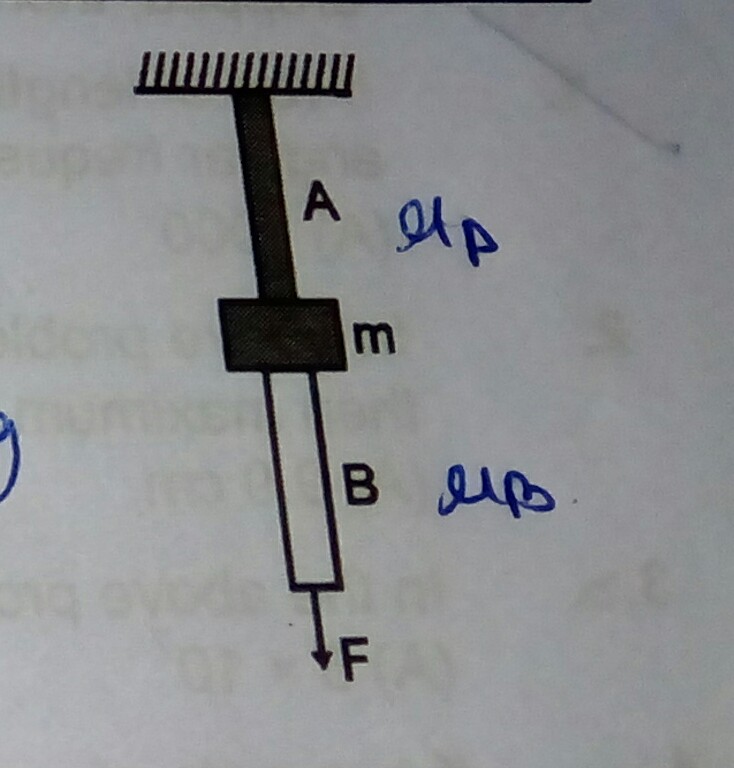
To analyze the situation with wires A and B, we need to consider how the forces are distributed across each wire based on their radii and the applied force. Since both wires are made of the same material, their breaking points will depend on their cross-sectional areas, which are influenced by their radii. Let's break this down step by step.
Understanding the Forces on the Wires
When a block of mass M is suspended between two wires, the total weight of the block exerts a downward force equal to Mg, where g is the acceleration due to gravity. In this case, the applied force F is Mg/3. This means that the tension in each wire will be affected by how the forces are distributed based on their respective cross-sectional areas.
Cross-Sectional Area Calculation
The cross-sectional area (A) of a wire can be calculated using the formula:
- A = πR² for wire A
- A' = π(R')² for wire B
Where R and R' are the radii of wires A and B, respectively. The larger the radius, the greater the cross-sectional area, which means the wire can handle more tension before breaking.
Stress and Breaking Point
The stress (σ) experienced by a wire is defined as the force (F) applied per unit area (A). It can be expressed as:
For wire A, the stress would be:
For wire B, it would be:
Since the total force is Mg/3, we need to consider how this force is distributed between the two wires. If we assume the block is in equilibrium, the forces in the wires will adjust based on their respective areas.
Comparing the Wires
If wire A has a smaller radius than wire B (R < R'), then:
- The cross-sectional area of wire A will be less than that of wire B (A < A').
- This means that for the same amount of force, wire A will experience greater stress than wire B.
As a result, if the applied force F is Mg/3, wire A will reach its breaking point before wire B due to the higher stress it experiences. Therefore, if R < R', wire A will break before wire B.
Conclusion
In summary, when comparing two wires made of the same material but with different radii, the wire with the smaller radius will break first under the same applied force due to the higher stress it experiences. In this case, if R < R', wire A will indeed break before wire B when subjected to a force of Mg/3.