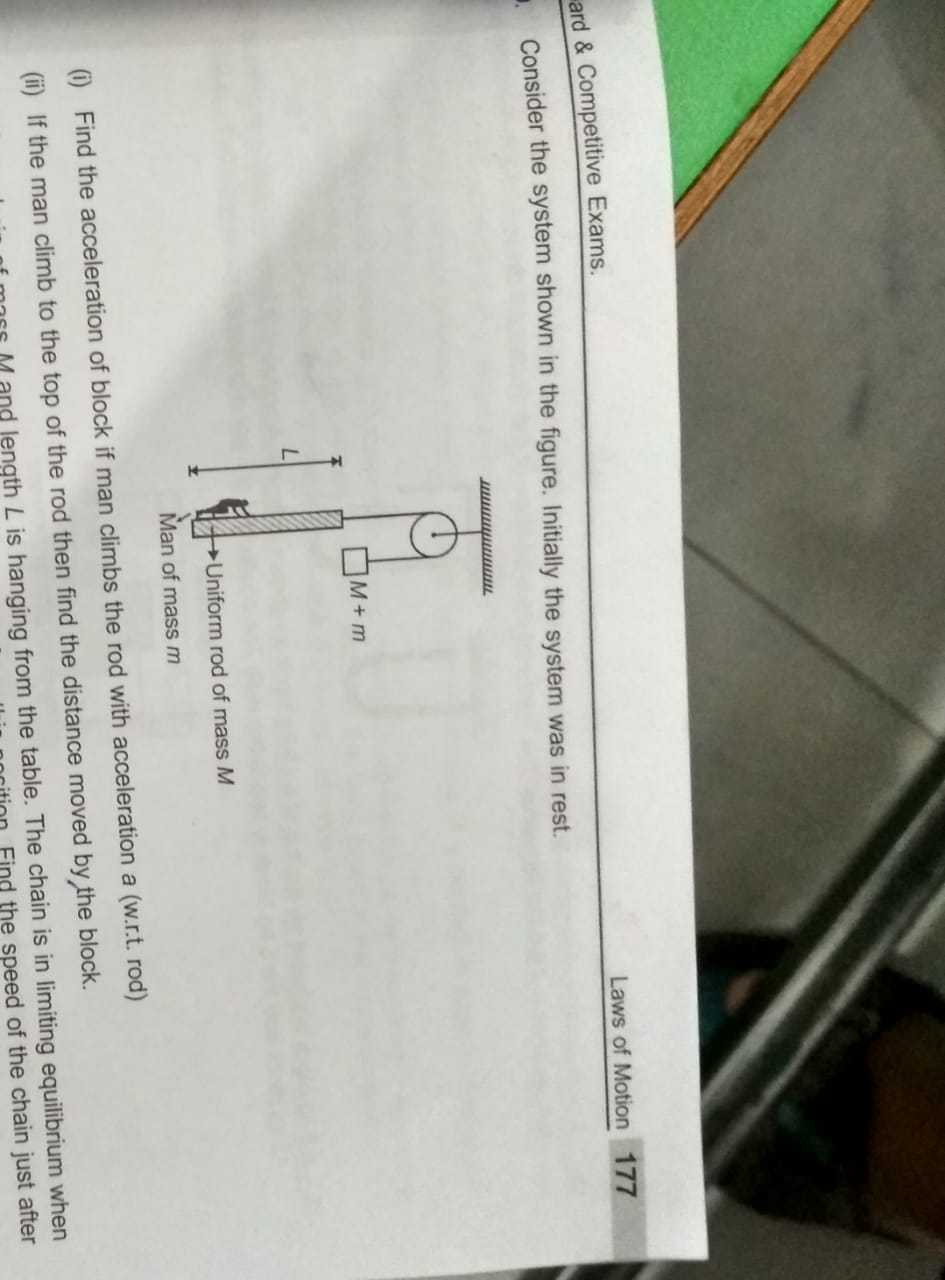
To determine the acceleration of the rod when the man climbs upward with an acceleration \( a \) relative to the rod, we need to analyze the system carefully. The key here is to understand the relationship between the movements of the man, the block, and the rod.
Understanding the System Dynamics
In this scenario, we have a man climbing a rod, which is connected to a block via a pulley system. When the man climbs with an acceleration \( a \), he exerts a force on the rod, which in turn affects the block's motion. The rod and the block are interconnected through the pulley, so their movements are related.
Analyzing Forces and Accelerations
Let’s break down the forces at play:
- The man climbing the rod exerts a force due to his weight and the additional force from his climbing.
- The block experiences a tension force from the rope connected to the rod.
When the man climbs with an acceleration \( a \), he effectively pulls the rod upward. This action creates a tension in the rope that is connected to the block. The acceleration of the rod can be derived from the relationship between the man’s climbing motion and the block’s motion.
Relating the Accelerations
Let’s denote the acceleration of the rod as \( A \). When the man climbs with an acceleration \( a \), the rod must also accelerate to maintain the system's equilibrium. The relationship can be expressed as follows:
- If the man climbs up with an acceleration \( a \), the rod will also move upward, but the acceleration of the rod \( A \) will be less than \( a \) due to the system's constraints.
- The block will move upward with an acceleration that is influenced by the tension in the rope, which is a result of the man's climbing.
From the mechanics of the pulley system, we can derive that:
Mathematical Relationship
Assuming the pulley is frictionless and the rope is massless, the acceleration of the rod can be expressed as:
A = a/2
This means that for every unit of acceleration the man climbs, the rod accelerates at half that rate. This relationship arises because the movement of the man and the block are interconnected through the pulley system, effectively distributing the acceleration across the components.
Conclusion
In summary, when the man climbs upward with an acceleration \( a \), the rod will accelerate upward at half that rate, or \( A = a/2 \). This relationship is crucial for understanding how forces and motions interact in a pulley system. By analyzing the forces and applying Newton's laws, we can derive the necessary relationships to solve such problems effectively.