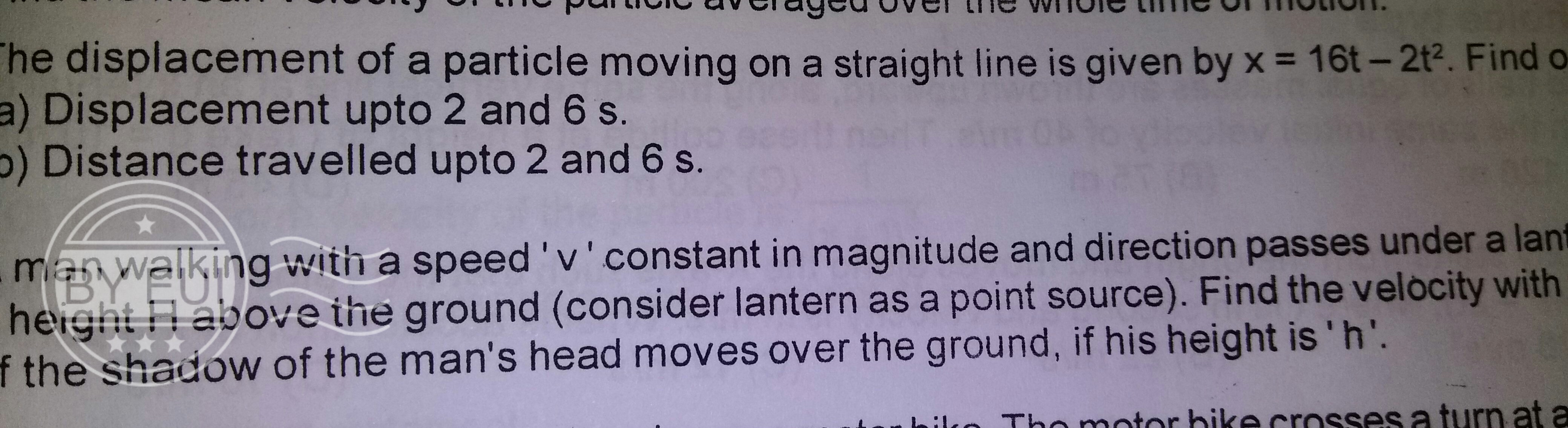
To solve the problem of finding the displacement and distance traveled by a particle moving along a straight line described by the equation \( x = 16t - 2t^2 \), we need to analyze the motion of the particle between the time intervals of 2 seconds and 6 seconds. Let's break this down step by step.
Understanding the Motion Equation
The equation \( x = 16t - 2t^2 \) represents the position of the particle at any time \( t \). Here, \( x \) is the position in meters, and \( t \) is the time in seconds. The equation is a quadratic function, which means the motion will involve acceleration.
Calculating Displacement
Displacement is defined as the change in position of the particle over a specific time interval. To find the displacement from \( t = 2 \) seconds to \( t = 6 \) seconds, we need to calculate the position at both of these times.
Substituting \( t = 2 \) into the equation:
\( x(2) = 16(2) - 2(2^2) = 32 - 8 = 24 \) meters
Now, substituting \( t = 6 \):
\( x(6) = 16(6) - 2(6^2) = 96 - 72 = 24 \) meters
Now, we can find the displacement:
Displacement = \( x(6) - x(2) = 24 - 24 = 0 \) meters
Calculating Distance Traveled
Distance traveled is the total length of the path taken by the particle, regardless of direction. Since the displacement is zero, we need to check if the particle changes direction between \( t = 2 \) and \( t = 6 \) seconds.
Finding the Velocity
The velocity \( v \) of the particle can be found by taking the derivative of the position function:
\( v(t) = \frac{dx}{dt} = 16 - 4t
\)
Next, we find when the velocity is zero to check for direction changes:
Setting \( v(t) = 0 \):
\( 16 - 4t = 0 \)
\( 4t = 16 \)
\( t = 4 \) seconds
This indicates that the particle changes direction at \( t = 4 \) seconds. Now, we can calculate the distance traveled in two segments: from \( t = 2 \) to \( t = 4 \) and from \( t = 4 \) to \( t = 6 \).
- From \( t = 2 \) to \( t = 4 \):
We already found \( x(2) = 24 \) meters. Now, we find \( x(4) \):
\( x(4) = 16(4) - 2(4^2) = 64 - 32 = 32 \) meters
Distance traveled from \( t = 2 \) to \( t = 4 \):
Distance = \( x(4) - x(2) = 32 - 24 = 8 \) meters
- From \( t = 4 \) to \( t = 6 \):
We already found \( x(6) = 24 \) meters. Now, we calculate the distance traveled:
Distance = \( x(6) - x(4) = 24 - 32 = -8 \) meters
Since distance cannot be negative, we take the absolute value:
Distance = 8 meters
Final Calculation of Total Distance
Now, we add the distances from both segments:
Total Distance = Distance from \( t = 2 \) to \( t = 4 \) + Distance from \( t = 4 \) to \( t = 6 \)
Total Distance = \( 8 + 8 = 16 \) meters
Summary
In summary, for the time interval from 2 seconds to 6 seconds:
- Displacement = 0 meters
- Total Distance Traveled = 16 meters