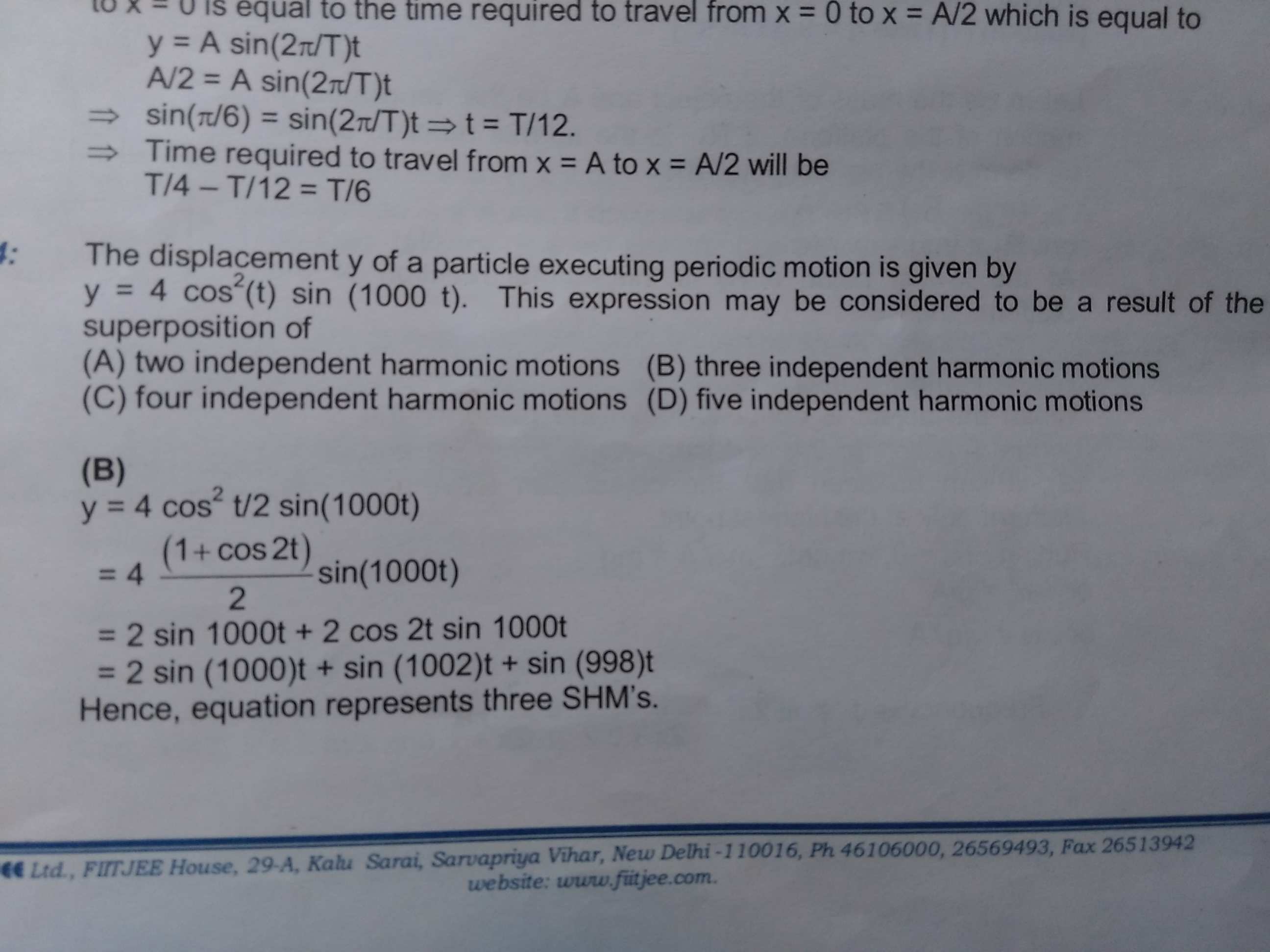
To analyze the displacement of the particle given by the equation \( y = 4 \cos^2(t) \sin(100t) \), we need to break it down into its components and understand how many independent harmonic motions are involved in this expression. The key here is recognizing that the equation can be rewritten using trigonometric identities, which will help us identify the harmonic motions present.
Breaking Down the Equation
The expression \( y = 4 \cos^2(t) \sin(100t) \) consists of two parts: \( \cos^2(t) \) and \( \sin(100t) \). To simplify our analysis, we can use a trigonometric identity for \( \cos^2(t) \).
Using Trigonometric Identities
Recall the identity:
- \( \cos^2(t) = \frac{1 + \cos(2t)}{2} \)
Substituting this identity into our equation gives:
\( y = 4 \left( \frac{1 + \cos(2t)}{2} \right) \sin(100t) \)
Now, simplifying this expression results in:
\( y = 2(1 + \cos(2t)) \sin(100t) \)
Distributing the Terms
Next, we can distribute \( \sin(100t) \) across the terms in the parentheses:
\( y = 2 \sin(100t) + 2 \cos(2t) \sin(100t) \)
Identifying Harmonic Motions
Now, we have two distinct terms:
- \( 2 \sin(100t) \)
- \( 2 \cos(2t) \sin(100t) \)
The first term, \( 2 \sin(100t) \), is a straightforward harmonic motion with a frequency of 100 rad/s. The second term, \( 2 \cos(2t) \sin(100t) \), can be further analyzed using another trigonometric identity:
Using the product-to-sum identities:
- \( \cos(A) \sin(B) = \frac{1}{2} [\sin(A + B) - \sin(A - B)] \)
Applying this to \( 2 \cos(2t) \sin(100t) \) gives:
\( 2 \cos(2t) \sin(100t) = \sin(100t + 2t) - \sin(100t - 2t) \)
Thus, we can express it as:
\( \sin(102t) - \sin(98t) \)
Summarizing the Components
Now, we can summarize the components of the displacement equation:
- \( 2 \sin(100t) \) contributes one harmonic motion.
- \( \sin(102t) \) and \( \sin(98t) \) each contribute additional harmonic motions.
In total, we have:
- One motion from \( 2 \sin(100t) \)
- One motion from \( \sin(102t) \)
- One motion from \( \sin(98t) \)
Final Count of Independent Harmonic Motions
Therefore, the expression \( y = 4 \cos^2(t) \sin(100t) \) can be considered as the result of the superposition of three independent harmonic motions:
- \( 2 \sin(100t) \)
- \( \sin(102t) \)
- \( \sin(98t) \)
This analysis shows how we can decompose a complex periodic motion into simpler harmonic components, allowing us to understand the underlying behavior of the system more clearly.