
Suppose that  Does this mean that we must have either d ≥ d1 or d ≥ d2 ? If not, explain why.
Does this mean that we must have either d ≥ d1 or d ≥ d2 ? If not, explain why.
Shane Macguire , 10 Years ago
Grade upto college level
 Mechanics> Suppose that Does this mean that we must ...
 Does this mean that we must have either d ≥ d1 or d ≥ d2 ? If not, explain why.
 1 Answers
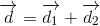 , then the magnitude of vector
 will be either greater than or equal to magnitude of vector
 or vector
 respectively. with component
 along the unit vector in x-direction,
 along the unit vector in y-direction respectively. can be represented as:
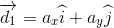 is given as:
 with component
 along the unit vector in x-direction,
  along the unit vector in y-direction respectively. can be represented as:
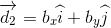 is given as:
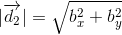 and vector is given as:
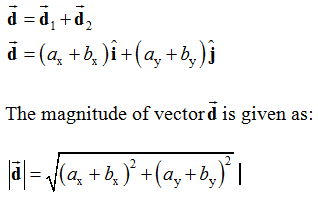 depends on the value of
  and
and  . Therefore, in a situation where has opposite sign to that with and has the opposite sign to that with , the magnitude of vector will be smaller than the magnitude of either vector or vector . is given as:
 is given as:
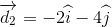 is:
is:
 is:
is:
 is:
is:

 is smaller than the magnitude of both vector
  and vector
 . It is important to note that in this assumption, the vector is such, that the value of and is reduced significantly and the magnitude of vector became smaller than the magnitude of both the vectors and . However if we take our vector as say -
 , the magnitude of vector will be greater than the magnitude of vector .
Prepraring for the competition made easy just by live online class.

Full Live Access

Study Material

Live Doubts Solving

Daily Class Assignments

Three identical balls are placed on a frictionless
horizontal surface touching each other. They stick to
each other because of adhesive. Another ball of same
radius and mass m is placed over the void created by
the three balls. Find the forces applied by the balls
kept on the floor to each other if the system remains
in equilibrium.
Last Activity: 5 Months ago
A car loaded with water having total mass 1000 kg moves on a straight horizontal Road starting from rest under the action of a force of 100 Newton. The water spills throw a small hole in the bottom at a rate of 0.1 KG per second the velocity of cart after 300 seconds is nearly.
11
21
31
41
Last Activity: 6 Months ago
Last Activity: 3 Years ago
Last Activity: 3 Years ago
Last Activity: 3 Years ago