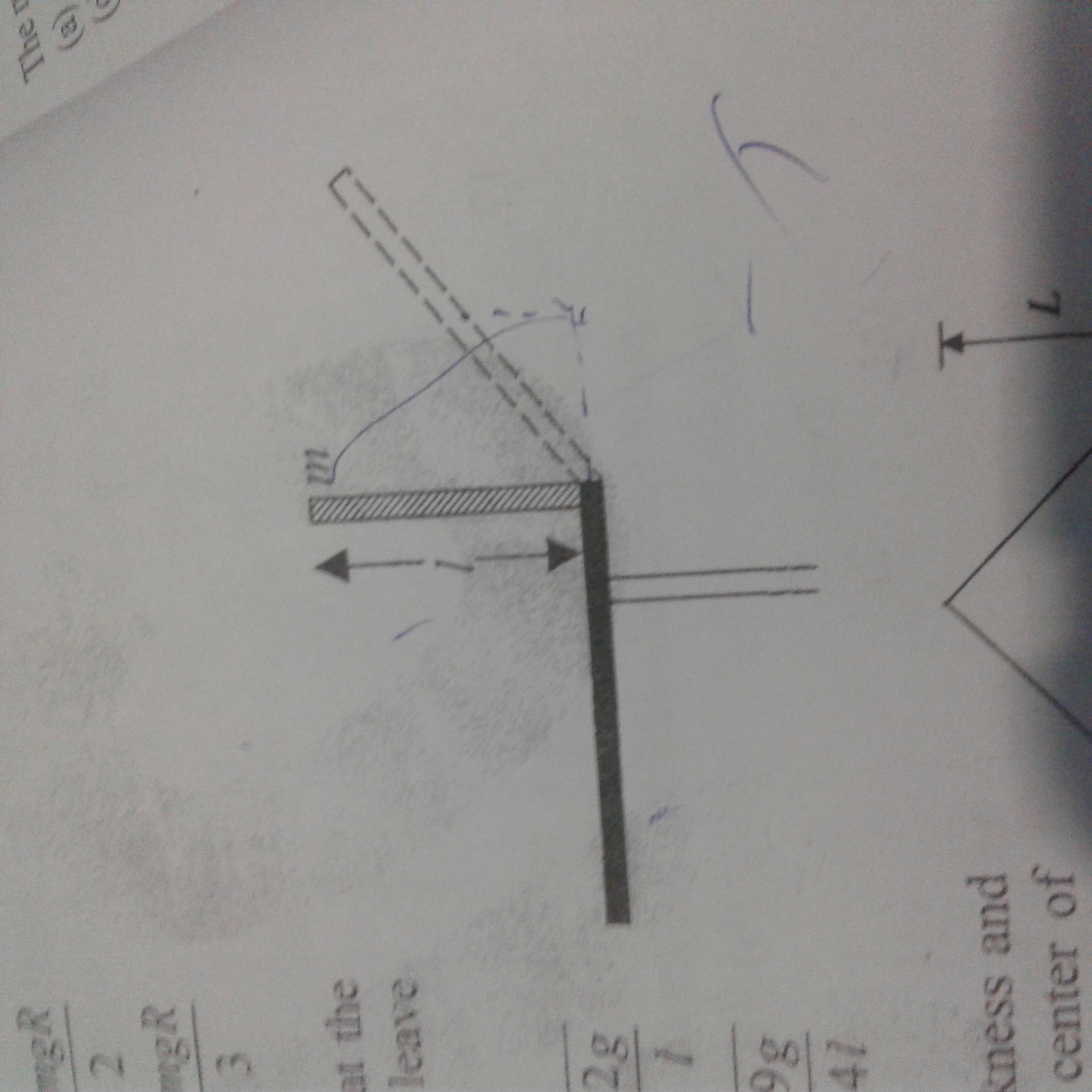
To determine the angular velocity of a rod when it leaves the table after being released from a vertical position, we can use principles from physics, particularly the concepts of rotational motion and energy conservation. Let’s break this down step by step.
Understanding the Setup
Imagine a uniform rod of length \( L \) that is pivoted at one end, hanging vertically off the edge of a table. When the rod is released from rest, it begins to rotate about the pivot point due to the force of gravity acting on its center of mass.
Key Concepts Involved
- Moment of Inertia (I): For a rod rotating about one end, the moment of inertia is given by \( I = \frac{1}{3} m L^2 \), where \( m \) is the mass of the rod.
- Torque (τ): The torque acting on the rod due to gravity can be calculated as \( τ = r \cdot F \), where \( r \) is the distance from the pivot to the center of mass (which is \( \frac{L}{2} \)) and \( F \) is the gravitational force acting on the rod's center of mass.
- Energy Conservation: The potential energy lost by the rod as it falls is converted into rotational kinetic energy.
Calculating the Angular Velocity
When the rod is released, it starts from a height of \( \frac{L}{2} \) (the center of mass) above the table. The potential energy (PE) at this height is given by:
PE = mgh = mg\left(\frac{L}{2}\right)
As the rod falls and rotates, this potential energy is converted into rotational kinetic energy (KE), which is expressed as:
KE = \frac{1}{2} I \omega^2 = \frac{1}{2} \left(\frac{1}{3} m L^2\right) \omega^2
Setting Up the Equation
By the conservation of energy, we can set the potential energy equal to the kinetic energy at the moment just before the rod leaves the table:
mg\left(\frac{L}{2}\right) = \frac{1}{2} \left(\frac{1}{3} m L^2\right) \omega^2
Simplifying the Equation
We can cancel \( m \) from both sides (assuming \( m \neq 0 \)):
g\left(\frac{L}{2}\right) = \frac{1}{6} L^2 \omega^2
Now, multiply both sides by 6:
3gL = L^2 \omega^2
Next, divide both sides by \( L^2 \):
3g/L = \omega^2
Finding Angular Velocity
Finally, take the square root of both sides to solve for \( \omega \):
ω = √(3g/L)
Final Thoughts
Thus, the angular velocity of the rod when it just leaves contact with the table is given by:
ω = √(3g/L)
This result shows how the gravitational force acting on the rod translates into rotational motion as it falls. The longer the rod, the smaller the angular velocity, and conversely, the shorter the rod, the larger the angular velocity at the moment it leaves the table.