

Mechanics
Questions no 1 multiple choice multi correct two particle projetted from the same point with same speed
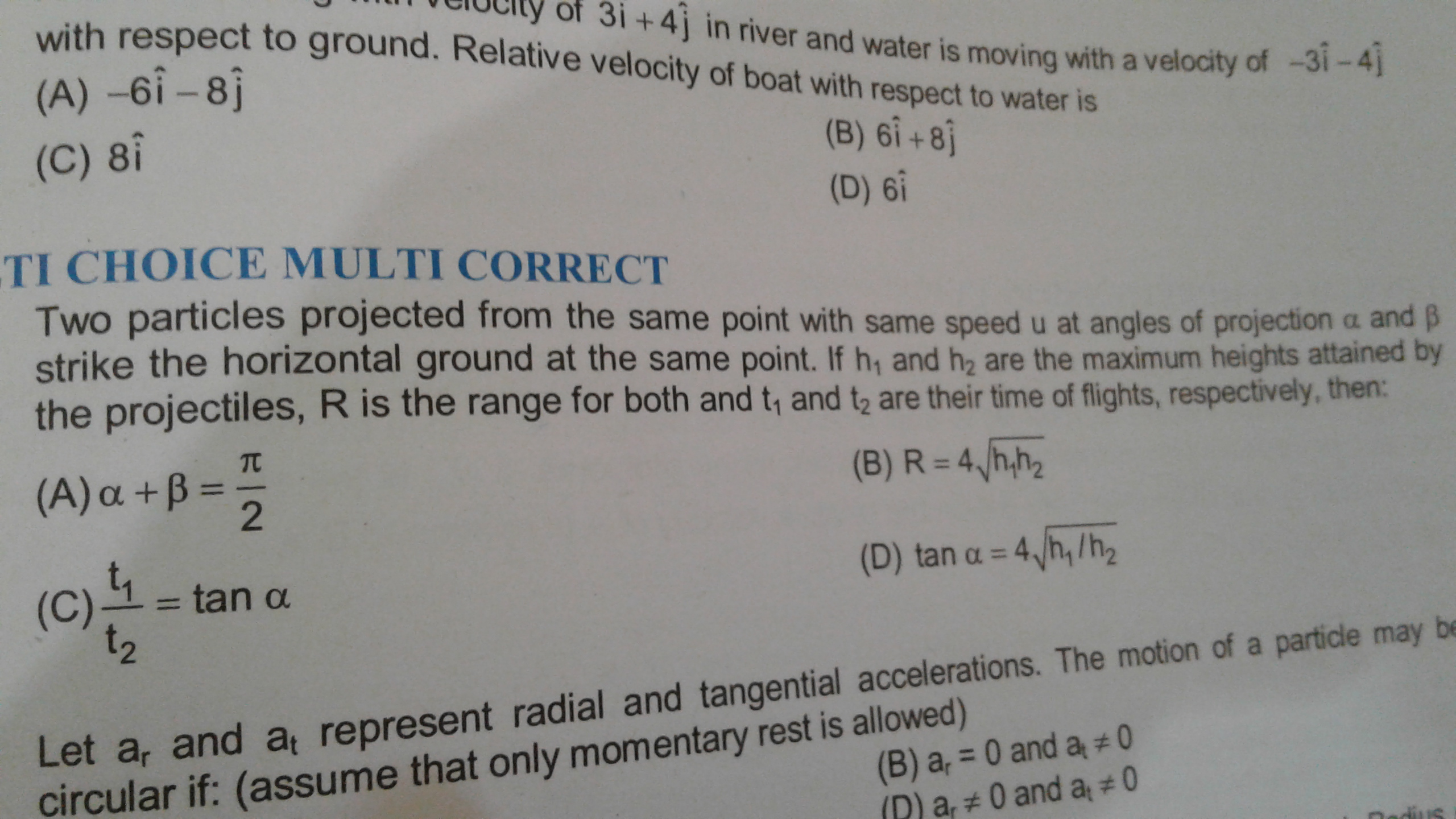



 Approved Tutor Answer1 Year ago
When two particles are projected from the same point with the same speed, several interesting dynamics come into play. The behavior of these particles can depend on various factors, such as the angle of projection, the effects of gravity, and air resistance. Let's break down the key concepts to understand how these particles will behave.
To analyze the motion of the two particles, consider the following factors:
Let’s consider two scenarios where the particles are projected at different angles:
Both particles will follow a parabolic path due to the influence of gravity. However, their maximum heights and ranges will differ:
The time each particle spends in the air can also vary based on the angle of projection. The formula for the time of flight (T) for a projectile is given by:
T = (2 * v * sin(θ)) / g
Where:
From this formula, you can see that the time of flight will differ for the two particles based on their angles, even though they have the same initial speed.
When answering a multiple-choice question regarding the motion of these two particles, consider the following:
Understanding these principles will help you analyze similar problems effectively. If you have specific multiple-choice options in mind, feel free to share them, and we can discuss which ones are correct based on the principles outlined here!

Three identical balls are placed on a frictionless
horizontal surface touching each other. They stick to
each other because of adhesive. Another ball of same
radius and mass m is placed over the void created by
the three balls. Find the forces applied by the balls
kept on the floor to each other if the system remains
in equilibrium.
Last Activity: 10 Months ago
A car loaded with water having total mass 1000 kg moves on a straight horizontal Road starting from rest under the action of a force of 100 Newton. The water spills throw a small hole in the bottom at a rate of 0.1 KG per second the velocity of cart after 300 seconds is nearly.
11
21
31
41
Last Activity: 10 Months ago
Last Activity: 3 Years ago
Last Activity: 3 Years ago