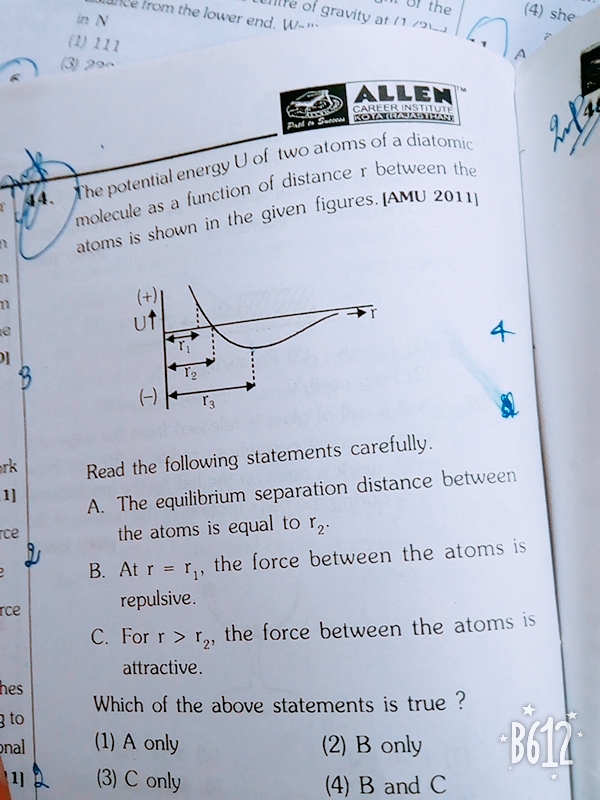
It sounds like you're grappling with the concepts of equilibrium and forces in the context of molecular interactions. Let's break this down step by step to clarify your understanding of equilibrium points and the nature of forces involved.
Understanding Equilibrium Points
In physics and chemistry, an equilibrium point is where the net force acting on a particle or system is zero. This means that the attractive and repulsive forces balance each other out. In your case, it seems that you are referring to a specific distance, denoted as r3, where the forces are in equilibrium.
Force Behavior Around Equilibrium
When analyzing forces in relation to distance, it's crucial to understand how these forces behave as you move away from the equilibrium point:
- At r = r3: The net force is zero, indicating a stable equilibrium.
- For r < r3: The distance is less than the equilibrium distance, leading to a repulsive interaction. This occurs because the particles are too close, and the forces push them apart to avoid overlap.
- For r > r3: The distance exceeds the equilibrium distance, resulting in an attractive interaction. Here, the forces draw the particles closer together, as they are in a more favorable configuration.
Visualizing the Forces
Think of it like a spring. When you compress a spring (r < r3), it pushes back against you (repulsive force). When you stretch it (r > r3), it pulls you back towards its natural length (attractive force). The point where the spring is neither compressed nor stretched is the equilibrium point (r = r3).
Mathematical Perspective
From a mathematical standpoint, if we denote the force as F(r), we can express it in terms of distance r. The behavior of F(r) can be described as follows:
- If r < r3, then F(r) > 0 (repulsive force).
- If r = r3, then F(r) = 0 (equilibrium).
- If r > r3, then F(r) < 0 (attractive force).
This relationship is crucial in understanding how particles interact at different distances. The sign of the force indicates whether the interaction is attractive or repulsive, and this is directly tied to the distance from the equilibrium point.
Practical Implications
In real-world applications, such as in molecular chemistry or materials science, understanding these interactions helps predict how substances will behave under various conditions. For instance, in molecular dynamics simulations, knowing the equilibrium distance allows scientists to model how molecules will interact, which is vital for designing new materials or drugs.
In summary, your understanding that r3 is the equilibrium point where the force is zero is correct. The behavior of forces as you move away from this point—repulsive when closer and attractive when further away—aligns with fundamental principles of physics. If you have any more questions or need further clarification, feel free to ask!