

Grade 12th passMechanics
Q8 Please explain this question`s answerA small body slides from rest............
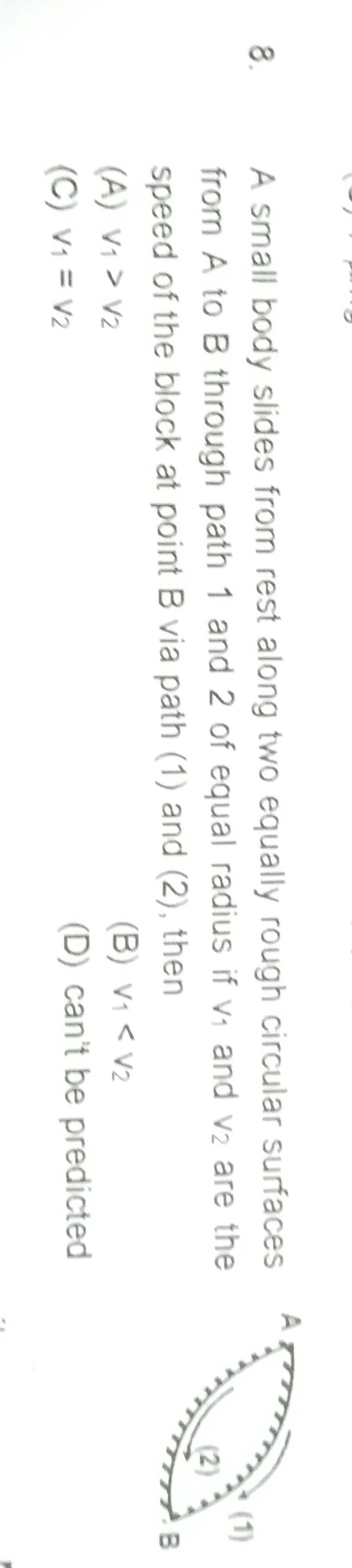


 Approved Tutor Answer11 Months ago
To address the question about a small body sliding from rest, we first need to understand the context and the principles involved. Typically, this scenario involves concepts from physics, particularly those related to motion, forces, and energy. Let’s break it down step by step.
Imagine a small object, like a block, positioned at the top of a frictionless incline. When released, it begins to slide down due to the force of gravity. The key points to consider here are:
According to Newton's second law of motion, the acceleration of an object is directly proportional to the net force acting on it and inversely proportional to its mass. In this case, the net force is the component of gravitational force acting down the slope.
The gravitational force can be calculated using the formula:
F = m * g
Where:
To find the acceleration of the block down the incline, we need to consider the angle of the slope (let’s call it θ). The component of gravitational force acting down the slope can be expressed as:
F_parallel = m * g * sin(θ)
Using Newton's second law, we can set up the equation:
m * a = m * g * sin(θ)
Here, the mass (m) cancels out, leading us to:
a = g * sin(θ)
Now that we have the acceleration, we can determine how fast the block will be moving after sliding down a certain distance. Since the block starts from rest, we can use the kinematic equation:
v² = u² + 2as
Where:
Substituting the values, we get:
v² = 0 + 2(g * sin(θ)) * s
This equation allows us to find the final velocity of the block after it has traveled a distance s down the incline.
Another way to analyze this situation is through the conservation of energy. The potential energy at the top of the incline converts into kinetic energy as the block slides down. The potential energy (PE) can be expressed as:
PE = m * g * h
Where h is the height of the incline. As the block descends, this potential energy transforms into kinetic energy (KE):
KE = 0.5 * m * v²
Setting the potential energy equal to the kinetic energy gives us:
m * g * h = 0.5 * m * v²
Again, the mass cancels out, leading to:
g * h = 0.5 * v²
This relationship can also help us find the final velocity, reinforcing the idea that energy is conserved in this system.
In summary, when a small body slides from rest down an incline, we can analyze its motion using Newton's laws, kinematic equations, and energy conservation principles. By understanding the forces at play and applying these concepts, we can predict the object's behavior as it moves down the slope. This approach not only enhances our grasp of physics but also illustrates the interconnectedness of different physical principles.

Three identical balls are placed on a frictionless
horizontal surface touching each other. They stick to
each other because of adhesive. Another ball of same
radius and mass m is placed over the void created by
the three balls. Find the forces applied by the balls
kept on the floor to each other if the system remains
in equilibrium.
Last Activity: 9 Months ago
A car loaded with water having total mass 1000 kg moves on a straight horizontal Road starting from rest under the action of a force of 100 Newton. The water spills throw a small hole in the bottom at a rate of 0.1 KG per second the velocity of cart after 300 seconds is nearly.
11
21
31
41
Last Activity: 9 Months ago
Last Activity: 3 Years ago
Last Activity: 3 Years ago