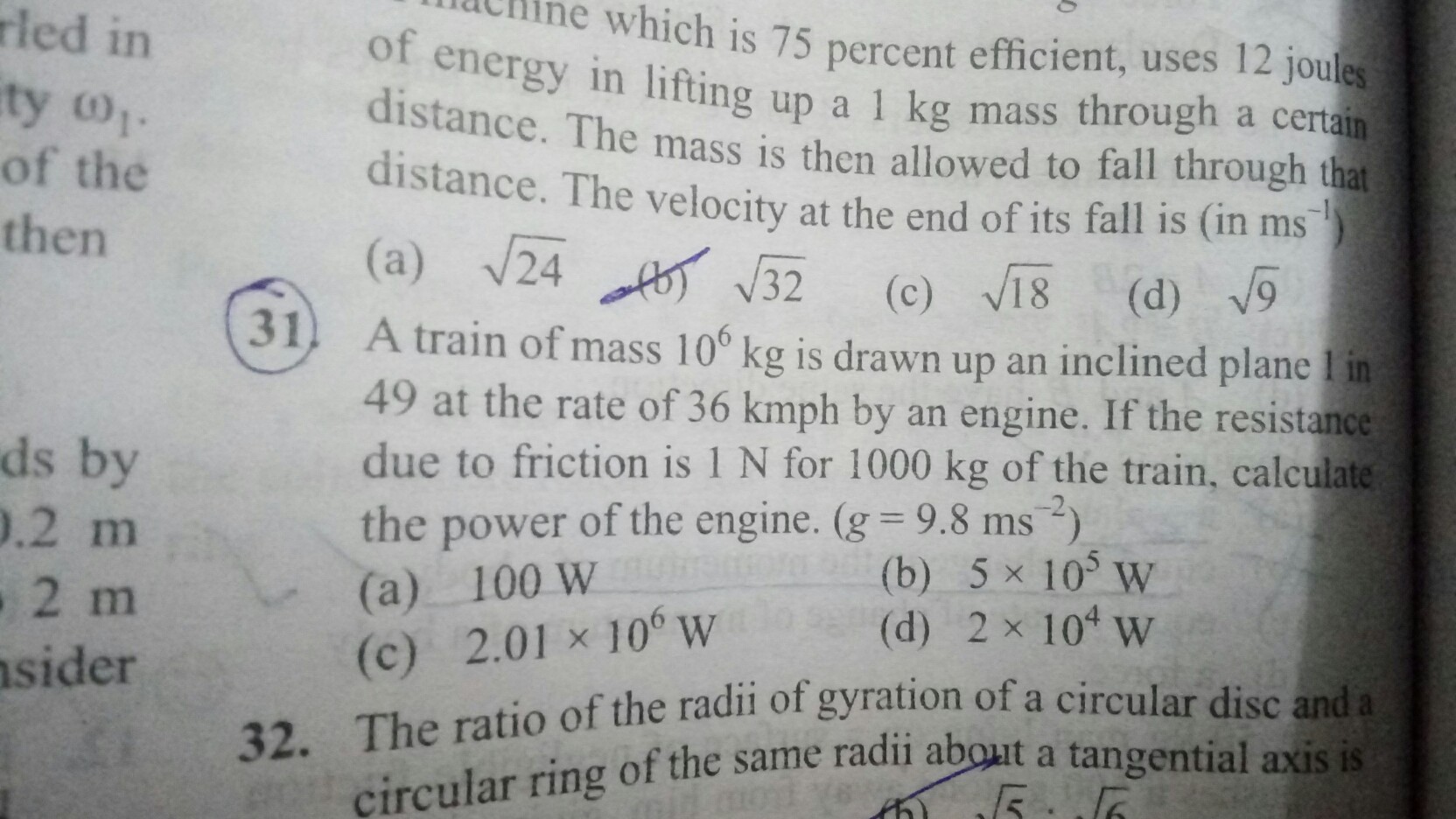
To determine the power of the engine pulling the train up the inclined plane, we need to consider several factors: the weight of the train, the incline of the plane, the frictional resistance, and the speed at which the train is moving. Let's break this down step by step.
Understanding the Forces at Play
The first step is to calculate the gravitational force acting on the train. The weight of the train can be calculated using the formula:
Weight (W) = mass (m) × gravitational acceleration (g)
Here, the mass of the train (m) is 1,000,000 kg, and the gravitational acceleration (g) is approximately 9.81 m/s². Thus:
W = 1,000,000 kg × 9.81 m/s² = 9,810,000 N
Calculating the Component of Weight Along the Incline
The incline of the plane is given as 1 in 49, which means for every 49 units horizontally, the height increases by 1 unit. To find the angle of the incline, we can use the tangent function:
tan(θ) = opposite/adjacent = 1/49
Now, we can find the sine of the angle, which is necessary to calculate the component of the weight acting down the slope:
sin(θ) = 1/√(1² + 49²) = 1/√(1 + 2401) = 1/√2402 ≈ 0.0204
Now, the component of the weight acting down the incline (F_gravity) is:
F_gravity = W × sin(θ) = 9,810,000 N × 0.0204 ≈ 200,000 N
Frictional Resistance
The problem states that the resistance due to friction is 1 N for every 1000 kg of the train. Therefore, for a train of 1,000,000 kg:
F_friction = (1 N/1000 kg) × 1,000,000 kg = 1000 N
Calculating the Total Force Required
The total force (F_total) that the engine must overcome is the sum of the gravitational force acting down the incline and the frictional force:
F_total = F_gravity + F_friction = 200,000 N + 1000 N = 201,000 N
Finding the Power of the Engine
Power (P) is defined as the work done per unit time. The work done against the total force while moving at a constant speed can be calculated using the formula:
P = F_total × velocity
Given that the speed (velocity) of the train is 10 m/s, we can substitute the values:
P = 201,000 N × 10 m/s = 2,010,000 W
To convert this into kilowatts (kW), we divide by 1000:
P = 2,010,000 W / 1000 = 2010 kW
Final Result
The power of the engine required to pull the train up the inclined plane at a speed of 10 m/s, overcoming both gravitational and frictional forces, is approximately 2010 kW.